Today I’d like to show you what the town of Vang Vieng itself looks like, together with a little of its surroundings.
What to see in Vang Vieng, in short. The main draw here is the natural scenery around the little town: karst cliffs, the Nam Song river and caves. People make their way down the river in kayaks and on inflatable tubes (tubing). The caves closest to town are Tham Chang and Tham Non; further from town are Tham Phu Kham cave and the famous Blue Lagoon. In the town itself, visitors take in the temples, the market and the village lanes five minutes from the tourist area. Below is our walk through the streets and the surroundings. This article was written in 2014, and the photos and impressions date from that time. When to go: the most comfortable time is the dry season, from November to March, when there is little rain.
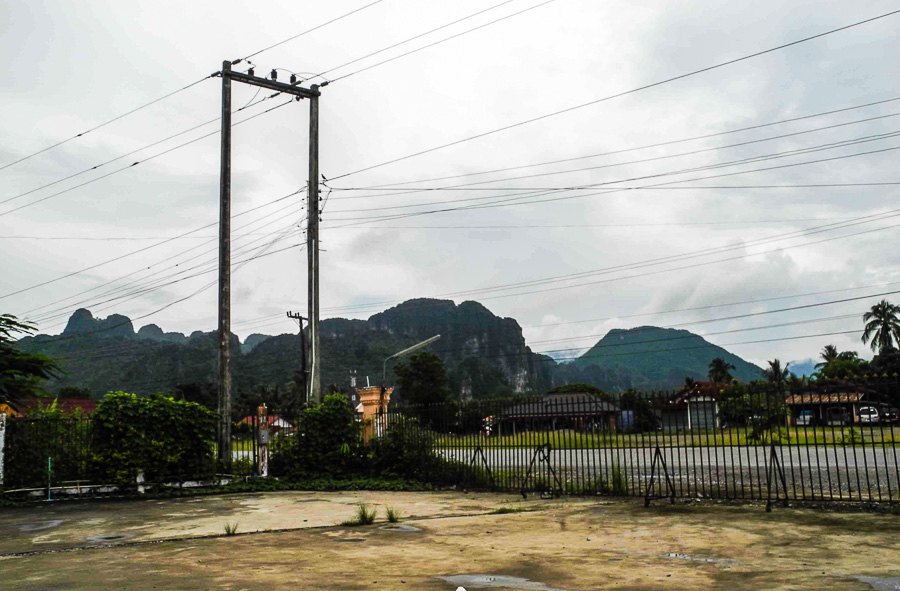
The surroundings are certainly striking — the town seems lost among the cliffs (this is the view from the bus stop):
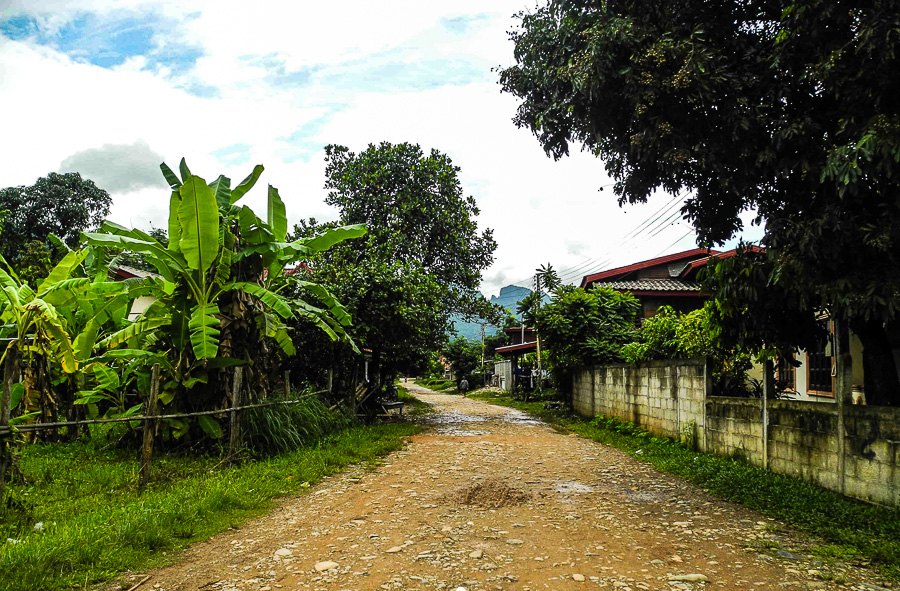
Most roads are unpaved; only the streets in the tourist part of town are asphalted:
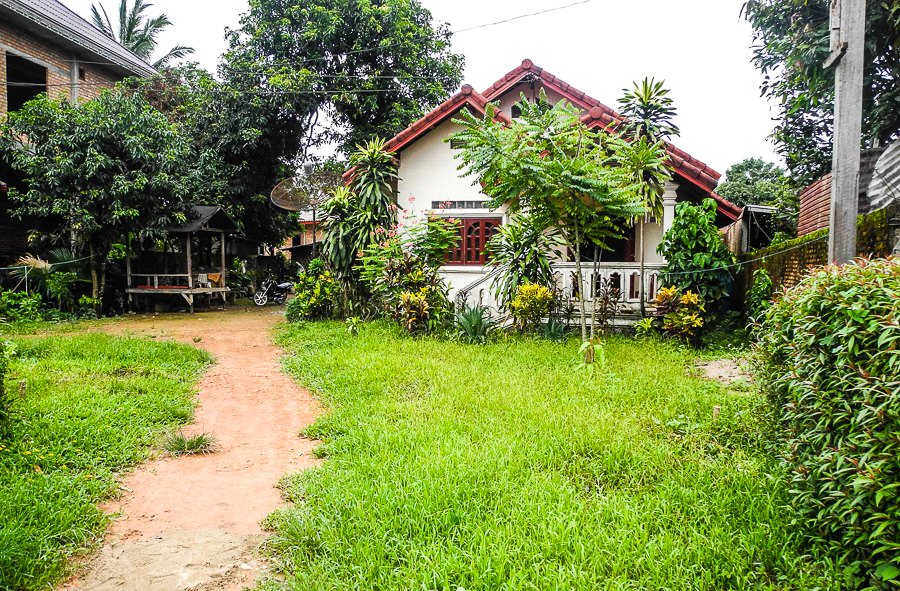
As well as hotels and guesthouses, you come across lovely little houses like these:
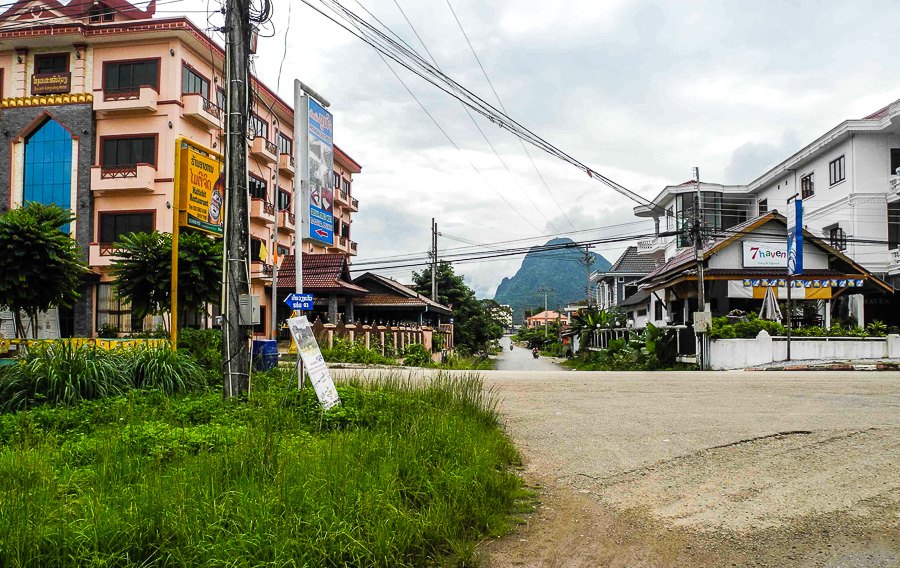
And this is the way into the tourist part of town, where every other building is a hotel or guesthouse:
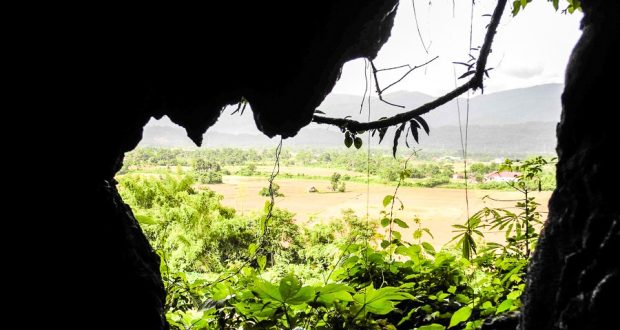
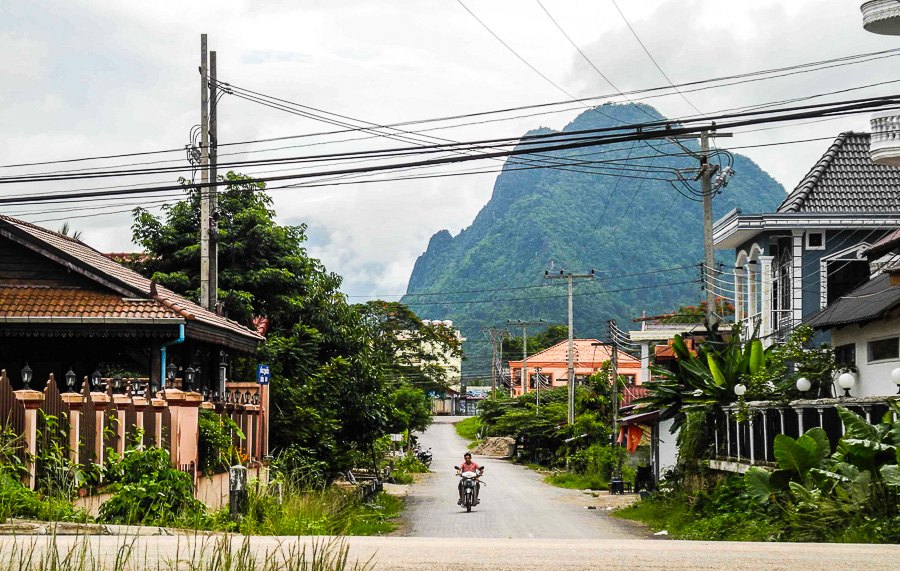
In town there is a simply stunning view of the mountains, and somewhere among them the numerous caves of Vang Vieng are hidden:
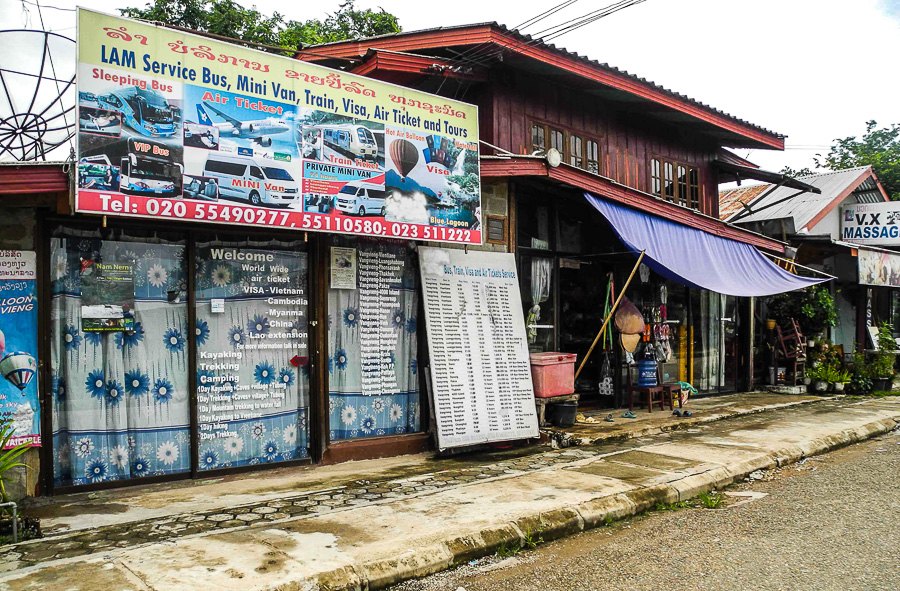
Buying a ticket to other towns and countries is no problem — there is yet another travel agency at every turn:
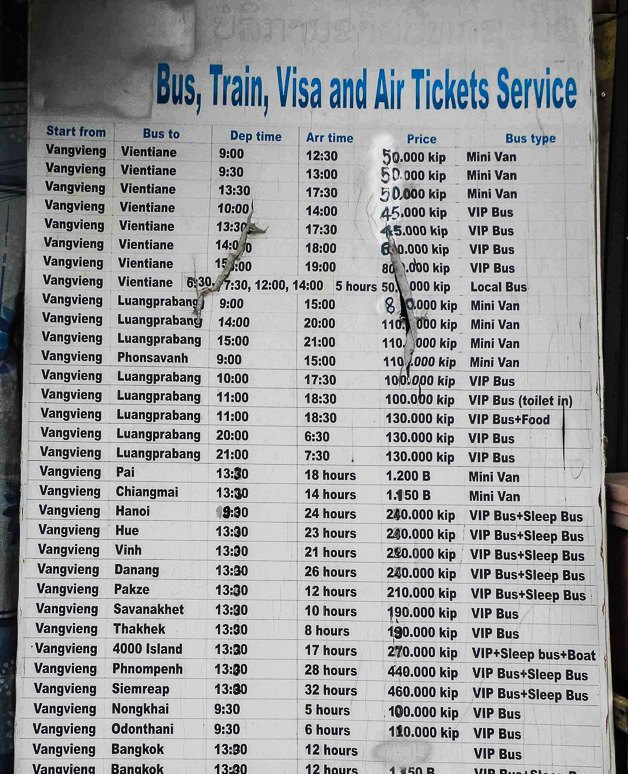
This is what the bus timetable and prices from Vang Vieng looked like when this article was written (2014) — it is not a current timetable, so don’t use the photo for guidance. Since December 2021 the town has also had a railway station on the Laos–China line, so you can get here from Vientiane by train in about an hour (as of October 2026, tickets go on sale a few days before departure and are snapped up quickly in high season):
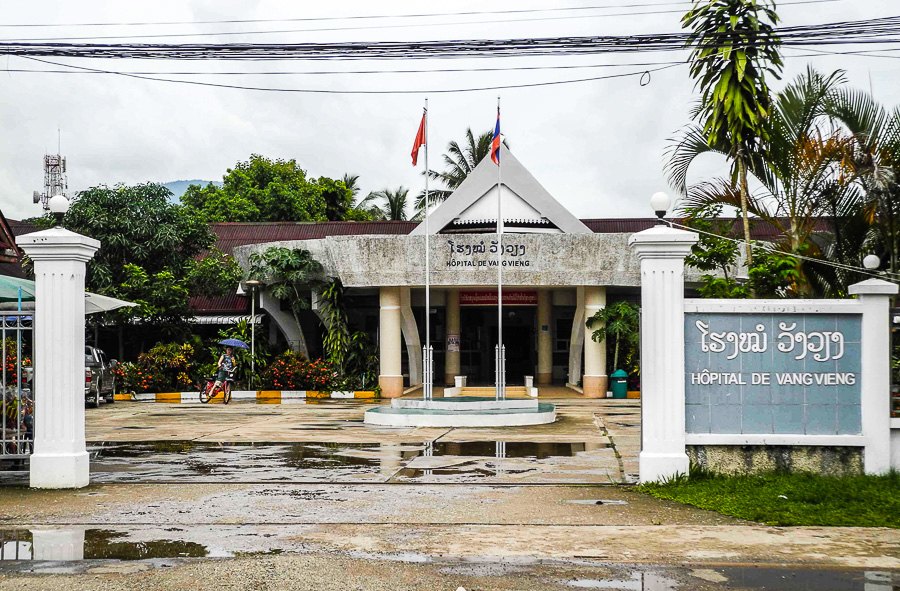
When we were writing this article in 2014, Vang Vieng had practically no infrastructure and the place wasn’t suited to a long stay — the internet was poor, there were no large supermarkets (only the market), the school was only for local children, and there was a single hospital, and a very small one at that:
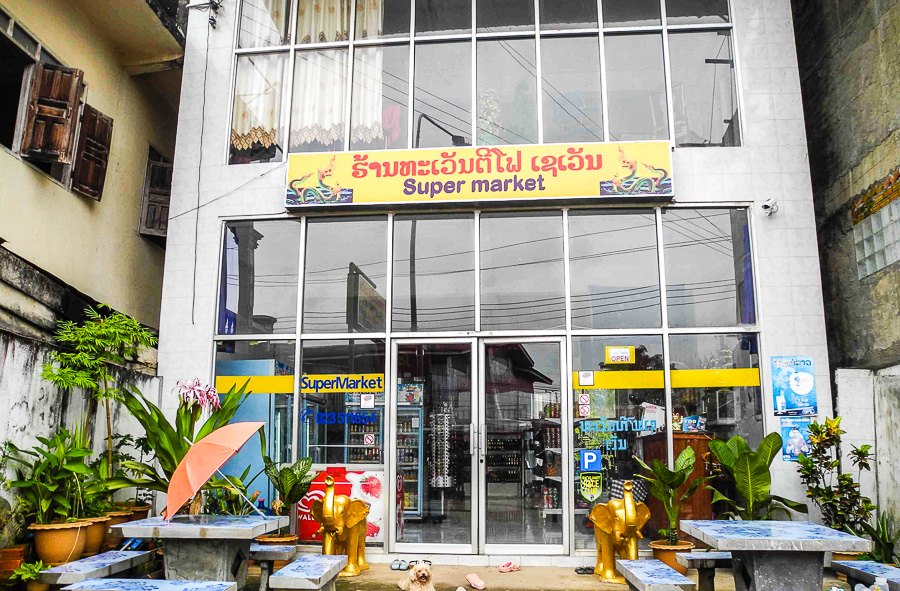
The only supermarket we found back then, and its range was snacks and alcohol:
Then again, people do somehow live in villages that have no infrastructure either. Even so, I’d prefer to live somewhere more developed.
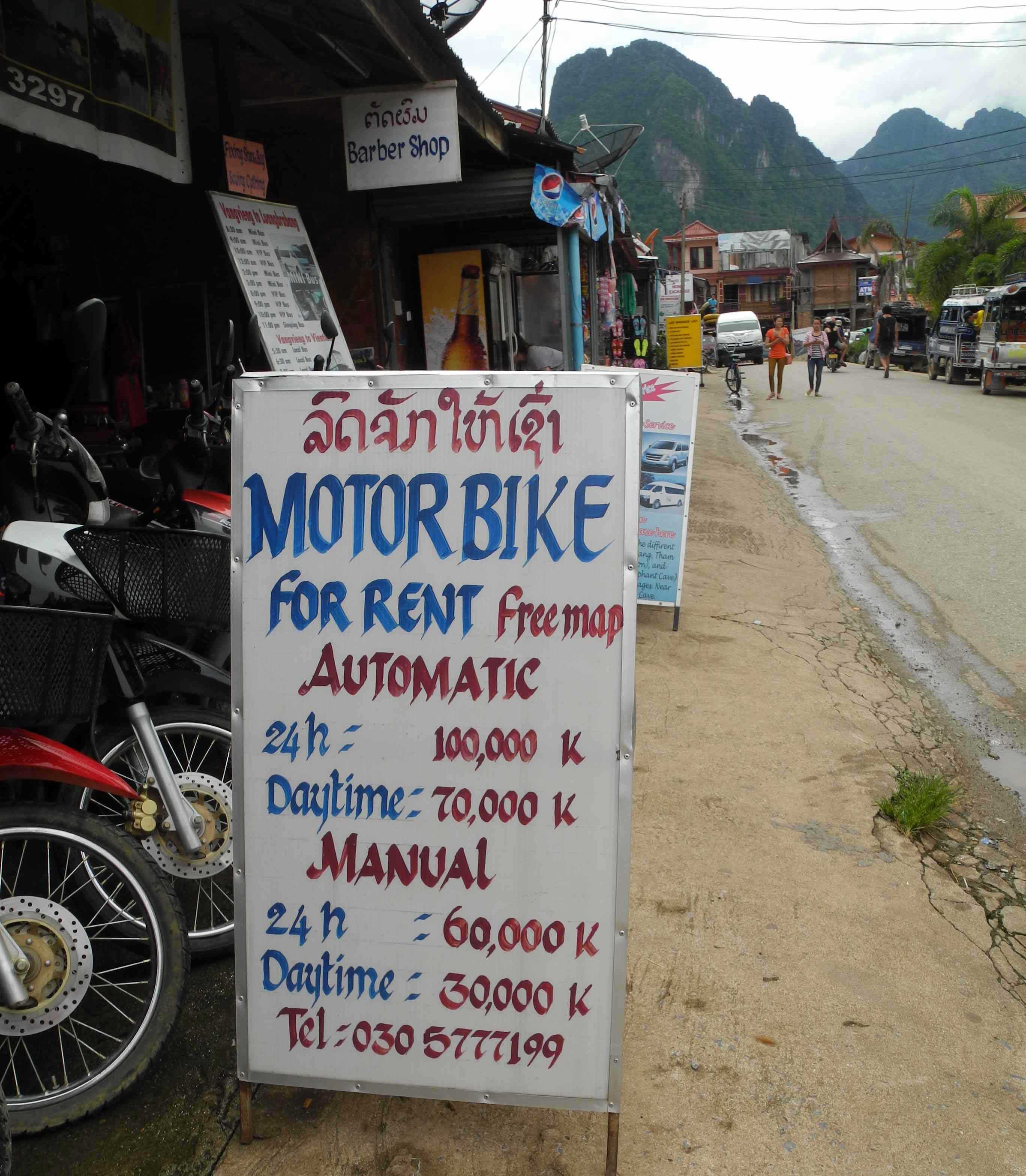
The main tourist street; two more streets run perpendicular to it, and this is where all the tourist life is concentrated — cafés, guesthouses, travel agencies and so on. You can hire a bicycle or a motorbike; when we wrote this article (2014), motorbike hire prices seemed unjustifiably high to us, especially compared with Thailand:
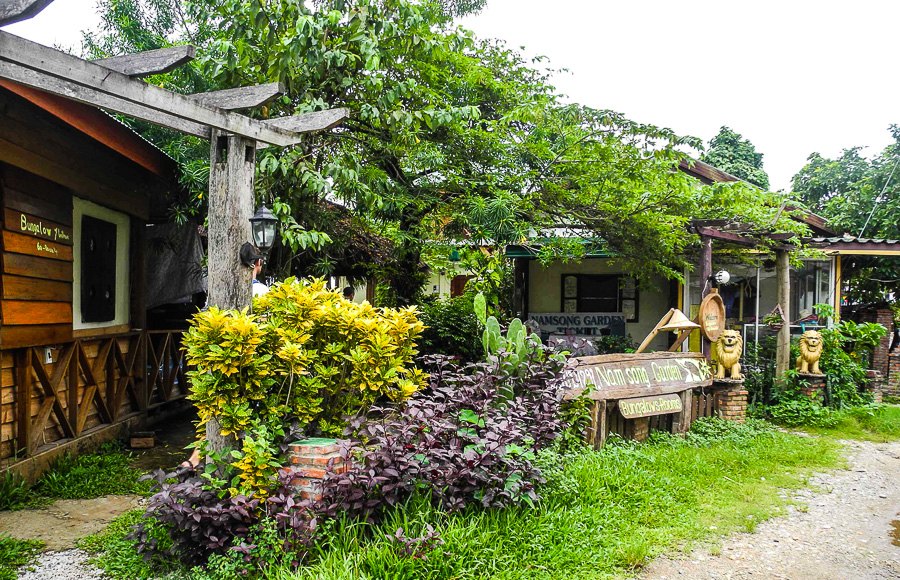
Some guesthouses look so cosy from the outside thanks to their pretty, well-tended grounds, yet the conditions inside are dreadful. In this one, for instance, some of the rooms have no windows at all. How can anyone stay in Vang Vieng without a balcony, let alone without even a window, when there are views like these all around?!
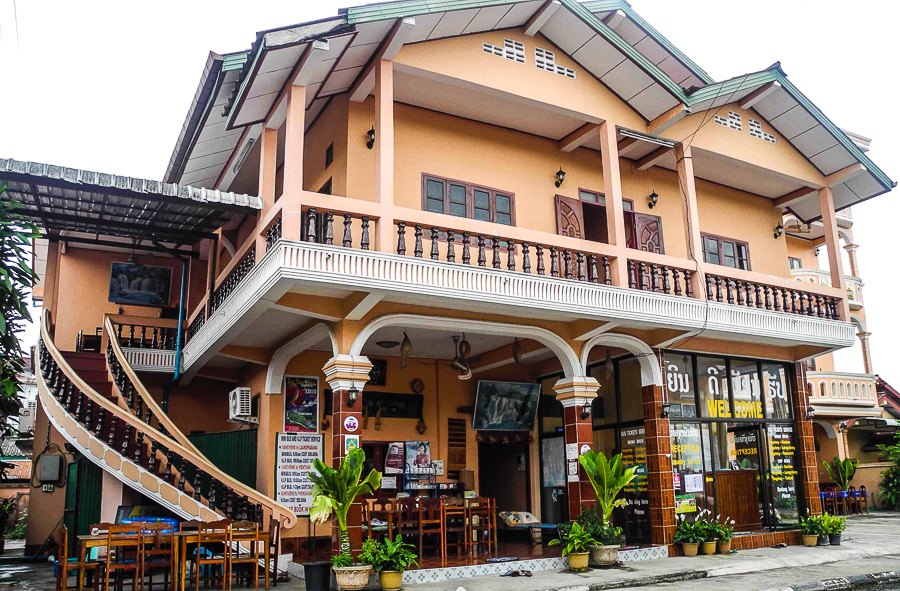
Another guesthouse. Interestingly, in Laos people are very fond of building houses with spiral staircases:
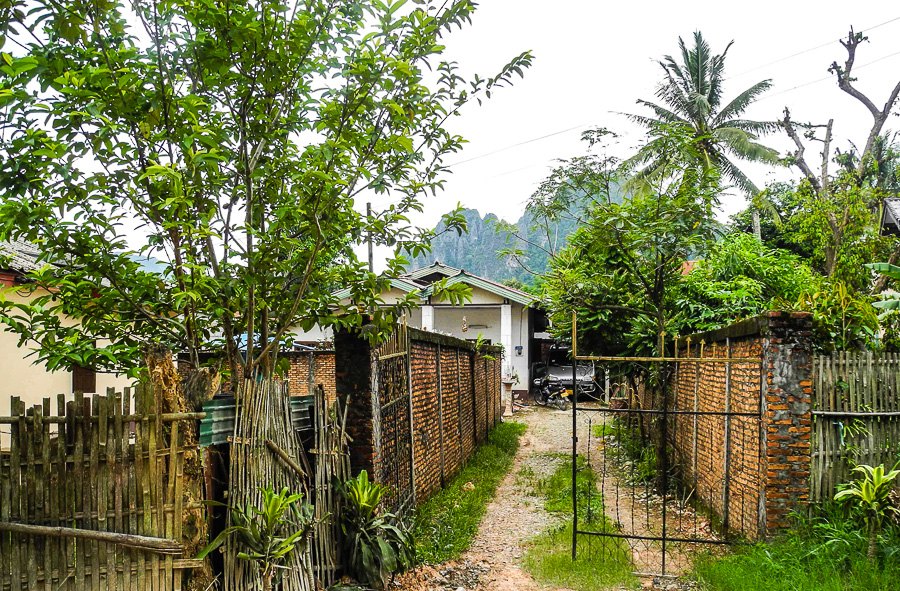
Five minutes’ walk from the tourist street, a typical village scene:
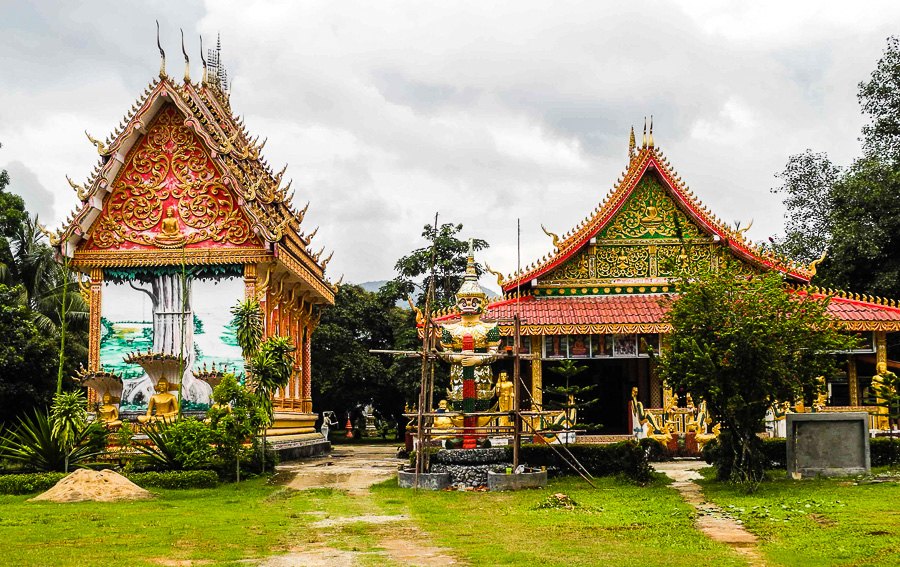
Vang Vieng (like Vientiane, incidentally) has a great many temples where monks live. First place for the number of monks goes to Luang Prabang (north of Vang Vieng), where tourists come from all over the world to photograph the monks and take part in the morning alms-giving ritual (monks are not allowed to cook for themselves, so every morning at dawn they walk the town’s streets relying on the generosity of residents and tourists, and for local people feeding the monks is considered an honour, improves their karma and so on). We never made it to Luang Prabang (maybe another time?), so we looked at the Lao temples in Vang Vieng instead.
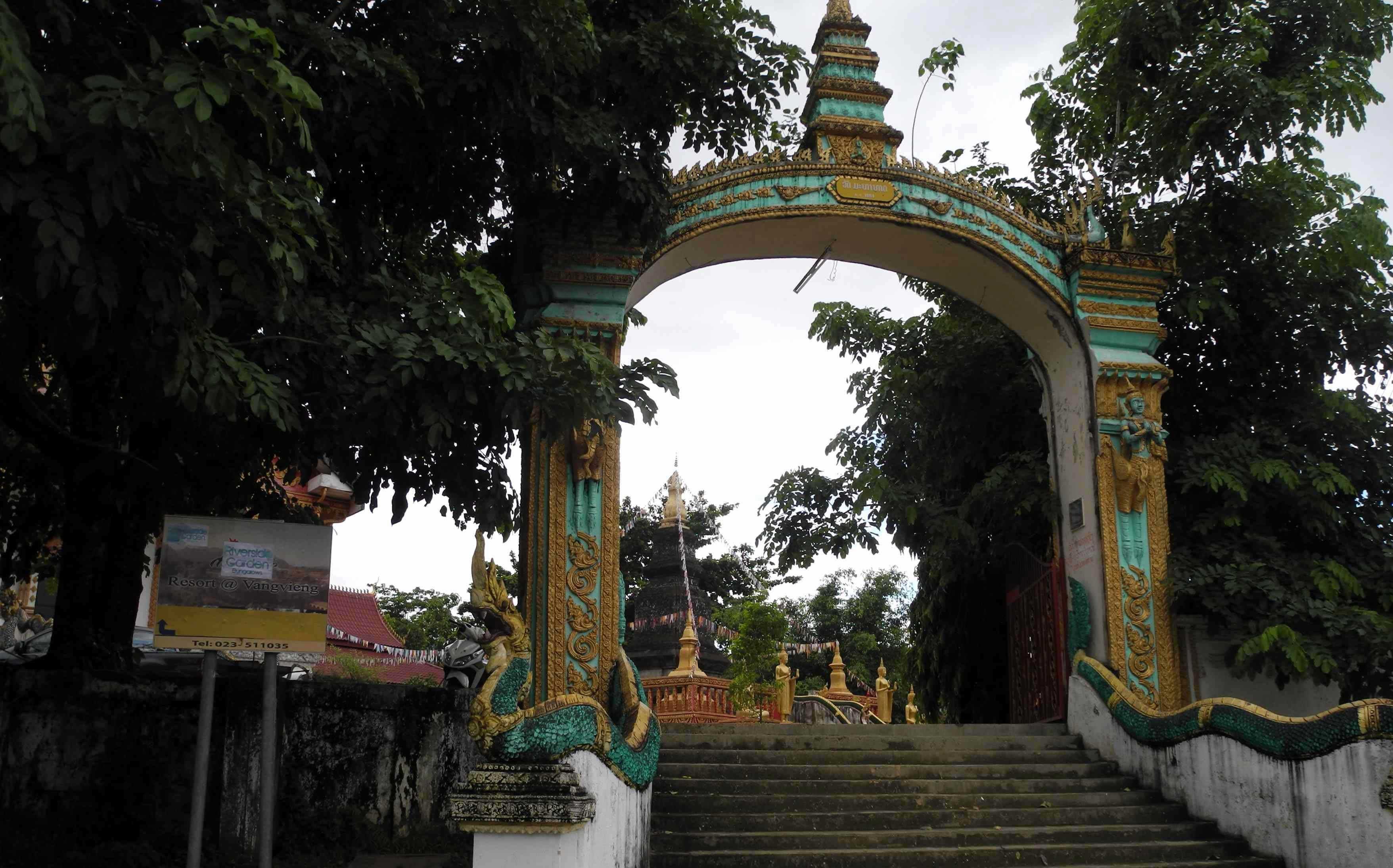
Another temple, right by the main road:
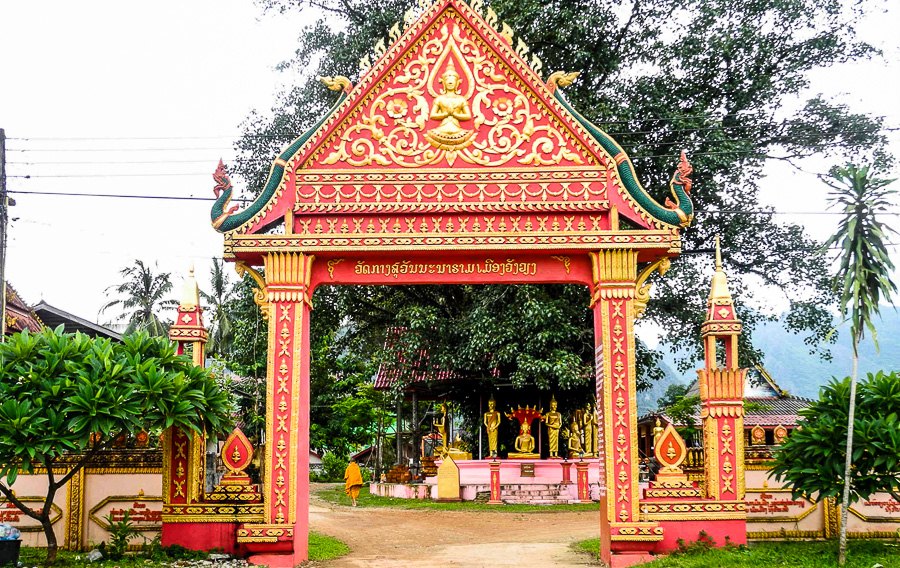
From another angle:
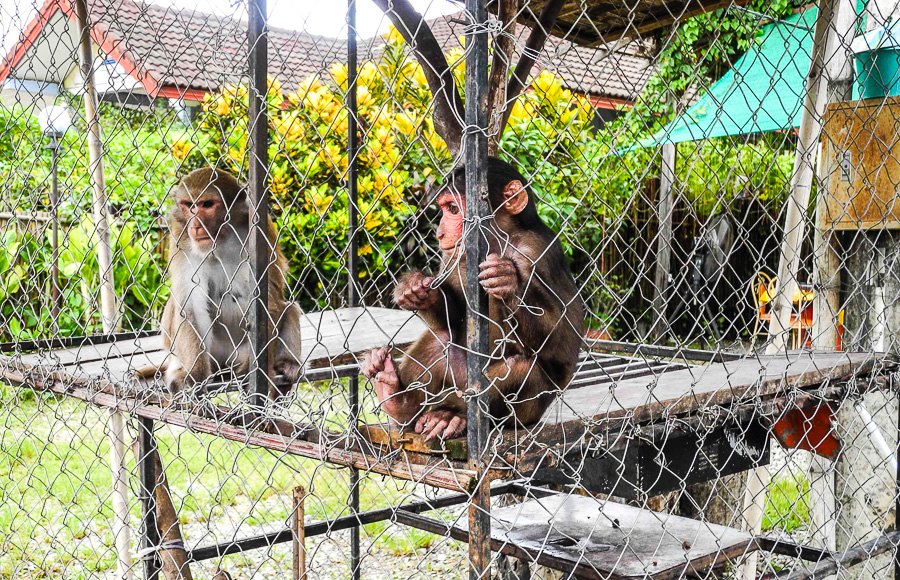
We came across some sad-looking monkeys that for some reason had been shut in a cage. The cage stands right on the street next to the road — we felt so sorry for them:
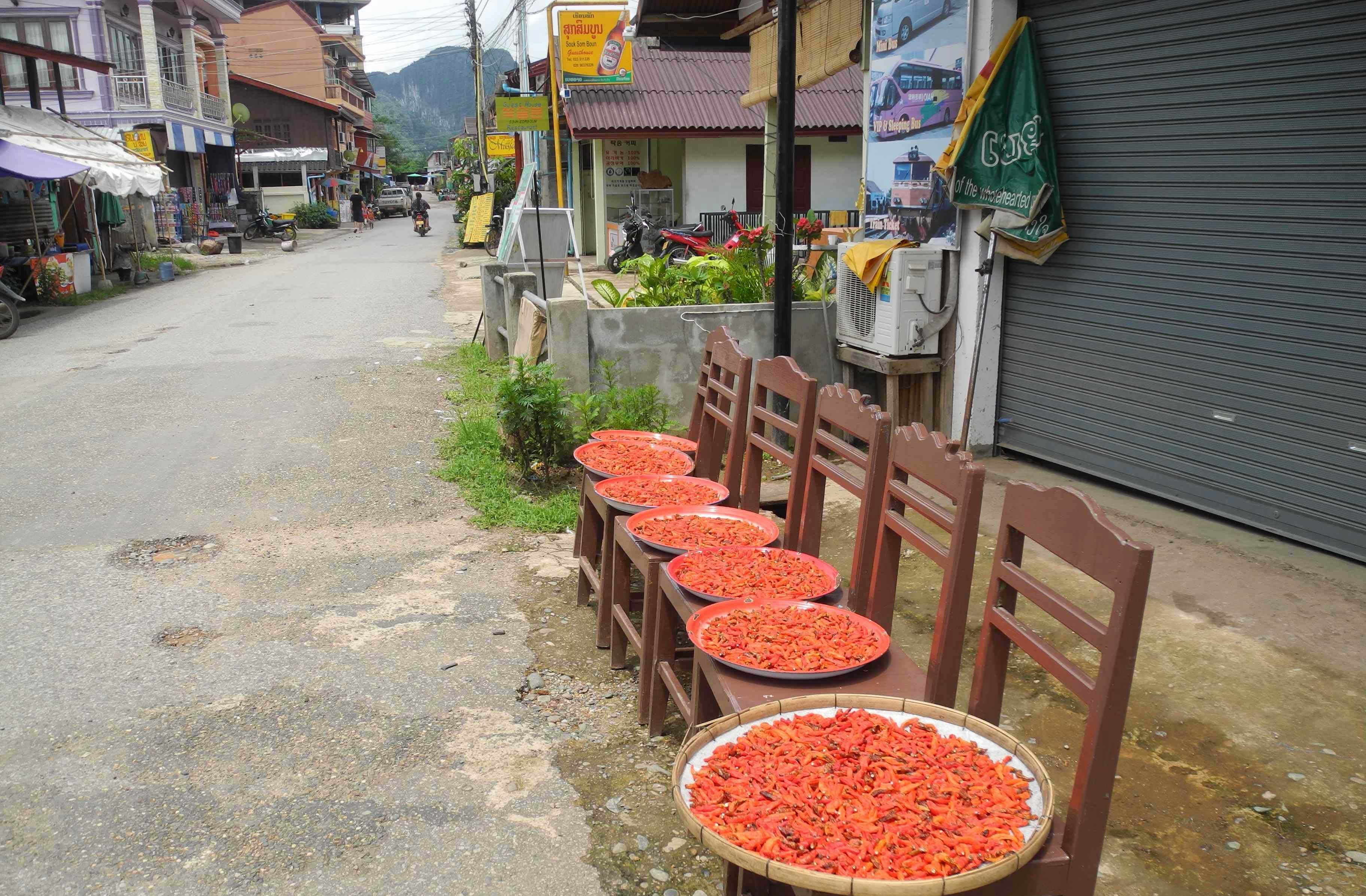
We had apparently arrived in Vang Vieng in the middle of the chilli harvest. On almost every little lane, dishes of drying chillies are set out — it looks very colourful:
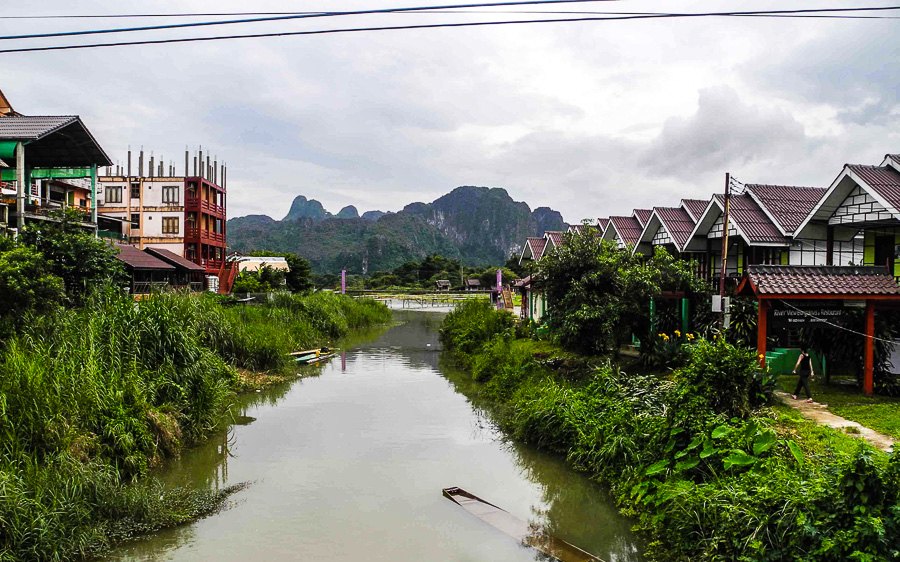
And now a few views of the river. Most guesthouses are located right along the river, as that’s where the prettiest view is, and every hotel has two types of room — river view and no river view. Definitely take one with the view — you won’t regret it!
In the middle of the river there is a small island. There used to be a lively, noisy nightlife here, but in 2012 the bars on the river were closed, and by 2014, when this article was written, it was quite a peaceful little spot:
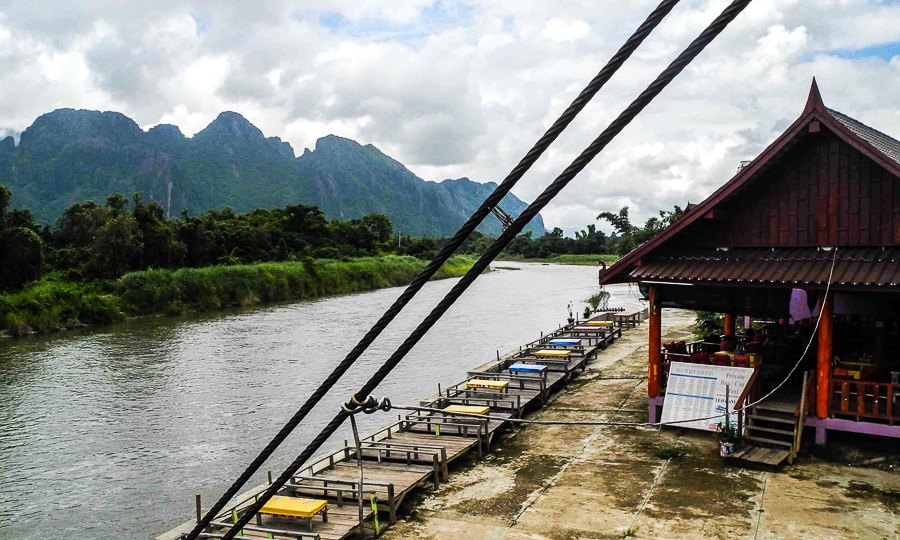
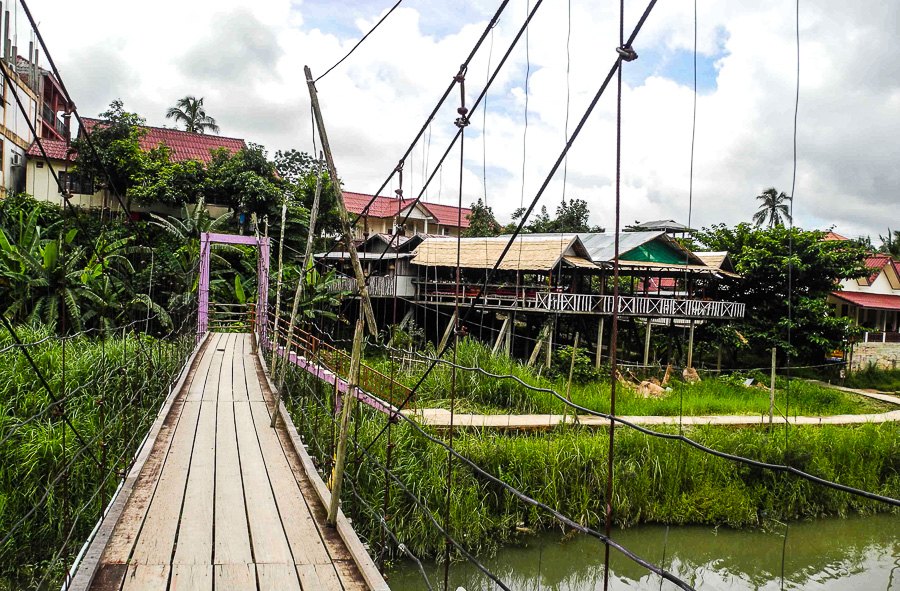
Many bridges span the river, some toll and some free. The free ones are usually flimsier, yet despite that people not only cross such a bridge on foot but also ride over it on bicycles and motorbikes. Imagine walking across a bridge when a motorbike suddenly comes towards you — it makes you feel a bit uneasy, and you have to press yourself against the very edge to squeeze past:
Guesthouses with views of the river and the cliffs:
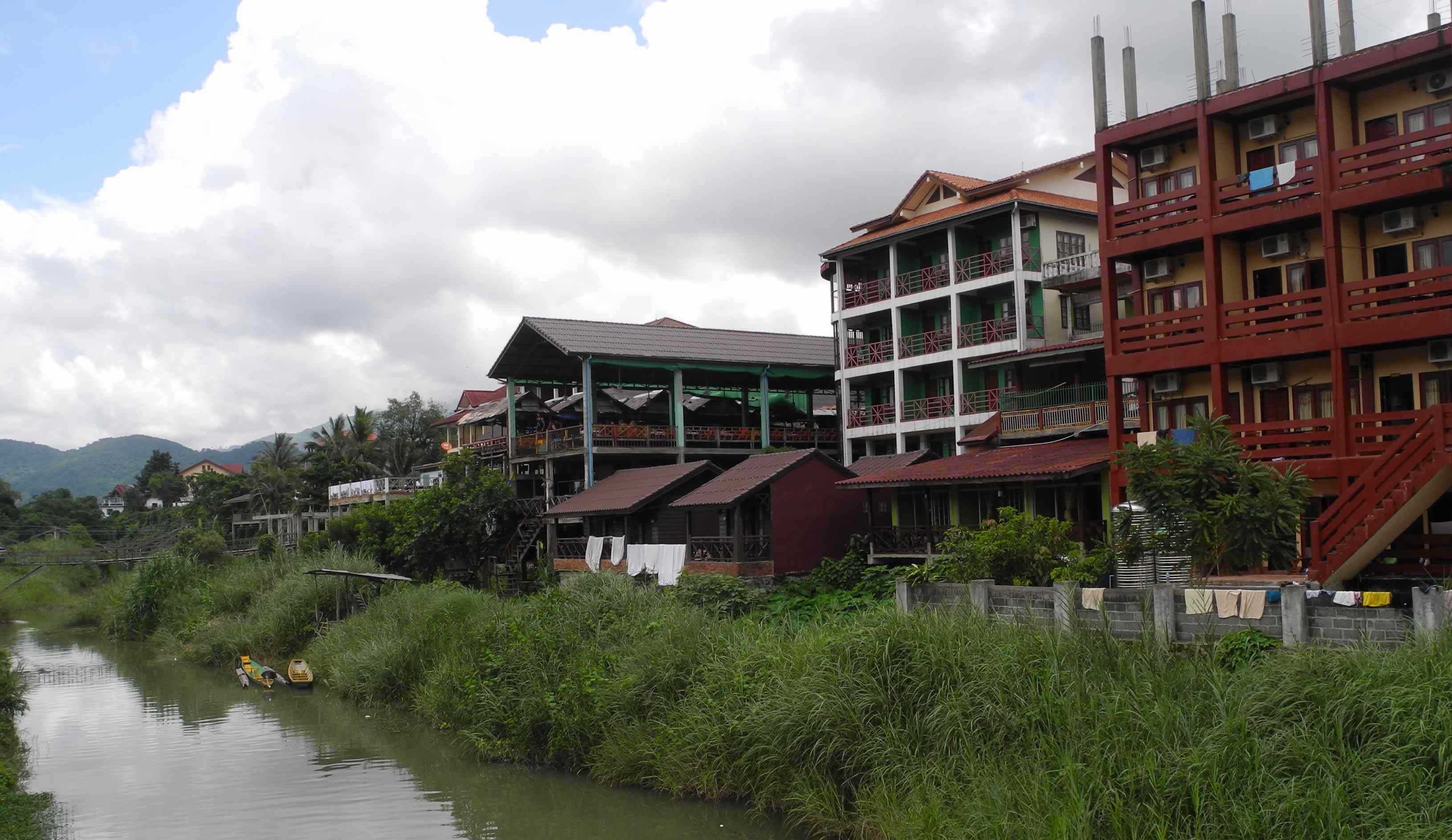
The path to the little bridge:
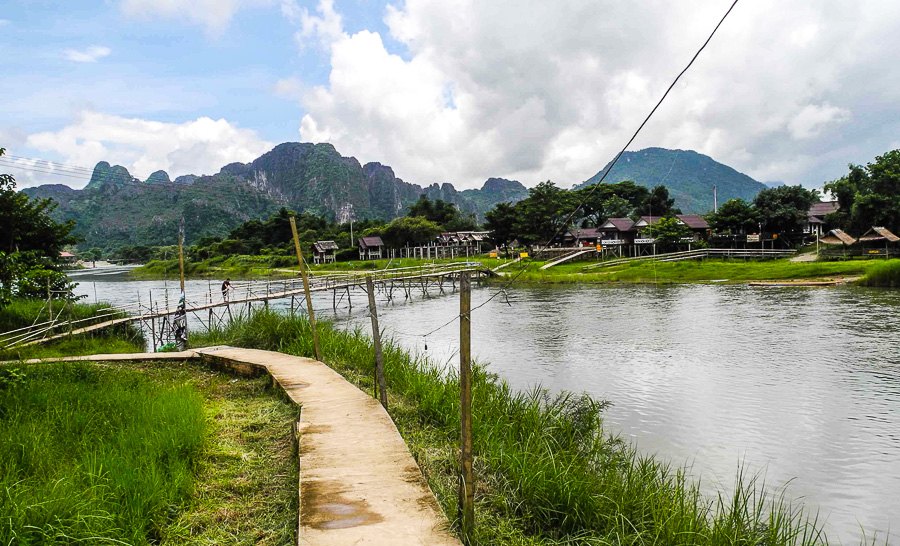
And this is the very tip of the island — it looks as though a ship is sailing:
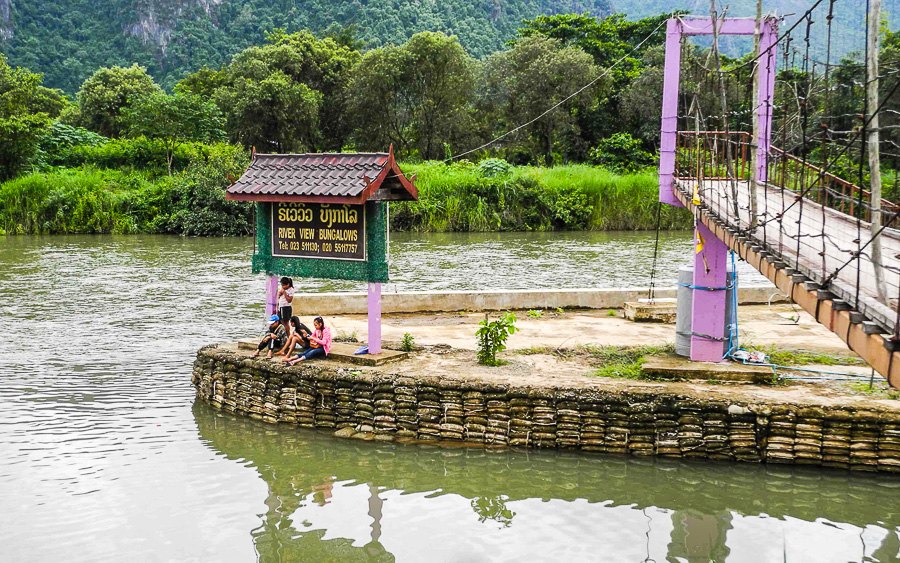
The river bursts its banks in the rainy season (which, as it happens, begins in June), so sometimes even the start of a bridge gets slightly flooded:
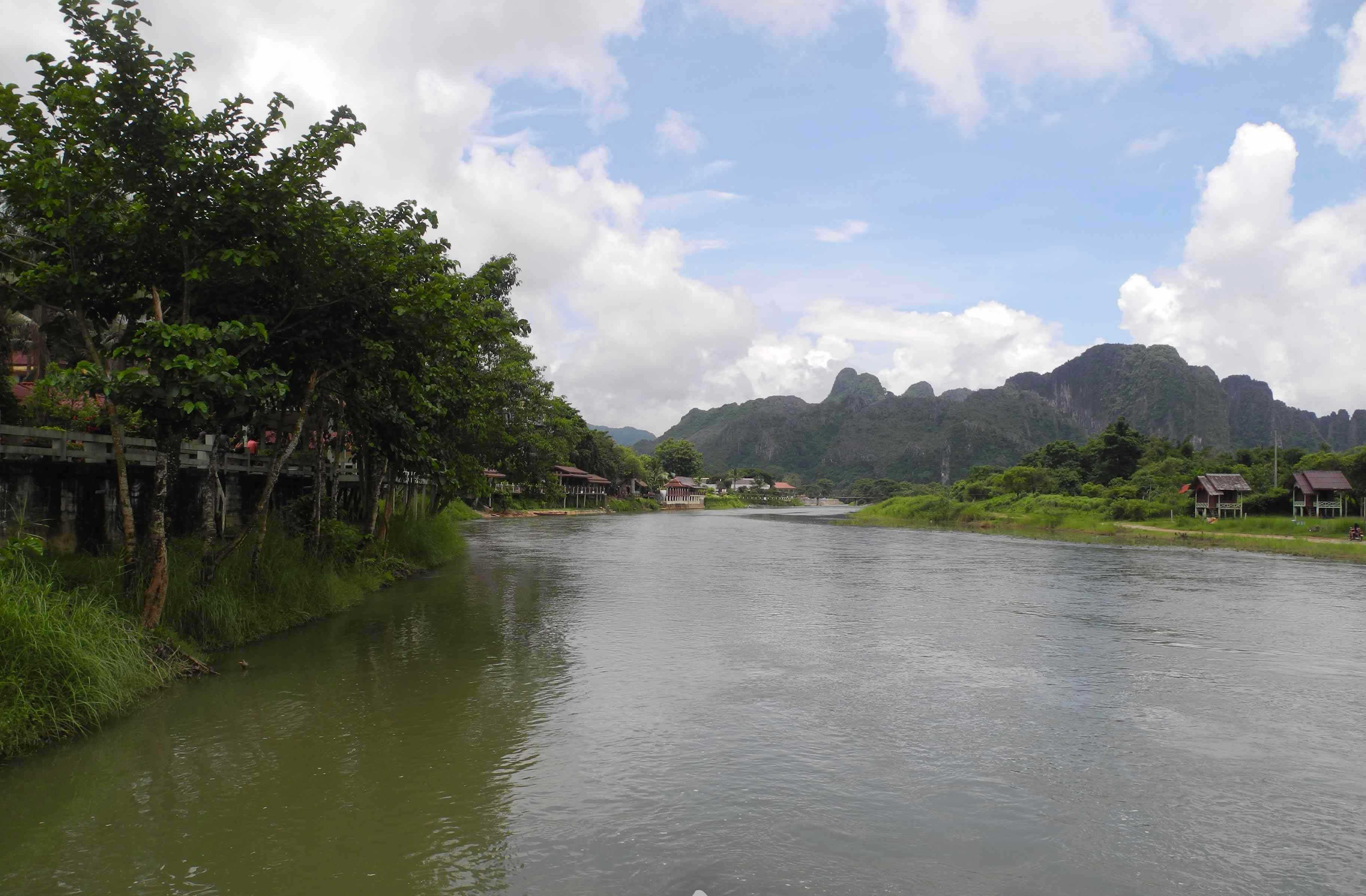
On the opposite bank you can rent a bungalow that looks like a hut on stilts:
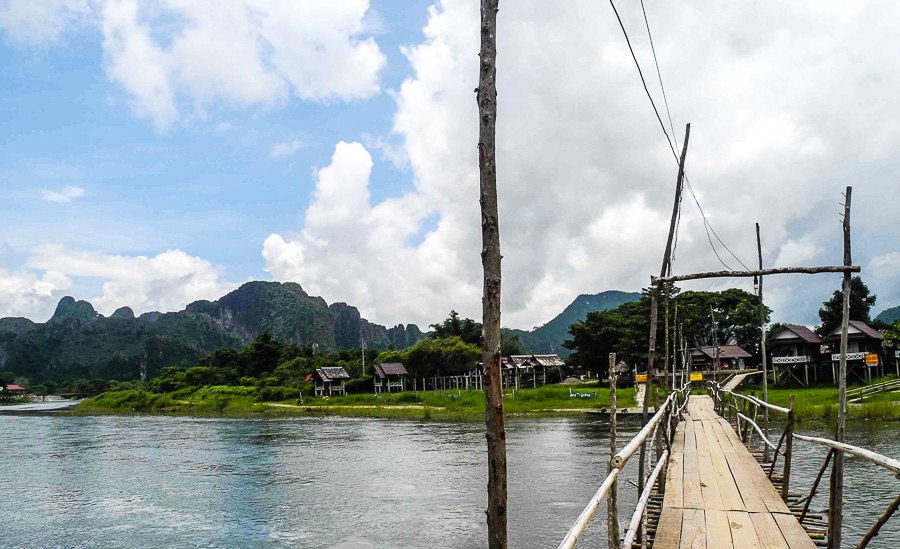
One of the activities in Vang Vieng is kayaking:
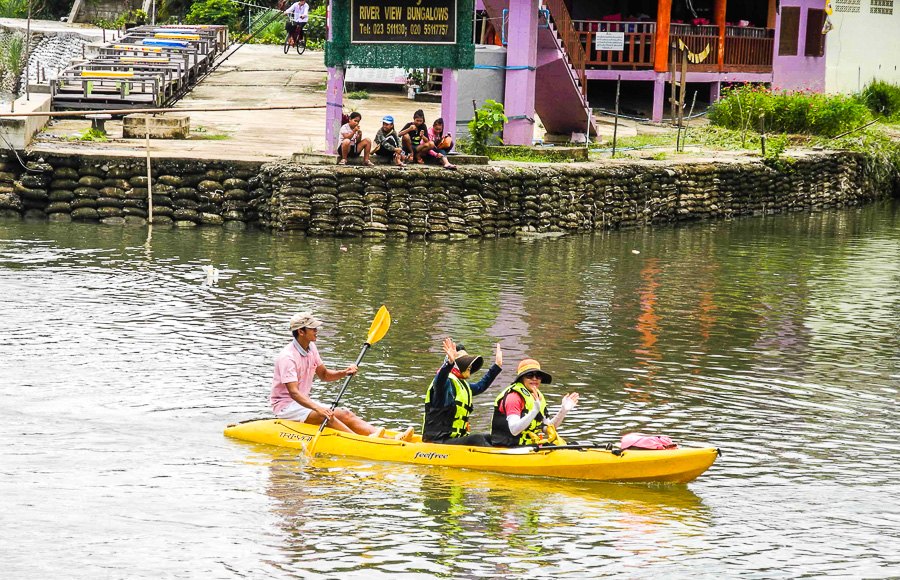
When we wrote this article, kayaking and trips to the caves were sold by the travel agencies on the main street.
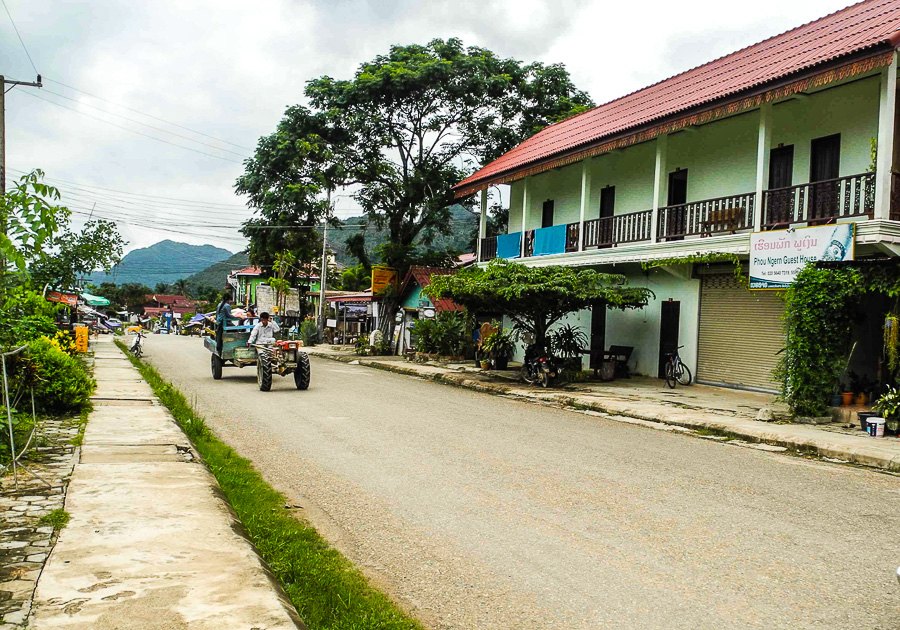
Returning to the tourist part of Vang Vieng. You see every kind of vehicle here — many people get about on two-wheeled tractors, which looks rather odd: you half expect to see a harnessed horse in front, but instead there is a soulless machine:
Next to the tourist centre there is a poster like this, calling on tourists to behave properly:
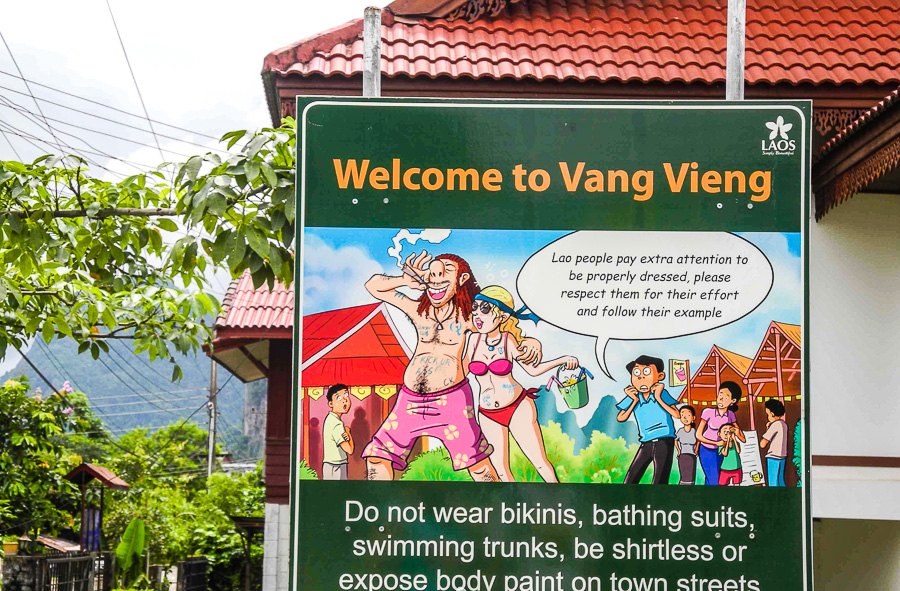
Nobody seems to notice the poster, because every evening we saw the same scene (just like the one drawn on it) — half-naked, drunk (or high?) lads and girls in nothing but swimwear, wandering barefoot right through the town. The locals have probably grown used to it, but still — let’s respect another culture and follow the rules of behaviour accepted in that country! And a warning from more recent times: in November 2024 six foreign tourists died after being poisoned by methanol in the strong alcohol they were drinking in Vang Vieng, so when it comes to drink here, the safer choice is beer or factory-bottled beverages in sealed bottles that you open yourself.
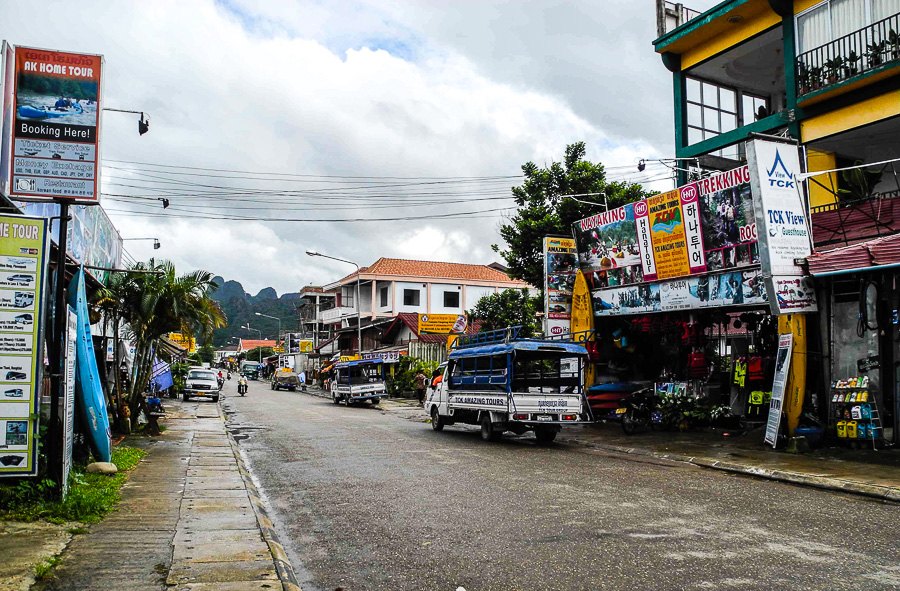
On the tourist streets, tuk-tuks wait ready to take you to any sight:
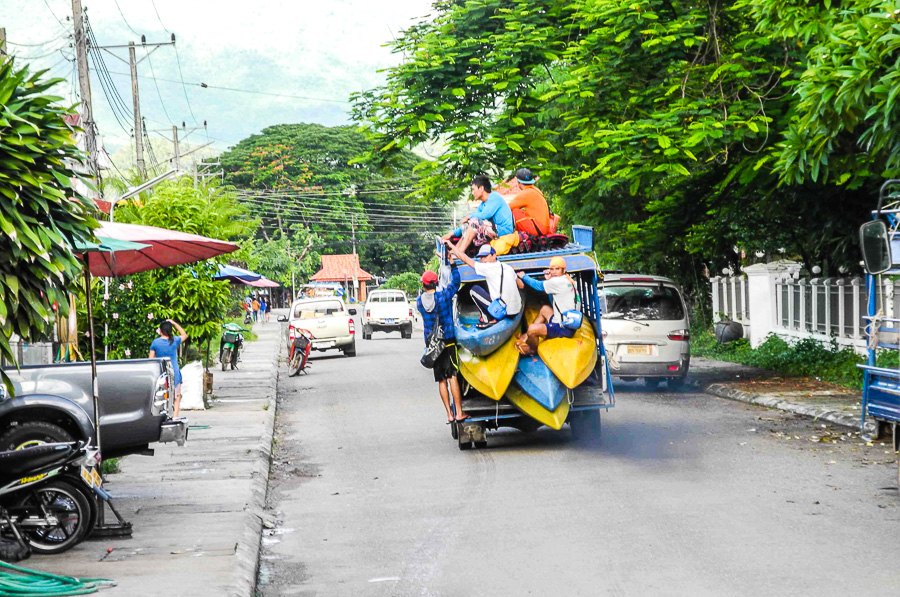
A lorry loaded with boats returns from a kayaking trip:
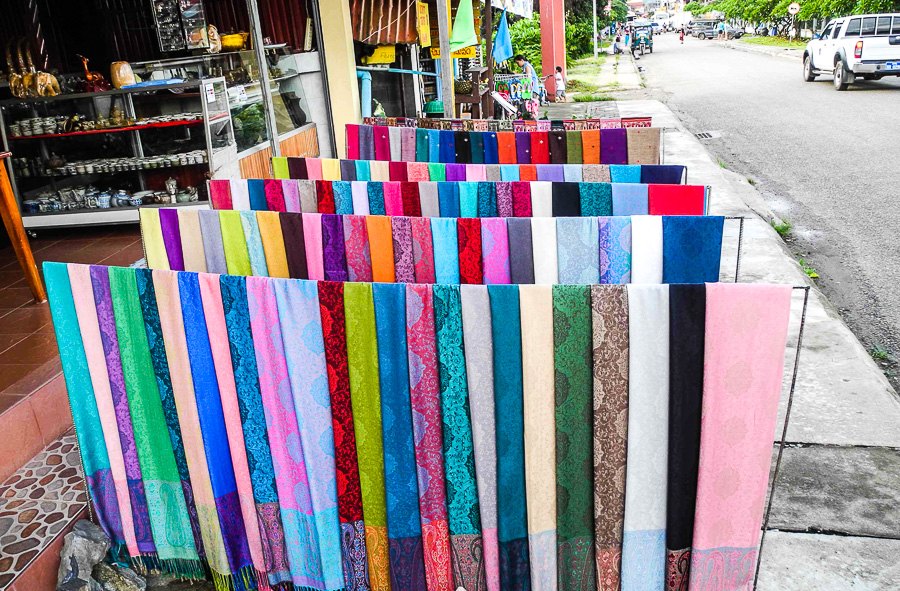
Walk a little further past the guesthouses and cafés (in the direction of Luang Prabang) and you come across various local shops:
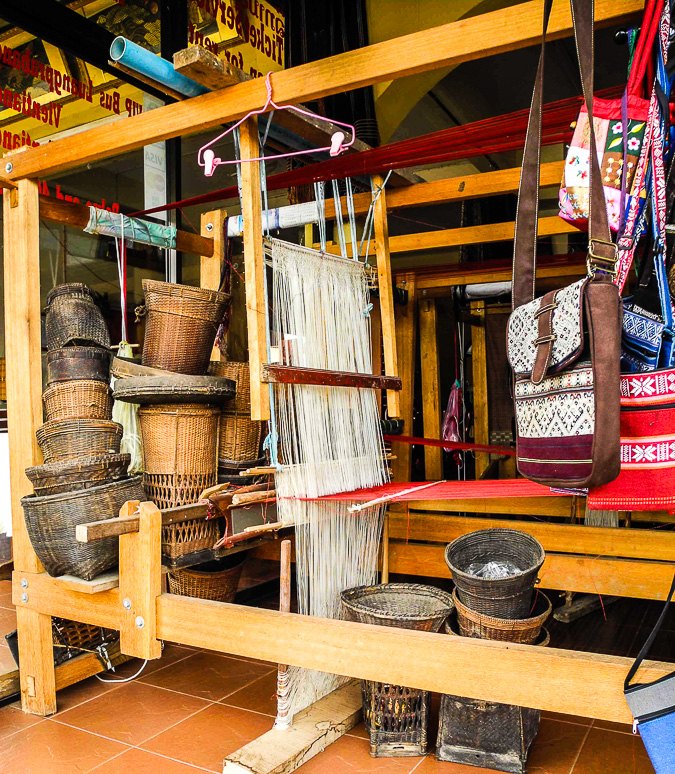
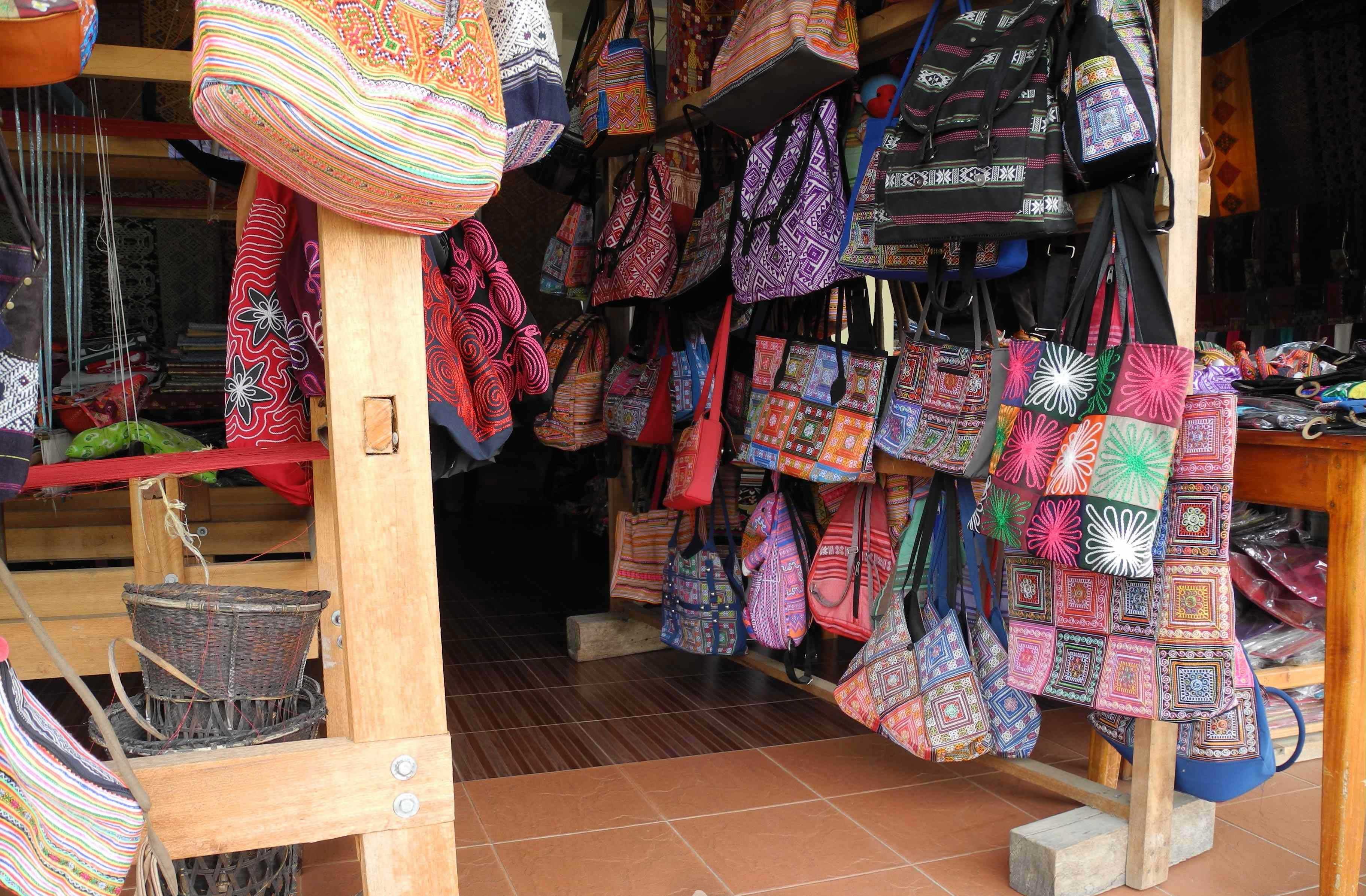
In the photo above there is a loom — apparently all these shawls are woven by hand right here:
At the market in Vientiane, similar bright bags and purses were on sale too:
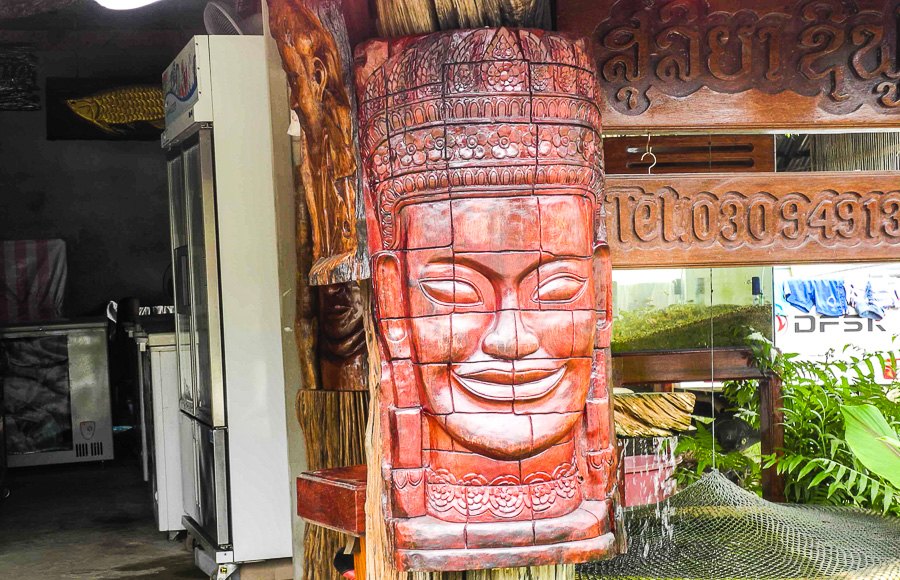
A wooden face reminded me of the temples of Cambodia:
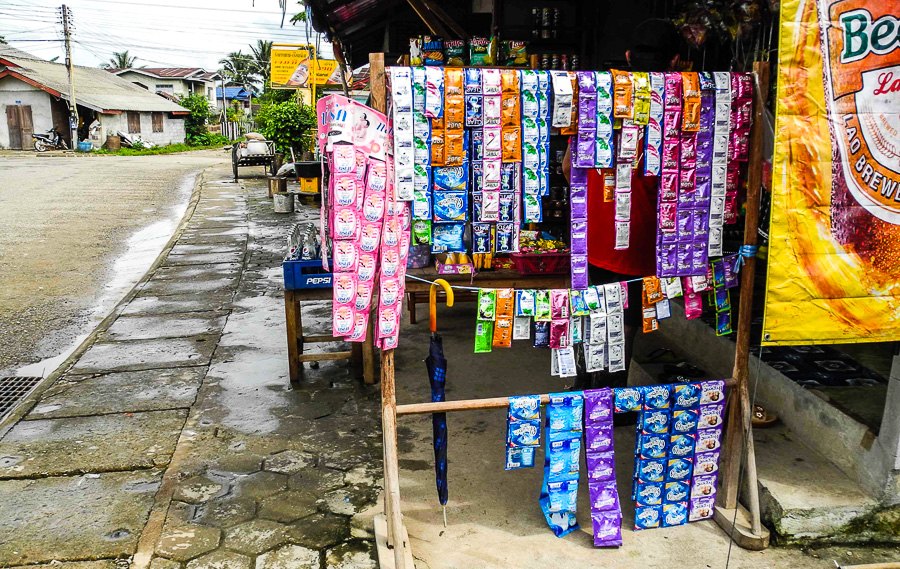
It’s handy that you can buy single-use sachets of shampoo and other toiletries without any trouble — you don’t have to lug your whole wash bag around, which really lightens the rucksack:
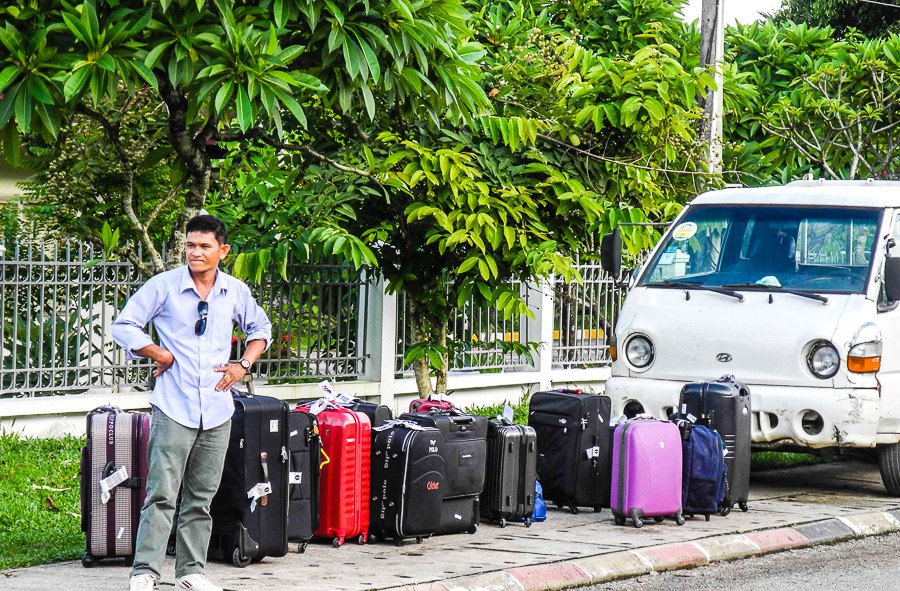
Judging by all appearances, a bus full of tourists had arrived. Except the suitcases are standing there while the tourists themselves are nowhere to be seen — a bewildered lad doesn’t know what to do with all this luggage. It does make you wonder what you could possibly pack for Vang Vieng to fill a whole suitcase?
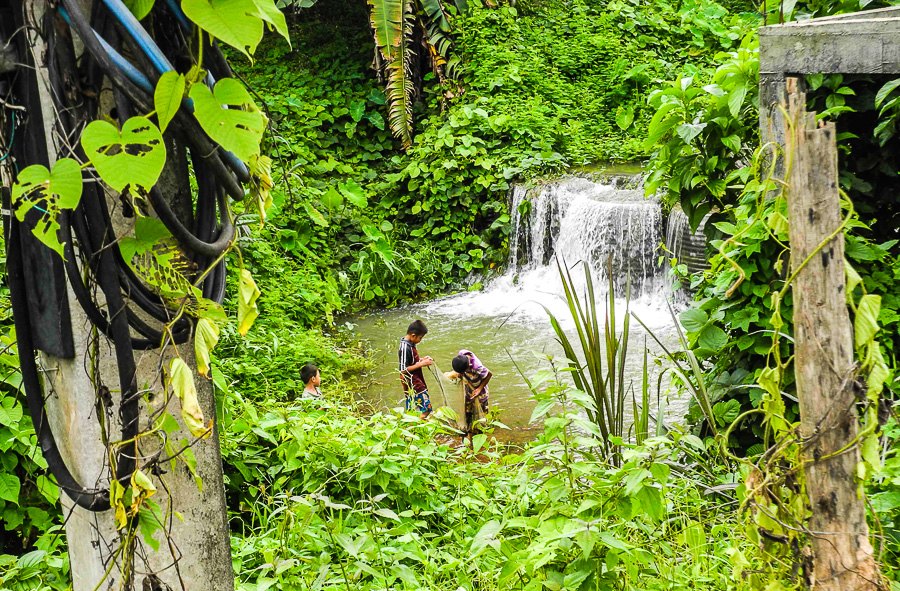
All the same, Vang Vieng has a great deal of greenery, the river and waterfalls. Turning off the tourist trail, we came across local children swimming in a mini-waterfall:
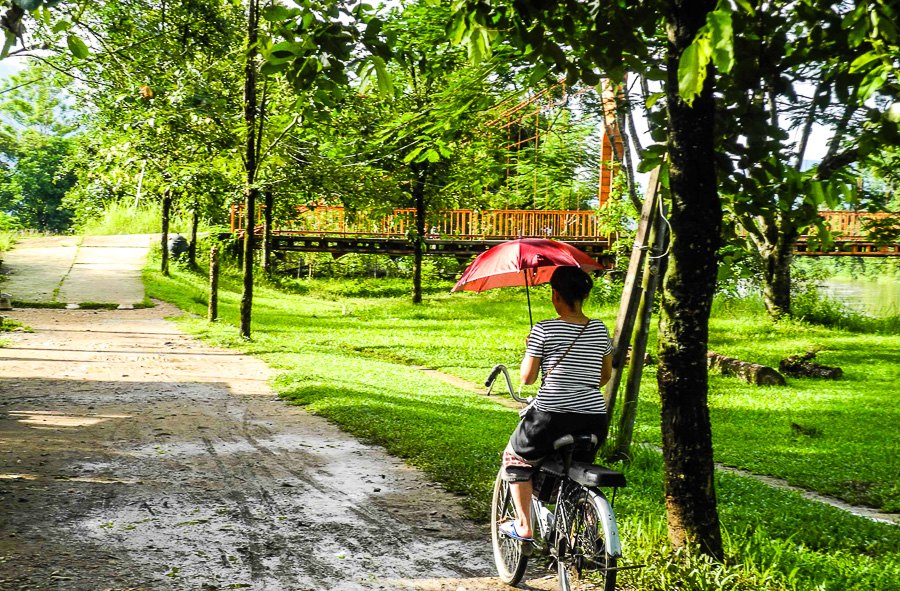
Many Lao people shelter from the scorching sun under umbrellas, even on a bicycle:
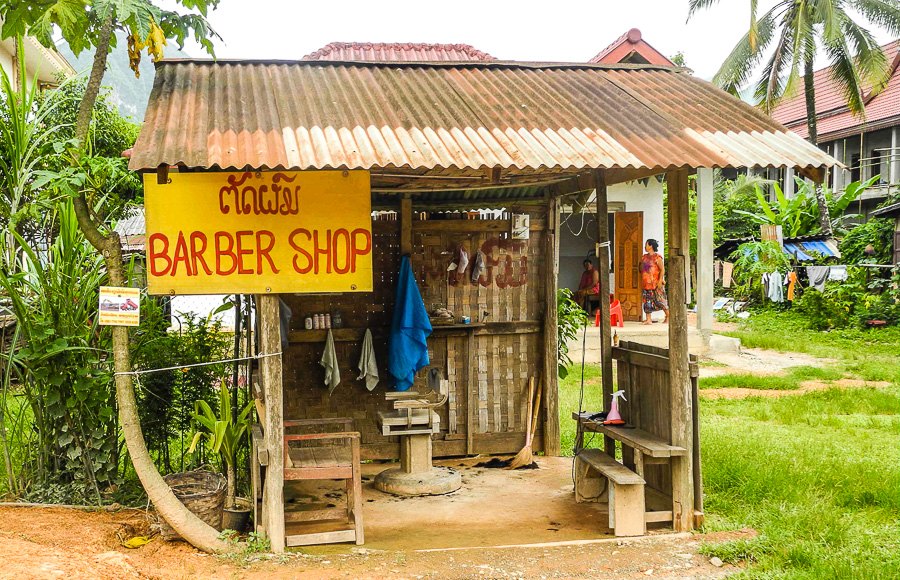
On the way we passed an amusing barber’s shop. I wouldn’t agree to have my hair cut there for anything — and you?
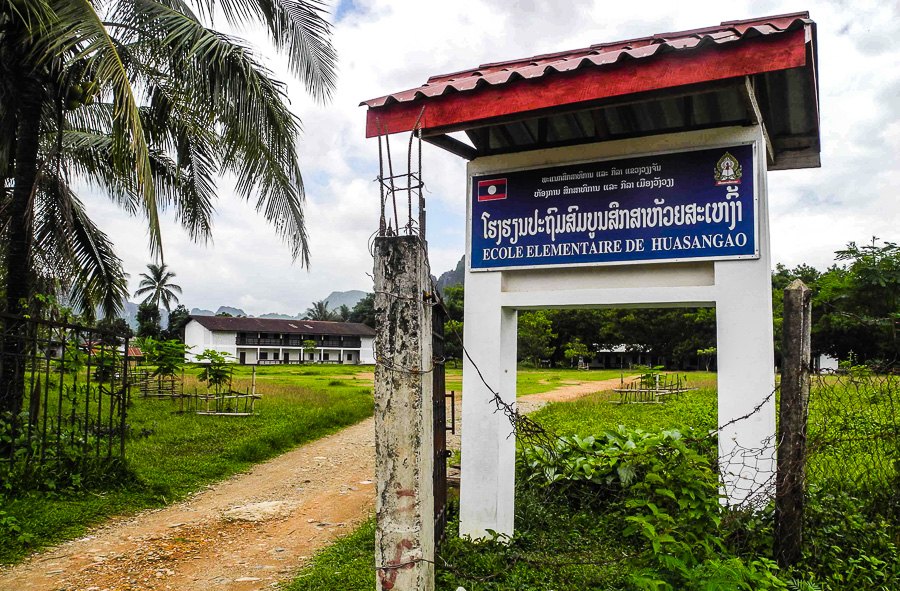
A primary school — it’s surprising, all the same, that the wording on the sign is duplicated in French rather than English; somehow that even feels unusual:
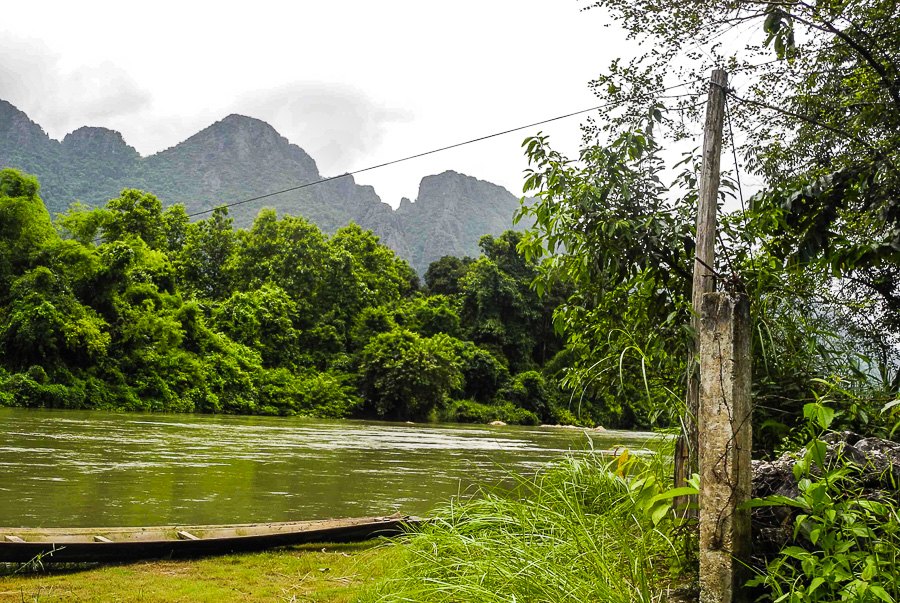
We also wanted to call in at one more cave (in Vang Vieng we had been inside Tham Chang cave) — it’s called Lusi (Tham Pha Lusi on OpenStreetMap), and I had read good reviews of it. Unfortunately we never got there: where the map showed a bridge, there is no bridge, and locals told us it had been flooded. You can cross the river by boat, but there was no point, as the cave itself turned out to be flooded too. The river that had broken its banks:
So we set off back.
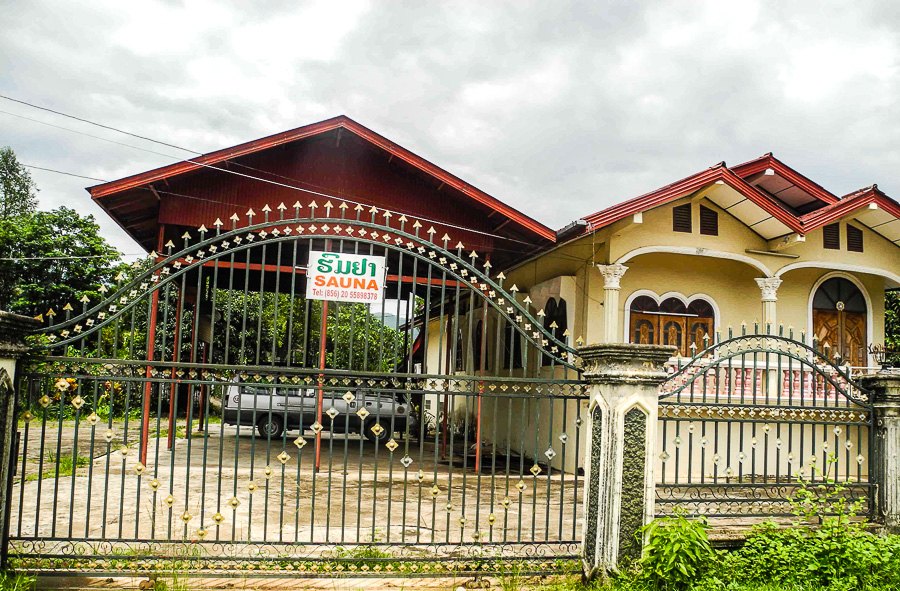
It does make you wonder — does anyone really use a sauna in a climate like this?
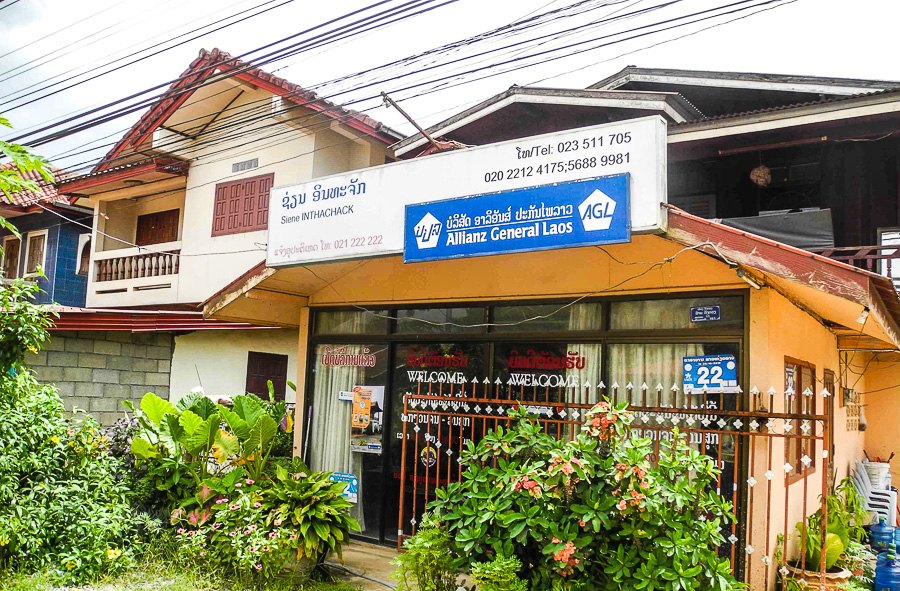
The ubiquitous Allianz, even in a remote Lao village:
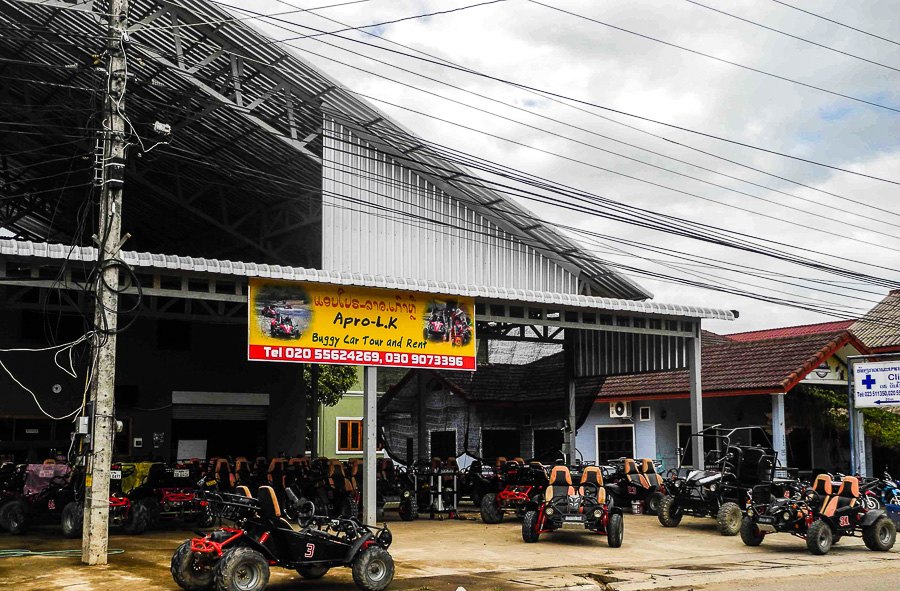
You can also go buggy riding in Laos, but it doesn’t seem to be a particularly widespread activity — we only saw tourists on buggies a couple of times:
That was our walk around Vang Vieng (this article was written in 2014). Back then, by day it was a quiet, peaceful village, and by night a party spot for European tourists. Vang Vieng is nice, but I wouldn’t have gone out into the street after 10 pm — too many drunk faces, as if some sort of zombies came out at night. I saw no families with children at all then; Vang Vieng was a tourist town for young people. I also noticed that despite the beautiful scenery, the cliffs and the abundance of greenery, the air in Vang Vieng is not all that clean — you feel it especially on the tourist streets, where there are lots of exhaust fumes even though there is no particular traffic; presumably the fuel is simply poor quality. But nearer the caves the air is already excellent — in principle you can rent a bungalow there too, if you really want peace and quiet.
My verdict on Vang Vieng: it’s definitely worth going if you find yourself in that part of the world! It’s only a couple of hours from Vientiane (and if you happen to be getting a Thai visa there, why not pop over to Vang Vieng as well), and the beauty here is simply stunning!