The butterfly farm was only one stop on our tour of the Cameron Highlands countryside; the last place we managed to visit was a strawberry farm.
Because the whole Cameron Highlands area lies at considerable altitude compared with the rest of Malaysia, the local climate allows crops that are exotic for the country — tea and strawberries. You can read about the tea plantations and the tea factory in a separate article; now let us head straight to the strawberry farm.
There really are plenty of strawberry farms around the Cameron Highlands. But you cannot simply drive up to any of them and expect identical service: at neighbouring farms standing half an hour’s walk apart, prices and rules differ twofold. In 2015 we were brought to a nameless farm below Brinchang, and it never even occurred to me to ask its name. Today you cannot set off without knowing the name. Here is who is who:
- Big Red Strawberry Farm (also the Taman Agro Pelancongan agro-park), Brinchang, next to the Cameron Centrum shopping centre. Entry and parking are free, the toilet is too, there is plenty of space, a large cafeteria and even a room with massage chairs. But the rows with ripe berries are closed to anyone who has not paid for picking. The farm stands on a steep slope with a one-way exit — best avoided with a pushchair or with bad knees.
- Raaju’s Hill Strawberry Farm, 42nd mile, Kea Farm, about three kilometres north of Brinchang. You can walk up here directly from the Kea Farm market, and there is a small car park. You are given scissors and a basket, there is a café on site, but apart from picking there is little to do. There is a charge for the toilet — 50 sen.
- Lavender Garden. The strawberry beds are raised on scaffolding right above the flower beds and look spectacular. Entry is paid, and berry picking is not included in the ticket.
- Royal Berry Strawberry Park & Café. The berries are smaller and more sour, but cheaper — and this is the only place worth going if you want to pick just a little rather than a kilogram. A decent café, with scones.
- Ladang Soon Cheong. Local guides reckon the biggest and sweetest berries in the highlands grow here. In return, no infrastructure at all: pick, have a look at the seedlings for sale, and off you go.
- Mountain Strawberry Farm, on the serpentine road to the summit of Gunung Brinchang, about four kilometres from it. Everything here is old-style and the freest of all: ask at the till for scissors and a bucket and wander about on your own, with no deposit and no overseer at your back. Next door is a free petting zoo with rabbits, chickens and goats, which children love.
- Also working nearby are Kok Lim (beyond Brinchang, one of the biggest), Healthy Strawberry Farm (at the turning for the golf club), Kasimanis, Highlands Apiary Farm (an apiary where berry picking is not always open) and Last Stop Strawberry Centre — the last spot for local strawberries on the way out via Simpang Pulai towards Ipoh.
The good news: Raaju’s Hill, Big Red, Kok Lim and Healthy stand close together — less than one and a half kilometres from the first to the last. You can walk round all four in a single outing and choose your farm on the spot, with your own eyes.
Now the bad news. Simply looking at how strawberries grow, free of charge, is no longer an option. At Big Red, nobody who has not paid for picking is allowed near the ripe rows. At Raaju’s Hill, a companion who has come just to stand nearby and picks nothing pays 15 ringgit. Lavender Garden takes 20 ringgit per person for entry alone, with picking charged on top. The freest is Mountain Strawberry Farm — no deposit and nobody following on your heels — but everything you pick is still weighed at the till. And not every farm has a café: at Ladang Soon Cheong there is nothing at all besides the greenhouses.
We came to the farm on a minivan excursion, but you can get here independently — and noticeably more cheaply than you might think.
All intercity buses arrive at the highlands’ only bus station, in Tanah Rata — it is called Terminal Freesia, and Brinchang is about four kilometres from it. From Kuala Lumpur the journey takes 4–4.5 hours: tickets from the aggregators start at 22.40 ringgit, the carrier Unititi charges 35 ringgit, and services run roughly from 08:00 to 17:00. From Ipoh it is cheaper still, from 18 ringgit, and from Penang about 32.
And now the most useful part: an ordinary local bus runs within the highlands, and fares start at 1.5 ringgit. It goes roughly once an hour along the main road Tanah Rata — Brinchang — Kea Farm, that is, right past the farms. Taxis at the bus station charge about 25 ringgit an hour — both the district council and the ticket aggregator quote the same figure, so do not let anyone talk you above it.
A word about the road, to which I gave no thought at all in 2015. Two routes lead into the highlands — from Tapah and via Simpang Pulai — and both are closed after heavy rain because of landslides. The most recent one came down on 17 July 2026 on the Tapah–Cameron road at the 25th mile, about seven kilometres from Ringlet: trees and rocks buried half the road. Then there are the jams: at weekends the tailback stretches 10–15 kilometres, and the Tapah–Tanah Rata stretch, which takes 45 minutes on a quiet day, takes more than two hours at peak times. If you are doing a one-day trip from Kuala Lumpur, check the road news the day before — the whole day can fall through.
If your trip falls in the coming winter, check the calendar: from 5 to 31 December 2026 Malaysian schoolchildren are on holiday (including in Pahang, where the highlands are), and 6–8 February 2027 is a run of three days off for Chinese New Year. For these dates, allow the same margin on the road as for a weekend and set off early. And a reminder about entry: even if you do not need a visa, before arrival you must complete the free MDAC electronic arrival card — on the Malaysian Immigration Department website.
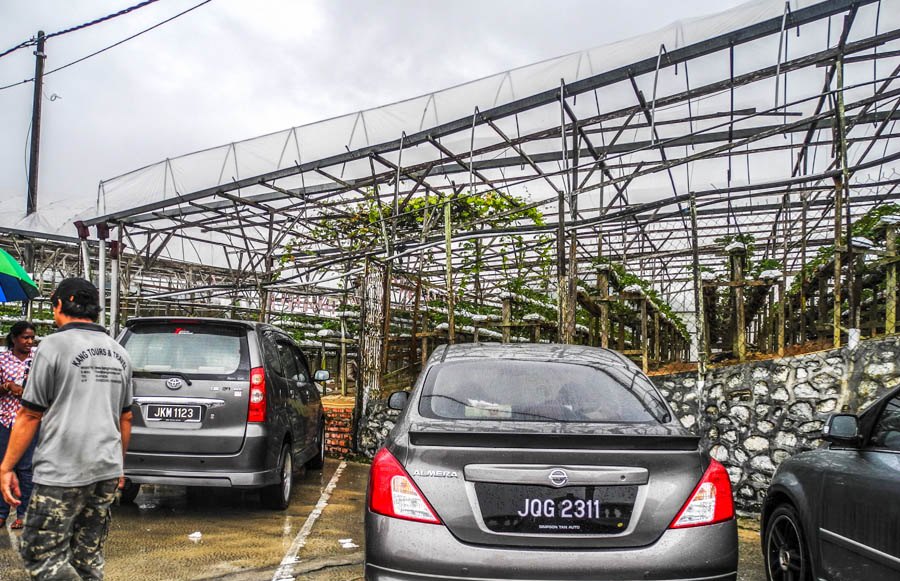
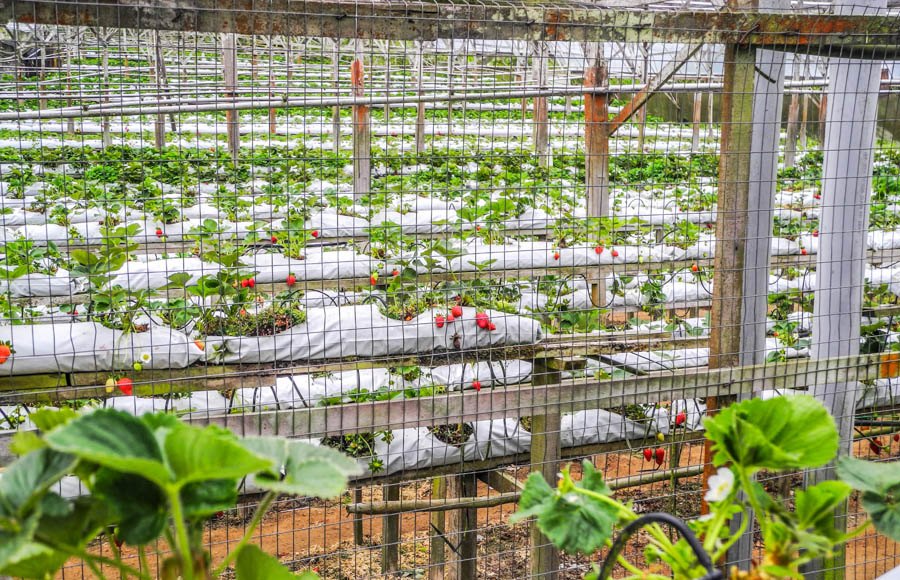
The farm consists of several huge greenhouses covered in polythene:
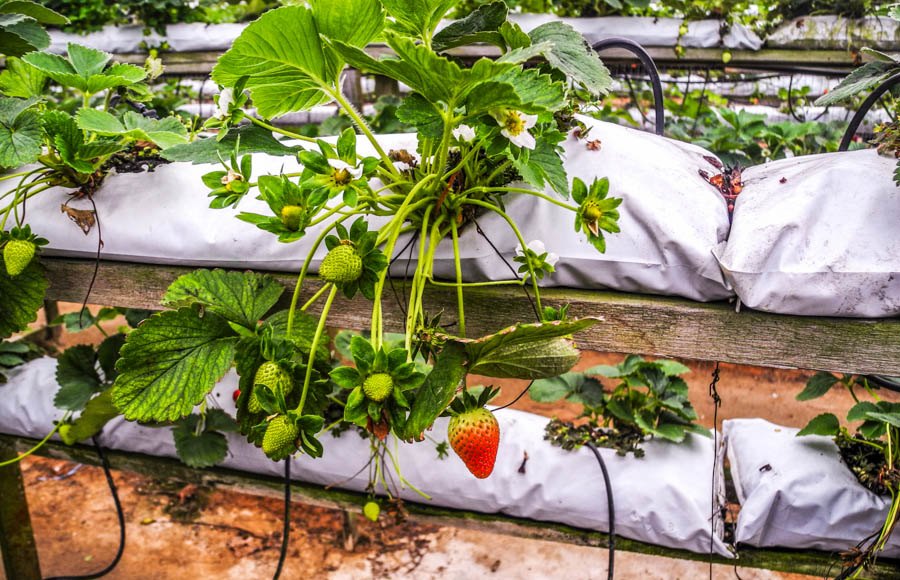
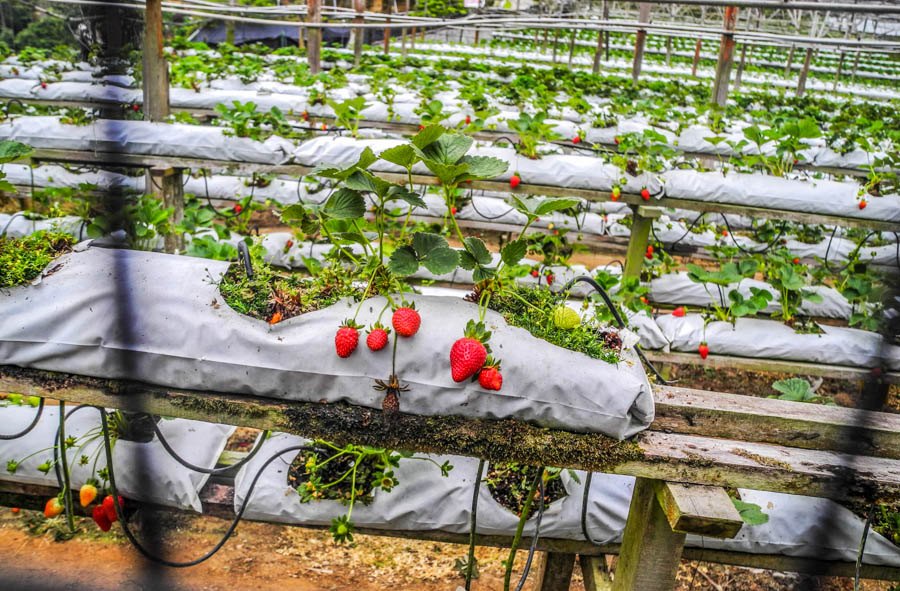
The strawberries grow in an unusual set-up — boxes of bushes are mounted at different heights and wrapped in film, so picking is very convenient. Each bush has its own individual watering system:
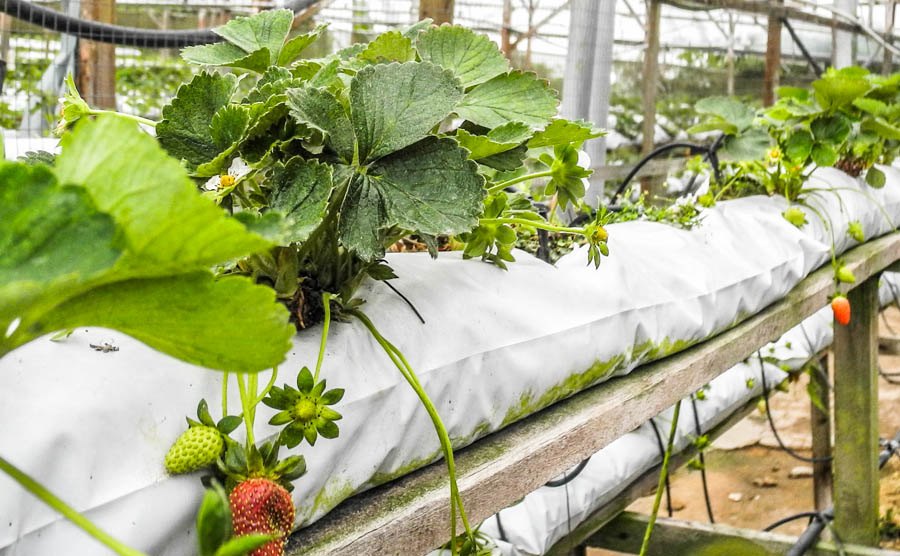
Strawberry bushes:
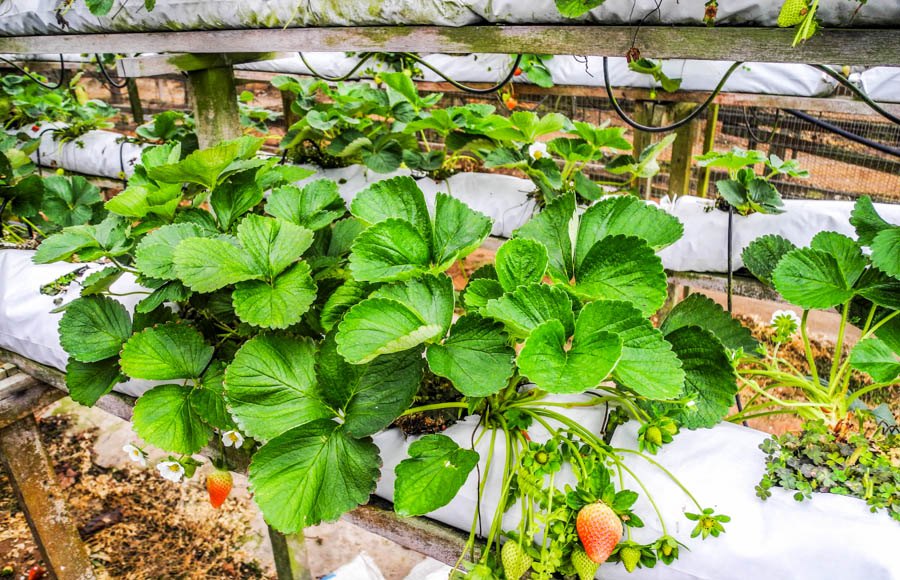
Thanks to the efficient use of space, a huge number of strawberry bushes fit into the greenhouse:
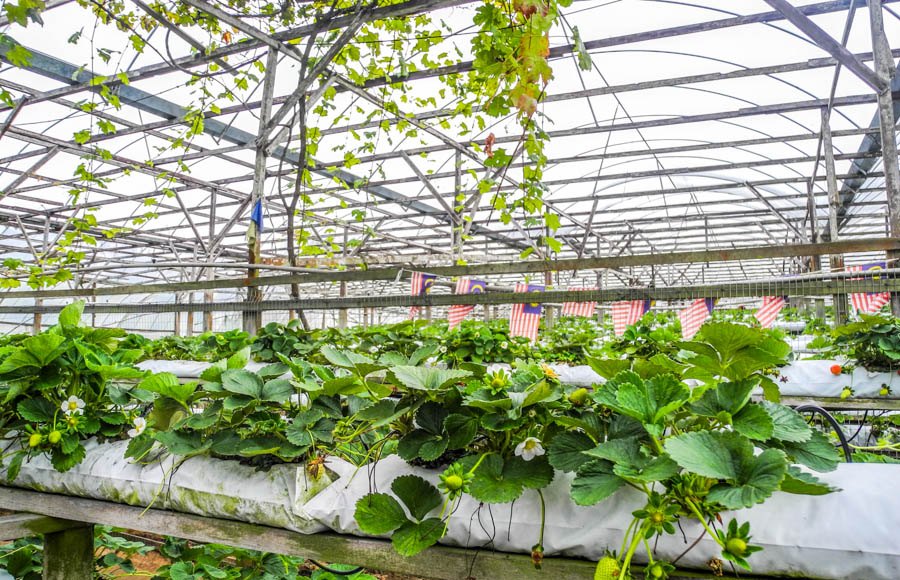
We chose not to pick strawberries, so we were only allowed into the part where there were no ripe berries. That is in fact the general rule; in 2015 it simply had not been worded as strictly yet:
All the ripe strawberries are behind a grille; you can only look from the side:
Juicy, bright berries:
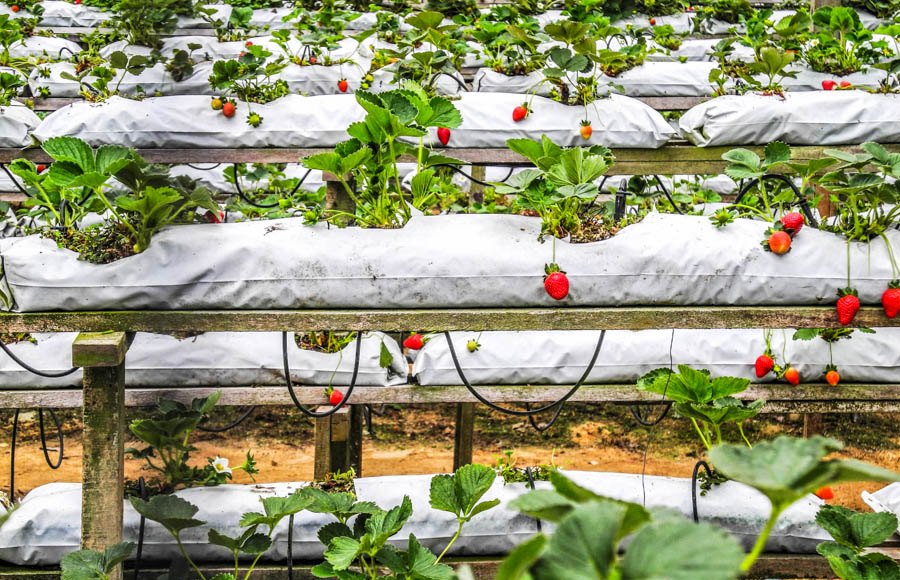
Here you can see the watering system:
When we were planning our trip to the Cameron Highlands and reading about the strawberry farm, we imagined we would be eating strawberries round the clock — they grow here, so surely they must cost pennies! In reality it all depends on where exactly you buy them. At the farm itself a 250-gram box costs 8–15 ringgit, while a couple of steps away at the Kea Farm market exactly the same box is 6–10. Nearly half the price. Hence a simple rule: admire and pick at the farm; buy at the market.
The night market in Brinchang works out cheaper still, but it has its own mechanics. Do not buy from the first seller you meet: prices at the start of the rows and deep inside the market differ noticeably, so it is worth walking the whole length first. And do not take the ready-packed boxes — bruised berries regularly turn up under the pretty top layer; it is better to fill a box yourself. Haggling at Kea Farm, incidentally, is not the done thing: you can try, but the sellers dislike it.
The Kea Farm market itself is a different place now. The old wooden stalls along the road were demolished back in 2020 and moved into an organised trading row, and there is now even a new arcade called “Bazar Kea Farm”. Parking is paid, 3–4 ringgit per car, and a free electric buggy runs from the far car park to the market — the wait is never more than fifteen minutes. And between 11:00 and 13:00 it is better to stay away altogether: that is the day’s heaviest traffic, and everyone is stuck in it.
Cross two landmarks out of your old guidebooks as well. The Time Tunnel Museum — the junk-shop museum next door to the strawberry farms — burned down together with its entire collection and is closed for good; official papers now describe it as the “former museum site”. And the snow-white “Santorini” attraction that still pops up in every Instagram round-up of Kea Farm stands closed: the authorities stopped it for operating without permits.
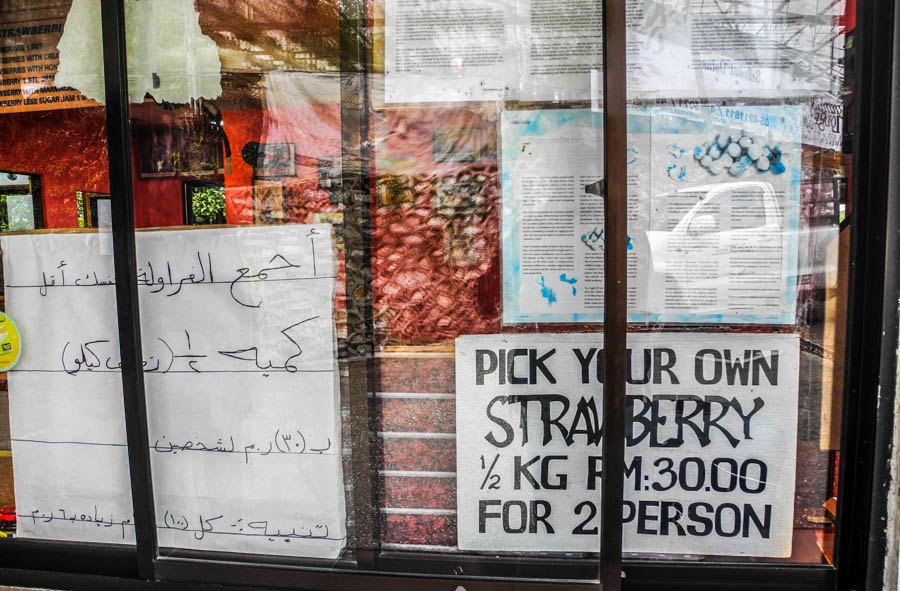
In 2015 our farm quoted a minimum of 30 ringgit for 500 grams. Amusingly, the figure itself has survived to this day: the general benchmark across the highlands is still 25–40 ringgit for a half-kilo box. What has changed is the structure of the bill. You now pay not by the gram but per box and per head, and the minimum spend at the greenhouse entrance has doubled:
- Big Red Strawberry Farm — they will not sell you less than a kilogram at all. A 1 kg box costs 60 ringgit and is priced for two adults with a child; every further person pays about 5 ringgit extra, even if they pick nothing themselves. I found this figure in two independent sources: from a local guide in May 2024 and from a Malaysian blogger who went there in September 2025.
- Raaju’s Hill — 35–40 ringgit for 500 grams, and that is the price for two adults with a child. The main trick is at the scales: if you have picked less than the norm, the staff top the berries up to weight — you cannot pay less than the minimum, and “I’ll just pick a little” does not work here. A companion who does not pick pays an extra 15 ringgit.
- Lavender Garden — 20 ringgit per person for entry only; picking is paid separately.
- Royal Berry — the cheapest of all, but the berries are smaller and more sour. Practically the only option if you do not need a kilogram of strawberries.
An honest caveat: I re-checked prices in September 2026, but the most recent confirmed figures for specific farms date from May 2024 and September 2025. Not one of the Cameron farms has a website of its own, so the final sum is in any case named at the till. Ask before you take the scissors in your hands:
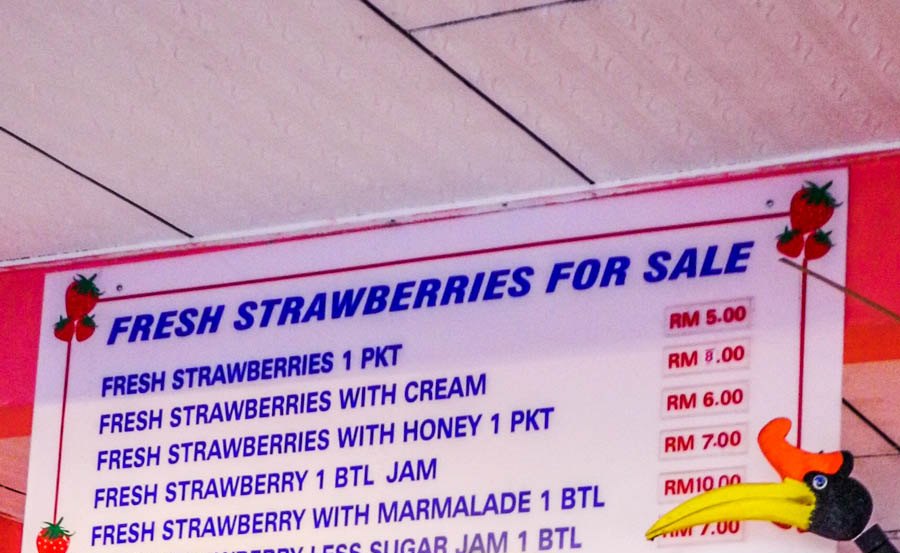
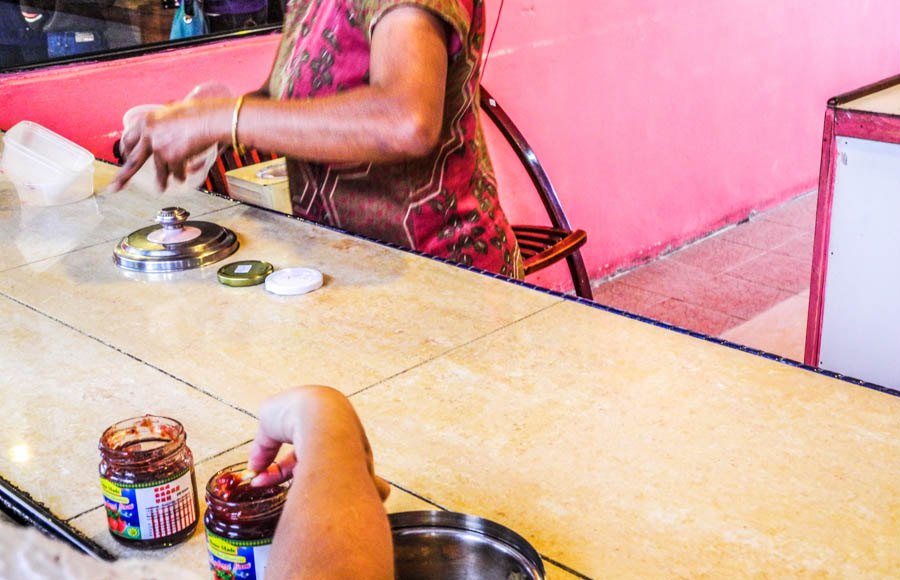
There is also a shop at the farm, where you can buy fresh strawberries with extras such as cream, honey or chocolate, as well as freshly made jam:
And here is the story that makes it worth reading this article to the end. In December 2025 a tourist at the Kea Farm market bought a box labelled “1 kg for 25 ringgit”, doubted the weight and asked the seller to weigh the purchase in front of her. He pulled a face at first but agreed — the box held 700 grams. The berries were silently topped up to a kilogram, while his partner immediately took down the “1 kg for 25 ringgit” tag and replaced it with another one: “box — 25 ringgit”. The clip spread across social media, and the Pahang state authorities launched labelling checks across the highlands.
What does this mean for you personally?
- The market-price benchmark is around 25 ringgit per kilogram. Anything noticeably cheaper usually turns out to be underweight rather than a bargain.
- Demanding that the box be re-weighed in front of you is a buyer’s legal right. The seller may frown but has no right to refuse.
- The permissible deviation from the weight on the label is 5%. The chairman of the state consumer affairs committee put it this way: a discrepancy of up to five per cent is acceptable; beyond that it is grounds for sanctions.
- False labelling is punished under Section 5 of Malaysia’s Trade Descriptions Act 2011: a fine of up to 100,000 ringgit for an individual and up to 250,000 for a company. Complaints are accepted by the domestic trade ministry KPDN and the Pahang state consumer affairs committee.
Before buying, incidentally, you can taste everything — which we did, and it was very tasty, I have to say:
One thing I did pointlessly back then was popping berries into my mouth straight from between the rows, unwashed. In 2023 the Malaysian agricultural institute MARDI published a study: 40% of Cameron Highlands farms exceed the safe level of pesticide use, and the concentration of chemicals in some local watercourses is 300% above the national standard. The strawberries here are still wonderful and you should eat them — but it is better to carry your pickings to a tap and wash them than to taste them right there in the greenhouse.
You can, of course, buy nothing at all, but resisting is genuinely hard — so many strawberry temptations:
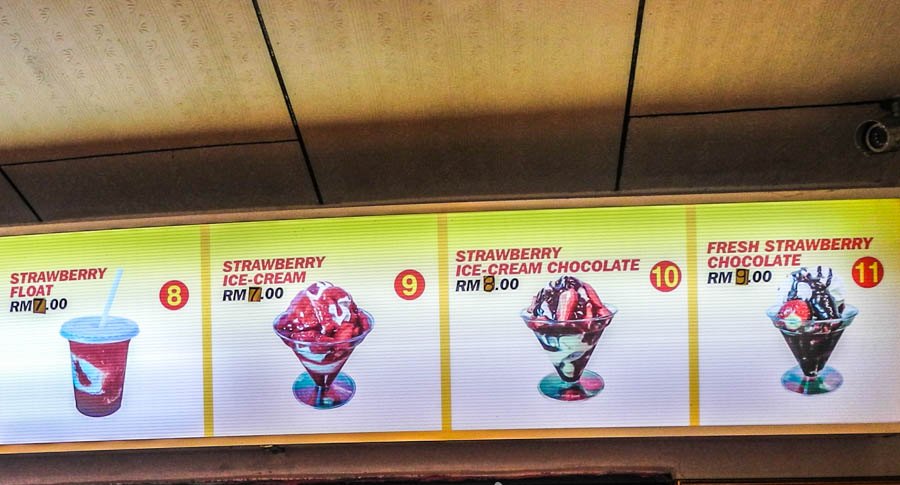
Ice cream, cakes, waffles — all with strawberries:
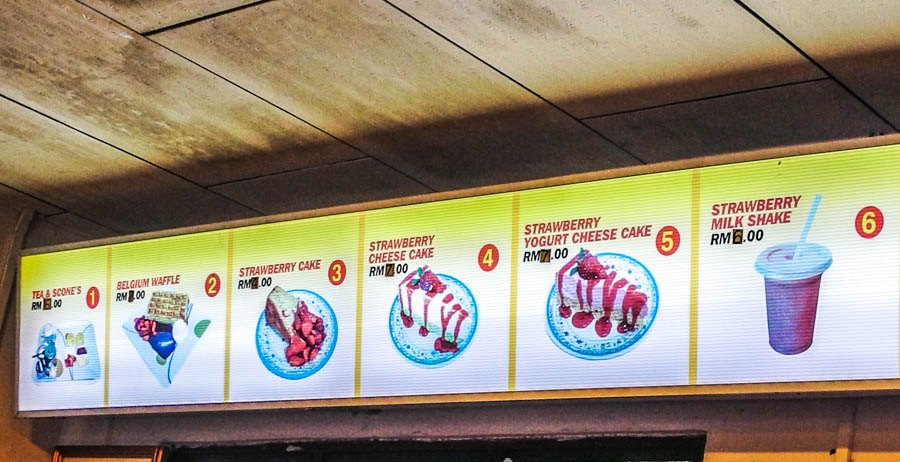
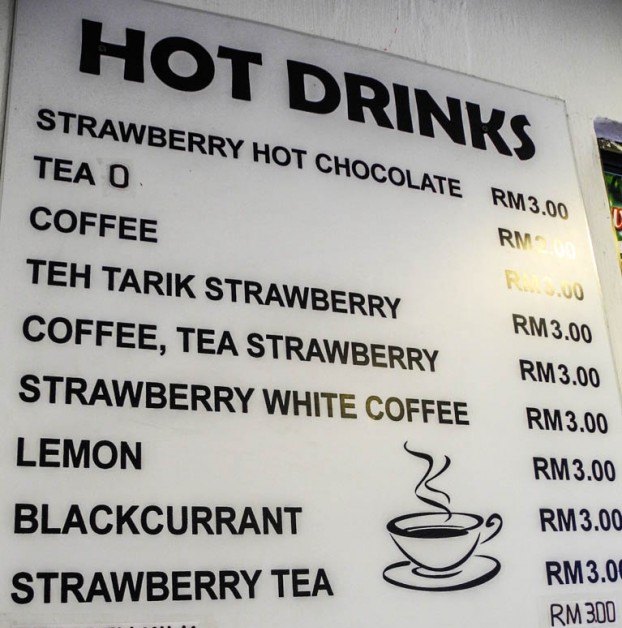
Most interesting of all, practically every drink comes with strawberry too — how about a strawberry coffee, for instance? Prices are ordinary, the same as in many Tanah Rata cafés:
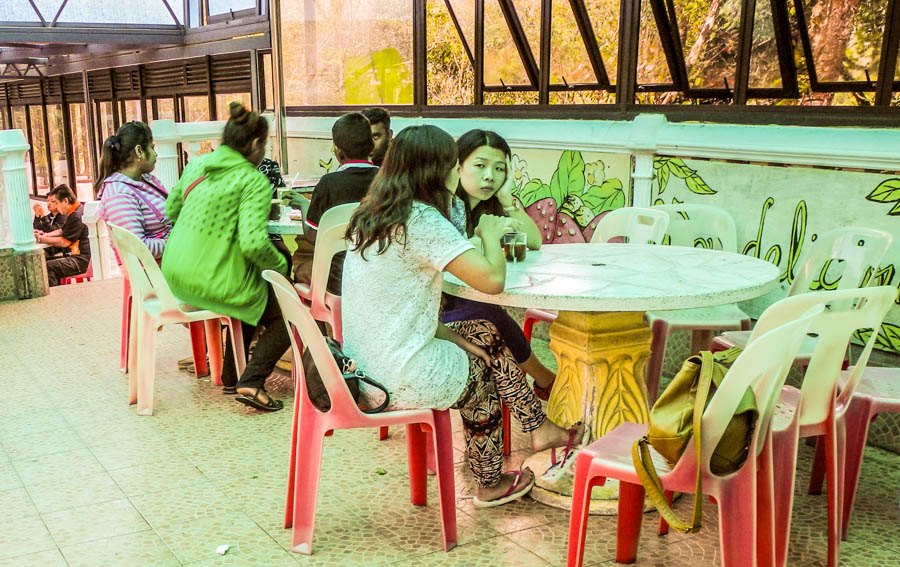
Every table is taken: strawberry farms are hugely popular not only with tourists but with Malaysians themselves, who come here for the weekend and even celebrate birthdays. The very noisy party at the table in the background was celebrating someone’s birthday:
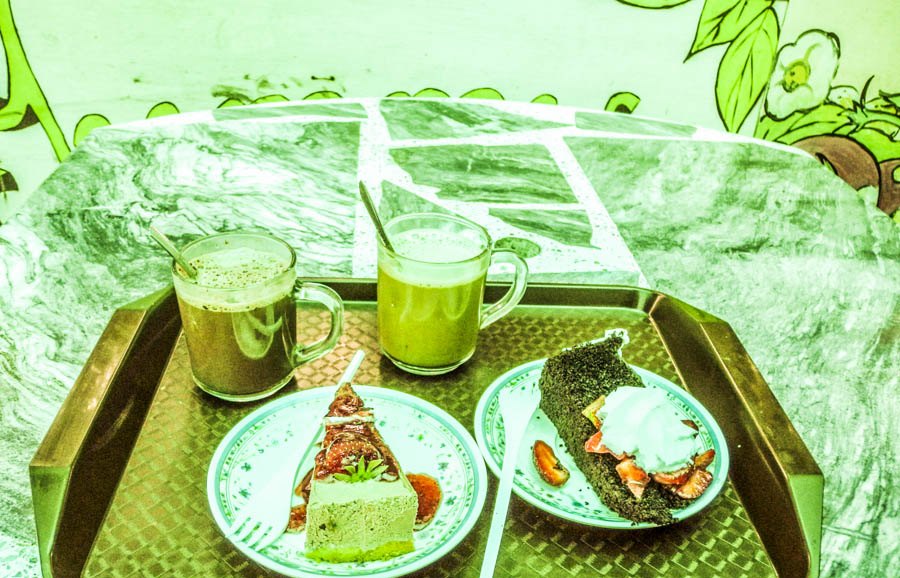
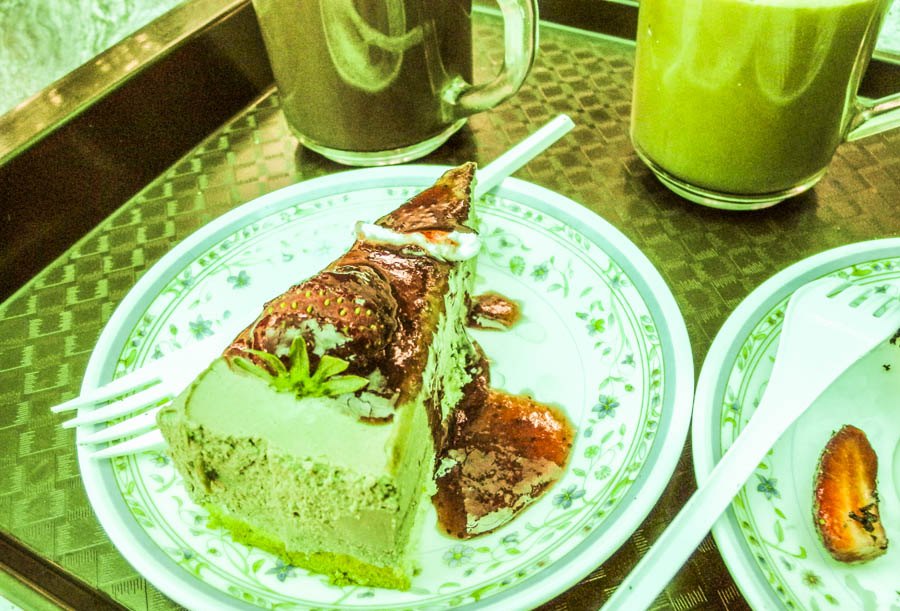
And this is our order — a chocolate strawberry cheesecake (left) and a chocolate cake with strawberries and cream (right); the cocoa and coffee, of course, we took with strawberry flavour — a very unusual combination:
A treat for 7 ringgit — that is a 2015 price, and since then none of the farms has posted its menu openly. For reference: a strawberry sundae at Raaju’s Hill cost about 10 ringgit according to 2024 reviews:
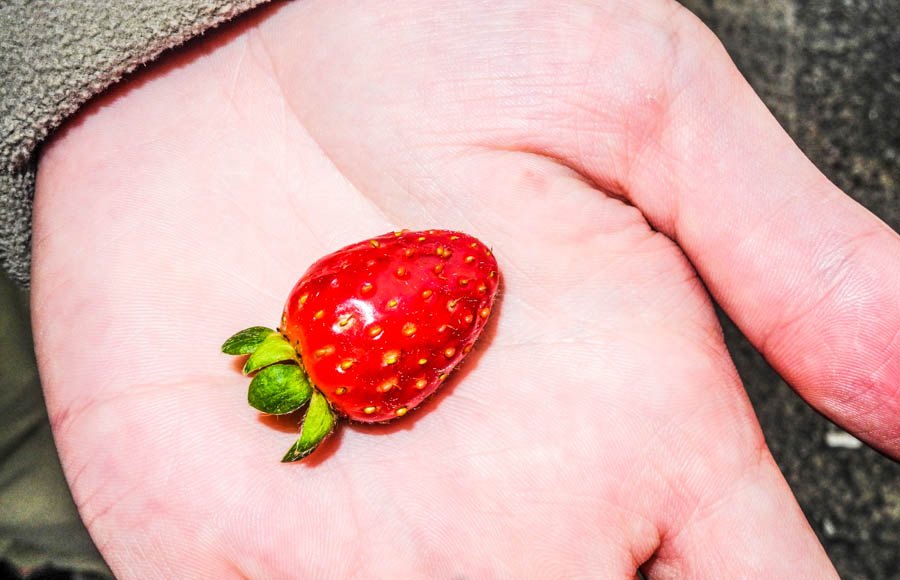
A nice moment — our guide bought a little box of strawberries and treated the whole group:
The bottom line of the trip: if you have made it as far as Tanah Rata, a trip to a strawberry farm is an absolute must!
For a start, it is interesting, and secondly it is delicious! The strawberries are sweet and aromatic, and here they are available all year round: the greenhouses stand at an altitude of 1,400–1,800 metres, and the harvest is picked in all twelve months. When it comes to the “peak season”, the reference books argue with one another — some name February–April and July–August, others June–August and December–February. So it is better to trust not the calendar but the rain forecast and a question at the farm till: in dry weeks the berries are bigger and sweeter; in rainy ones they are smaller, and there are simply fewer of them.
And come in the morning. Fresh boxes are put out on the farm counters and at the Kea Farm market from early morning, and on weekdays before 10:00 you will get the best choice, empty aisles between the rows and decent light for photographs. By midday there is already a crowd.
You do not have to buy an excursion — you can even walk, as some farms are very close to the settlements. From the Kea Farm market you climb on foot to Raaju’s Hill in a few minutes, and from there Big Red, Kok Lim and Healthy are a stone’s throw away. Plus there is the local bus for one and a half ringgit, which passes all these farms. But if your time is very limited, a tour is better — in a single day you will fit in a great many places. You can even join a day tour straight from Kuala Lumpur: twelve-hour itineraries include tea plantations, viewing platforms, a local market and a strawberry farm in the programme. And if you are staying in Tanah Rata for a few days, you will have no trouble finding a tour agency — they are on every corner.