In brief, for those planning to go themselves. The Hospital in the Rock (Sziklakórház) is a museum in the caves beneath Buda Castle: an underground Second World War hospital and a Cold War nuclear bunker. The address is Lovas út 4/c; the entrance is on Lovas út beneath the castle wall, reached by a staircase opposite Matthias Church. Entry is by 60-minute guided tour only: tours run daily from 10:00, the last one starting at 18:00. As of October 2026, an adult ticket for an English-language tour costs €30, and every visitor gets a free audioguide. Children under 6 are not admitted. Details below.
1. A brief historical background
The caves here are of natural origin and have existed for a long time: thermal water carved passages through the travertine, and over time these grew into a genuine underground labyrinth.
Gradually the residents of this part of Budapest dug tunnels between the passages, linking them together. The district’s underground world has still not been fully explored. Budapest and its surroundings are full of caves — I have managed to visit two of them, Szemlő-hegyi and Pál-völgyi. But the Hospital in the Rock is something else entirely.
When the Second World War broke out, the Hungarian authorities decided to equip these caves as a shelter from the bombing. Work on the cave shelters began in 1939; the hospital itself was built in 1941–1943 and opened on 20 February 1944.
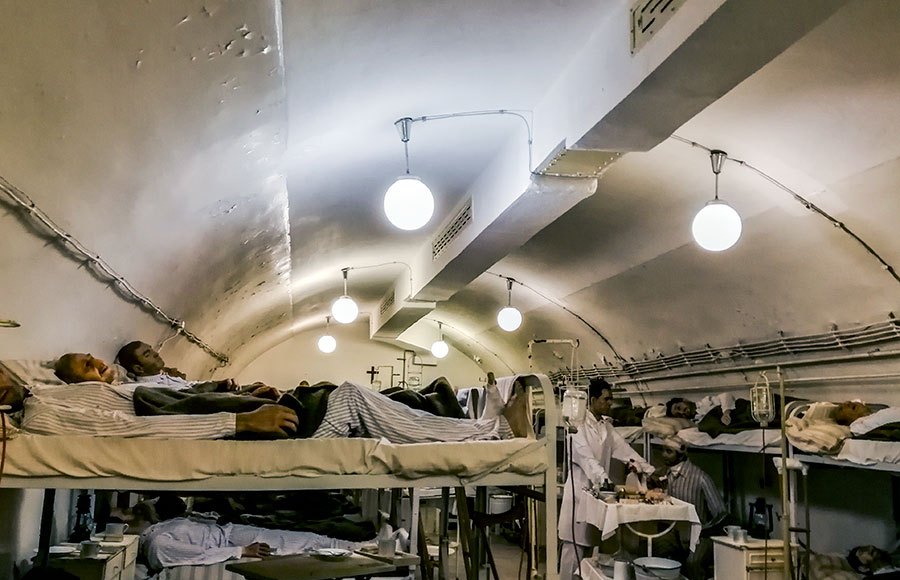
By then the situation at the front was catastrophic: there were huge numbers of wounded, and this underground complex housed a hospital for both military personnel and civilians. There were not enough beds — the place was literally crammed with casualties.
The hospital had its own generator, which meant operations could be carried out around the clock and an X-ray machine kept running. Despite the doctors’ skill, the mortality rate was fairly high — shortages of medicines and dressings took their toll.
This is how cramped the conditions were for the wounded (an exact reconstruction of one of the hospital’s rooms!):
Once the fighting was over, the hospital housed a factory producing typhus vaccine for export. But as early as the 1950s a hospital was being set up here again — and this time it was classified, with its own code name, autonomous ventilation, water supply and everything else essential.
During the uprising of 1956 the insurgents once again used the underground hospital for its intended purpose, but the uprising was soon crushed by the Soviet army. According to the museum, the hospital operated until December 1956.
In 1958–1962 the hospital was converted into a bunker-shelter with protection against radiation: new ventilation with gas filters was installed, along with a water pipeline from the Danube. The site was classified: the nuclear bunker remained secret until 2002 — after the end of the Cold War in Europe — and a caretaker family secretly looked after it until 2004.
The museum has been operating since 2007: visitors were first let in during the 2007 Night of Museums, and it has been open permanently since 11 March 2008. At first there were no figures of staff and patients, but the museum has gradually been filling with exhibits. It also hosts exhibitions devoted to the 1945 siege of Budapest and to the atomic strike on Hiroshima and Nagasaki.
2. Practical information
2.1. Where it is
The museum is in Buda, not far from Buda Castle.
The exact address: 1012 Budapest, Lovas út 4/c.
Location on the map:
2.2. How to get there
- by metro, travel to Széll Kálmán tér station — line M2 will do;
- by bus 5 (or trams 41, 56 and 56A) you can get to the Mikó utca stop, while buses 16, 16A and 116 go to Szentháromság tér, a few minutes’ walk from the museum. Routes checked against the official BKK timetable in September 2026. If you are travelling in late December–early January, bear in mind that timetables change over the holidays: BKK publishes its holiday changes on bkk.hu — check them a week before your trip.
If you plan to get around Budapest on a Hop-On bus, the stop you need is called “Castle/Funicular”. From there it’s a short walk to the hospital, but the option is convenient because you can see several of Budapest’s sights in one go, with an audioguide.
The museum itself is not included in sightseeing-tour programmes. There is, however, a free English-language walking tour available to anyone who has bought the Budapest Card, the city’s tourist card. The Buda walking tour is also on the card’s list of free services for 2026/2027. In 2020 it set off daily at 14:00 from the Holy Trinity Column, and the hospital got plenty of coverage on it; check the current start time when you buy the card. It was on that very tour that I decided this museum was worth a visit (I had originally planned to go to the underground Labyrinth, but the guide persuaded me to choose the Hospital instead).
2.3. Opening hours
The museum is open daily, including Mondays. Opening hours as of October 2026, according to the official website, are as follows:
- the museum is open from 10:00 to 19:00; English-language tours start every hour, the last one at 18:00;
- the ticket office and souvenir shop are open from 10:00 to 18:00; the museum is closed on 1 January, 1 November and 24, 25 and 31 December.
For the 2026–2027 Christmas and New Year holidays: according to the official website (as of 17 October 2026) the museum is closed on 24, 25 and 31 December and 1 January. 26 December does not appear on the list of closed days, so the museum should be open, but the website publishes no separate holiday timetable — check the hours on the museum’s website a week before your trip.
Tours are conducted in English and Hungarian, and entry is with a guide only. Every visitor is given a free audioguide. A tour lasts about an hour. You can’t leave early, as wandering around the underground labyrinth on your own is not allowed. The times of upcoming tours and the number of free places can be seen in the online-purchase form on the museum’s website; online sales for a particular tour close 30 minutes before it starts, after which the remaining places are sold on site on a first-come, first-served basis.
2.4. Admission prices
- An adult ticket (ages 18–65) for an English-language tour costs €30 as of October 2026; payment is made in forints at the National Bank of Hungary’s exchange rate on the day of purchase.
- A child ticket (ages 6–18) costs €15; a student ticket (ages 19–26, with an ISIC card) and a ticket for visitors over 65 costs €22. A family ticket for one adult and one child costs the same as a single adult ticket — €30.
- The price of a ticket with a Budapest Card is 10% lower than the standard one.
- Cash is not accepted: you pay by bank card at the machines by the ticket office and on the website. Places on each tour are limited, so in high season it’s best to buy your ticket online in advance.
2.5. Official website
3. A photo tour of the museum
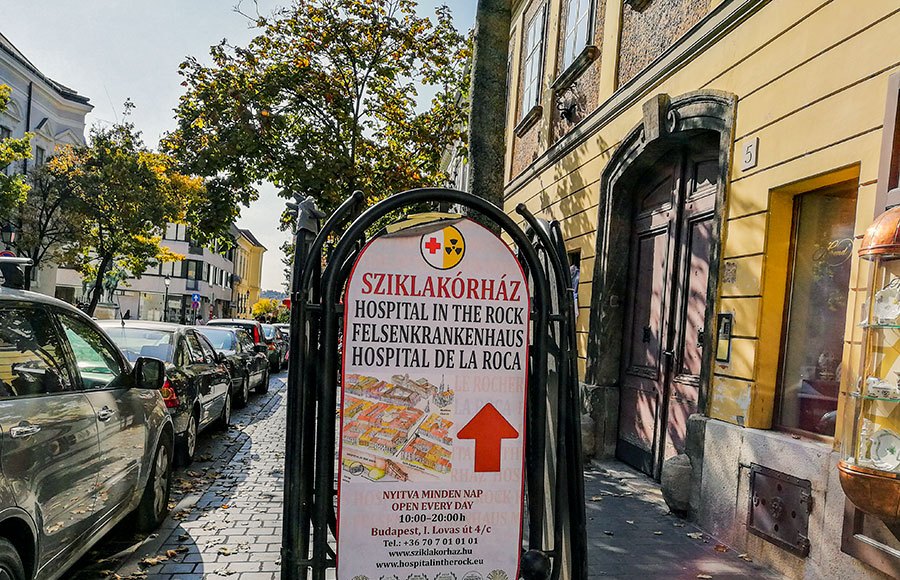
If you’re heading to the museum after visiting Buda Castle, the easiest way down is by lift.
The lift is at the level of the Tóth Árpád promenade:
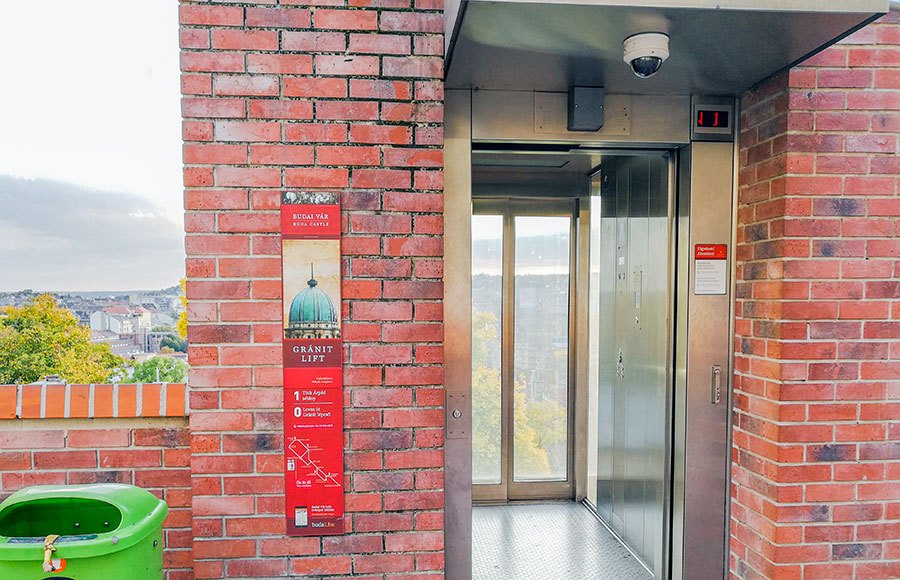
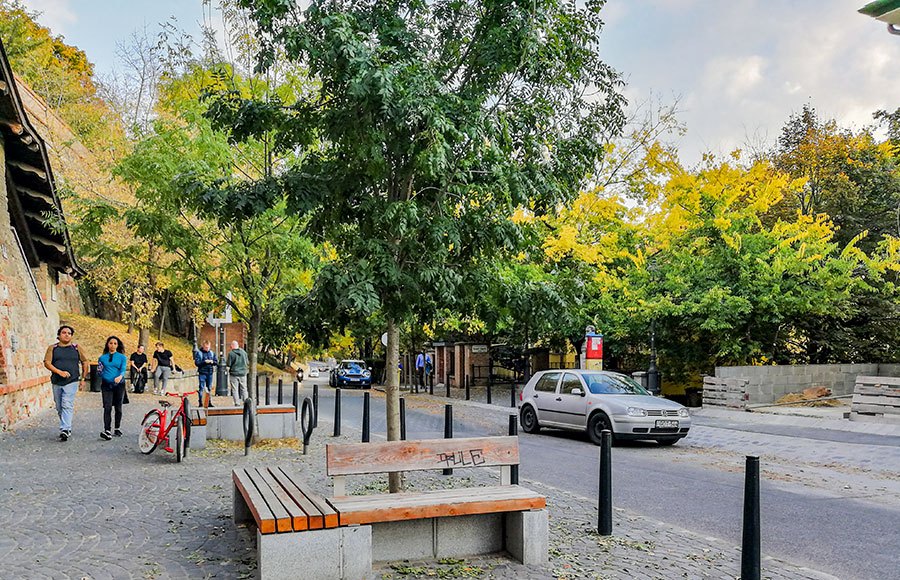
Down we go in the lift. To get inside the museum, you need to go round the exit on the right-hand side:
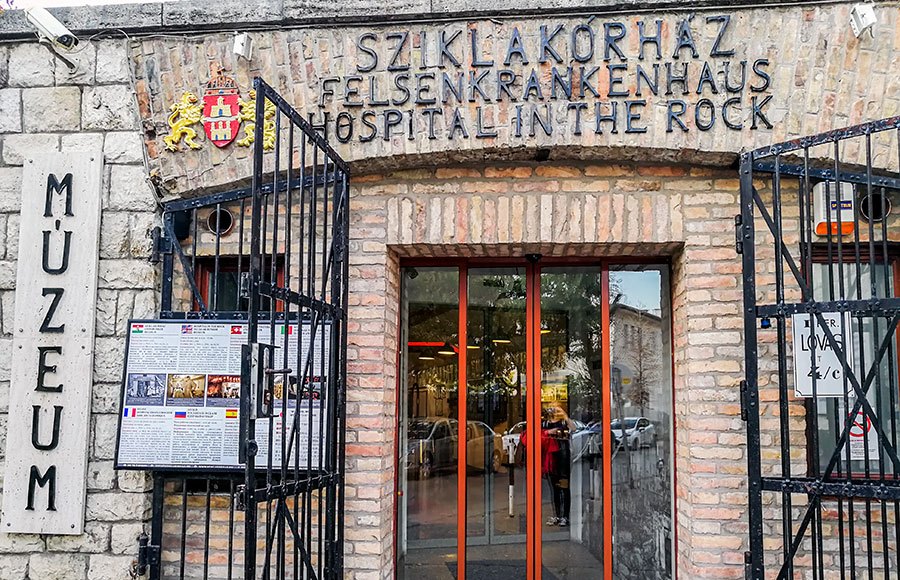
And here is the museum entrance:
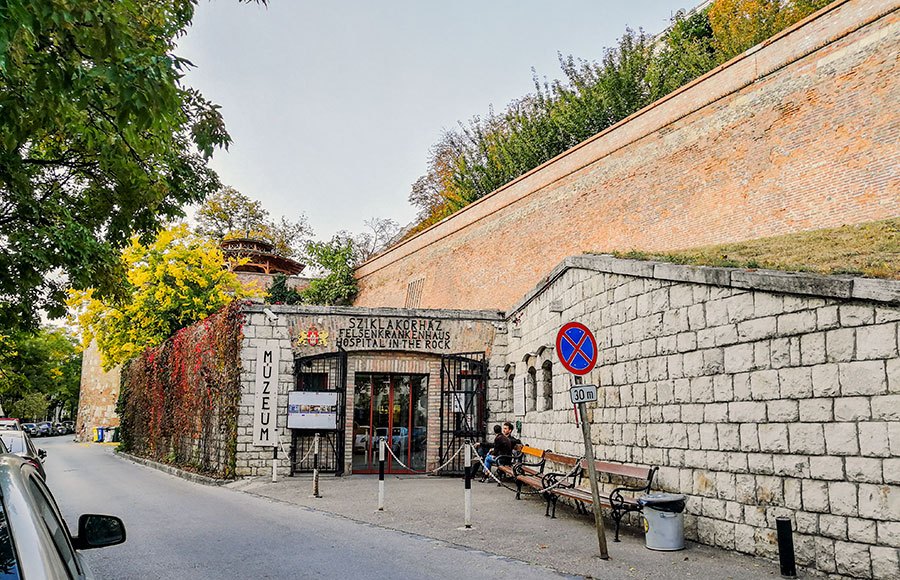
The name in different languages:
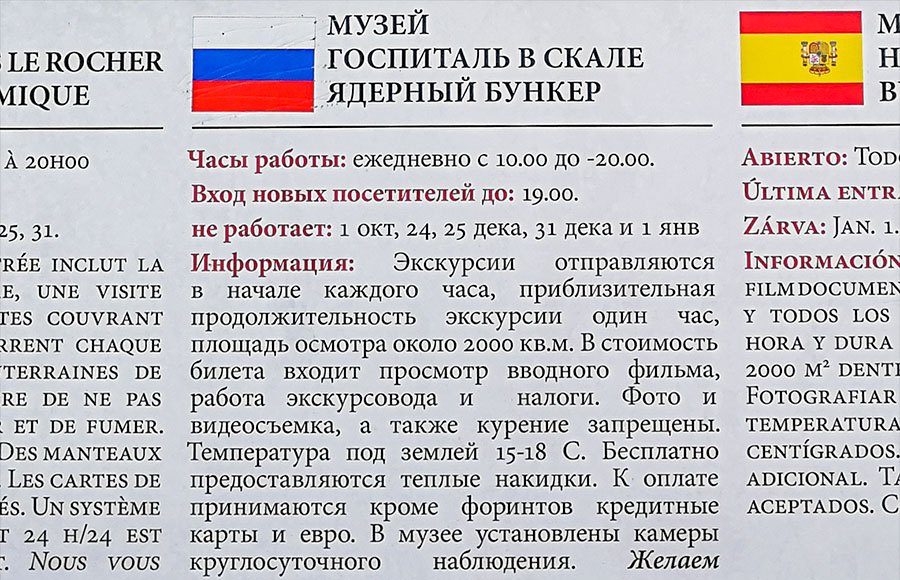
The rules of conduct inside are also set out in several languages:
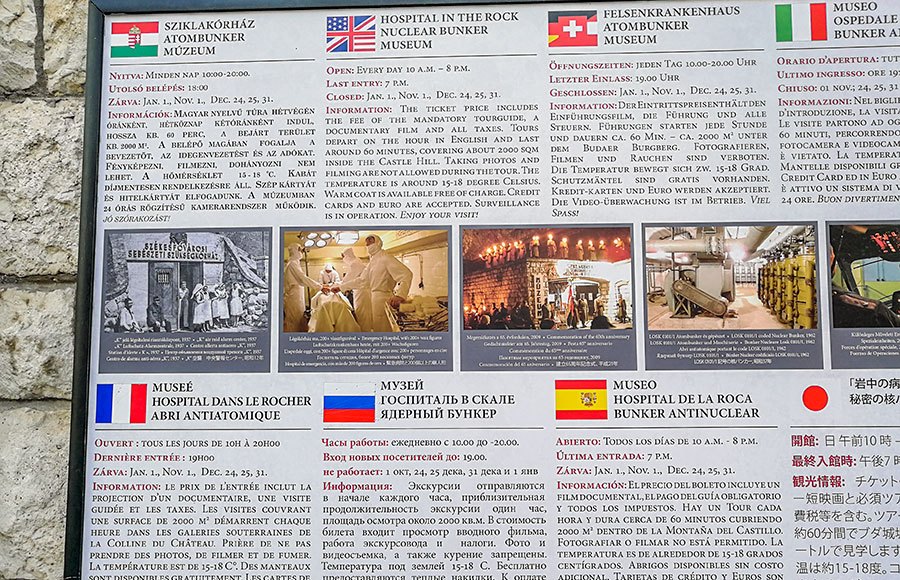
Let’s read the rules. For example, photography is not allowed inside, and in summer it can be cold (according to the museum, it’s 15–18 °C inside all year round):
Museum souvenirs are also on sale — this section is devoted to protection against a nuclear blast:
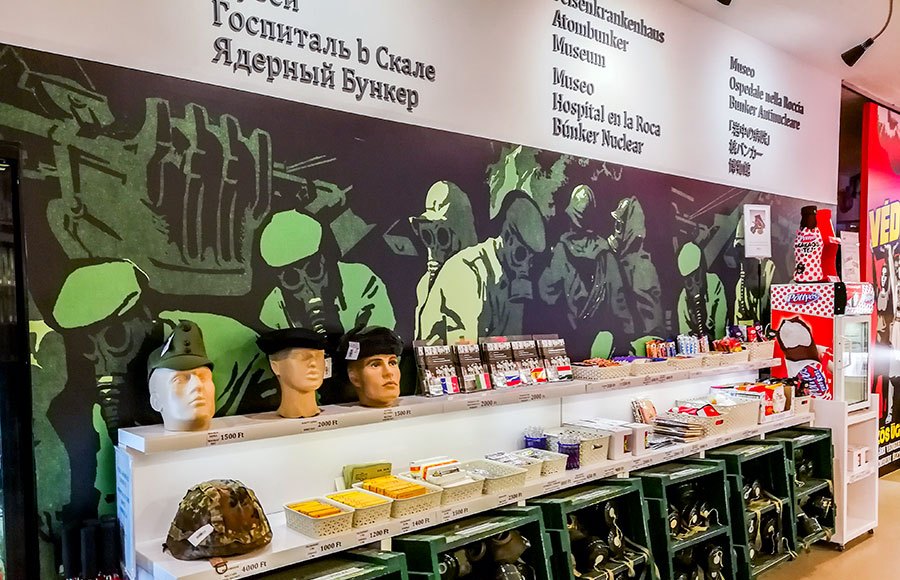
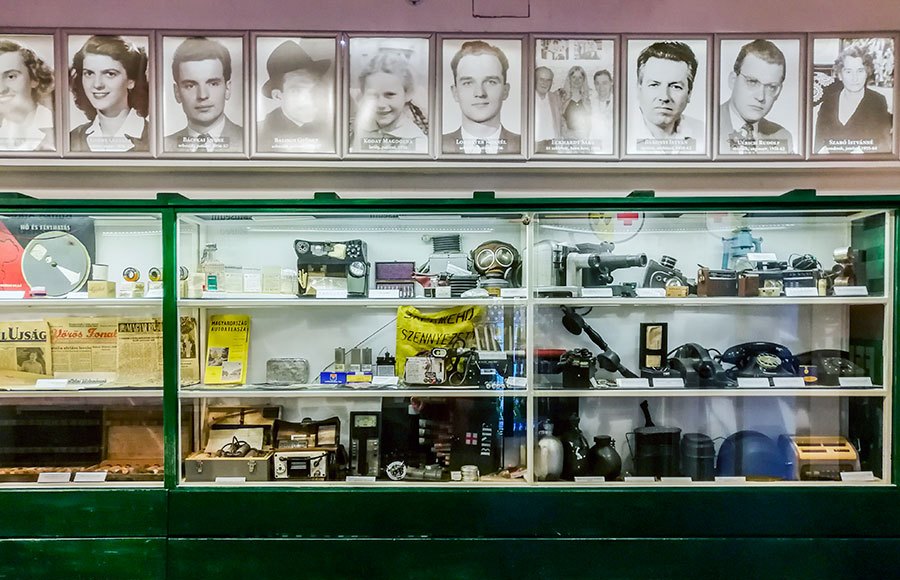
All sorts of items, from gas masks to mess tins and telephones:
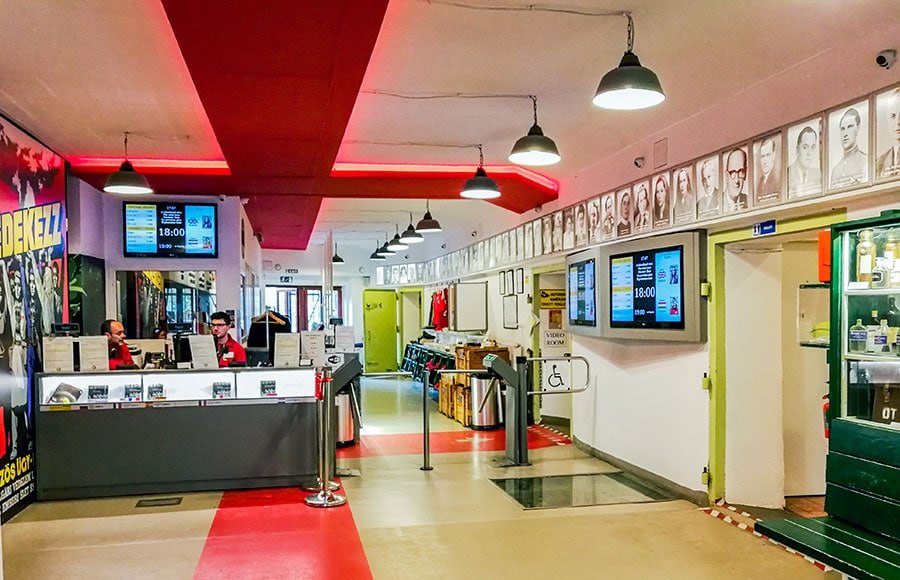
The ticket desks; the screen shows the start time of the next tour in large digits:
After buying tickets, we head inside. Remember that photography is strictly forbidden? Well, all the remaining photos were taken “on the sly”, so I apologise for the quality.
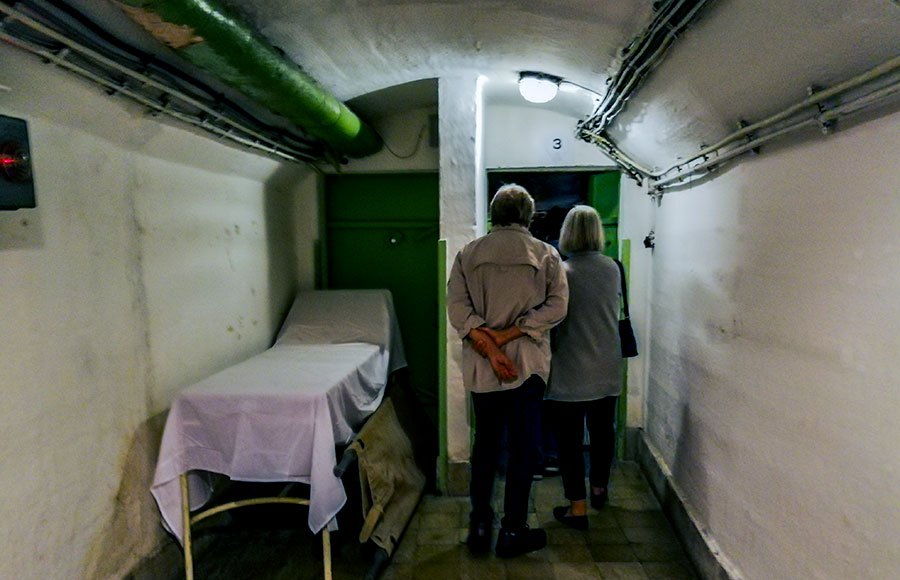
We go inside with the guide; the walls really do remind you of some kind of prison:
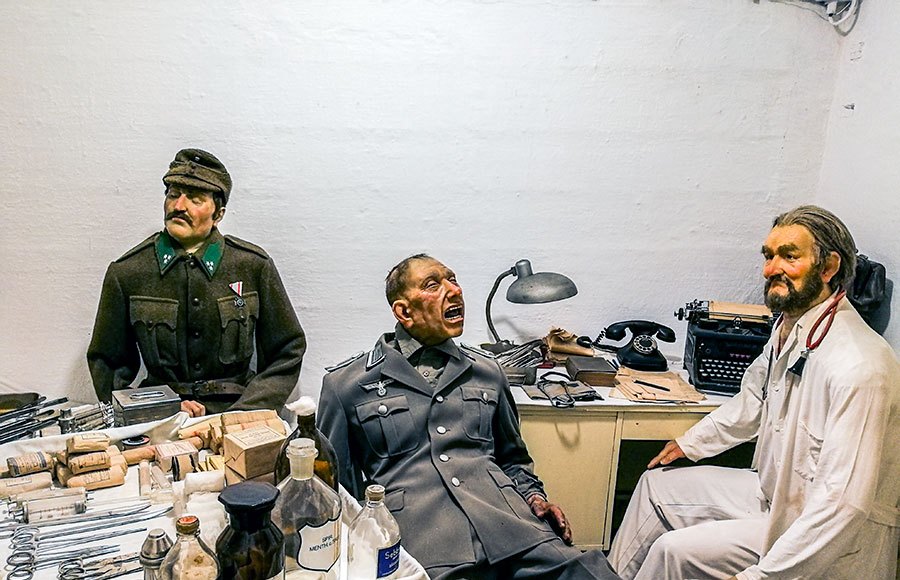
And in the very first room we’re greeted by a scene from the hospital’s everyday life in wartime. All the equipment is genuine, from those times.
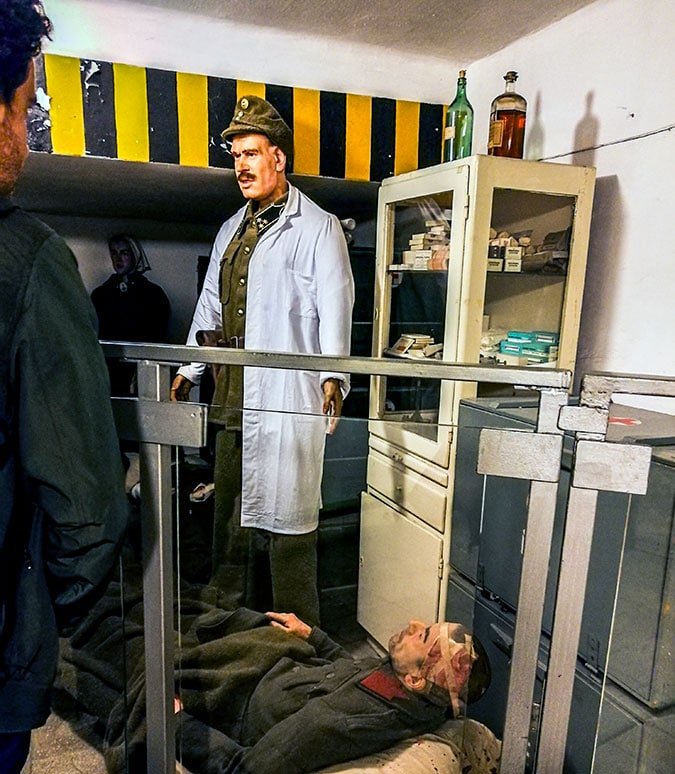
The senior corporal — infantry, judging by the colour of his collar tabs — is apparently helping the doctor admit the wounded. Meanwhile, a German officer has been brought in to see the doctor:
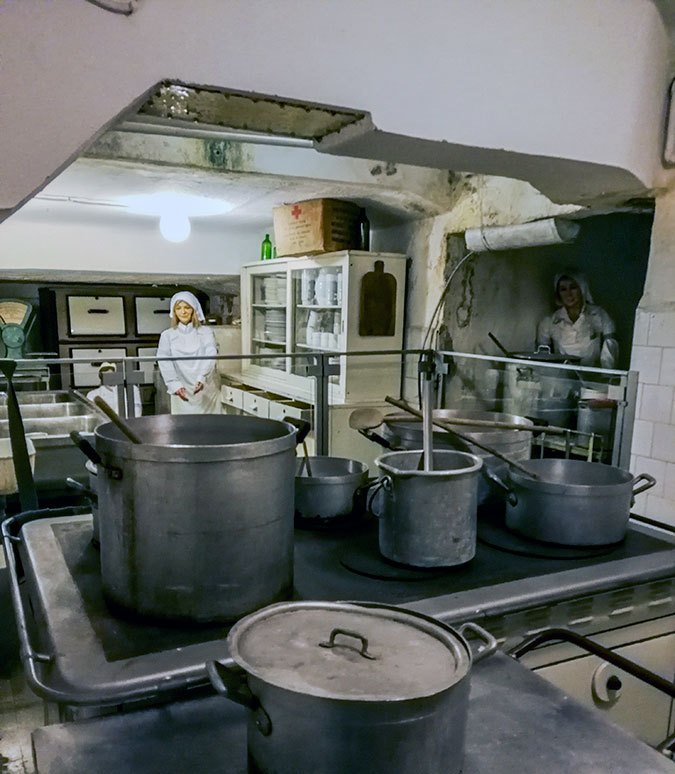
The hospital kitchen:
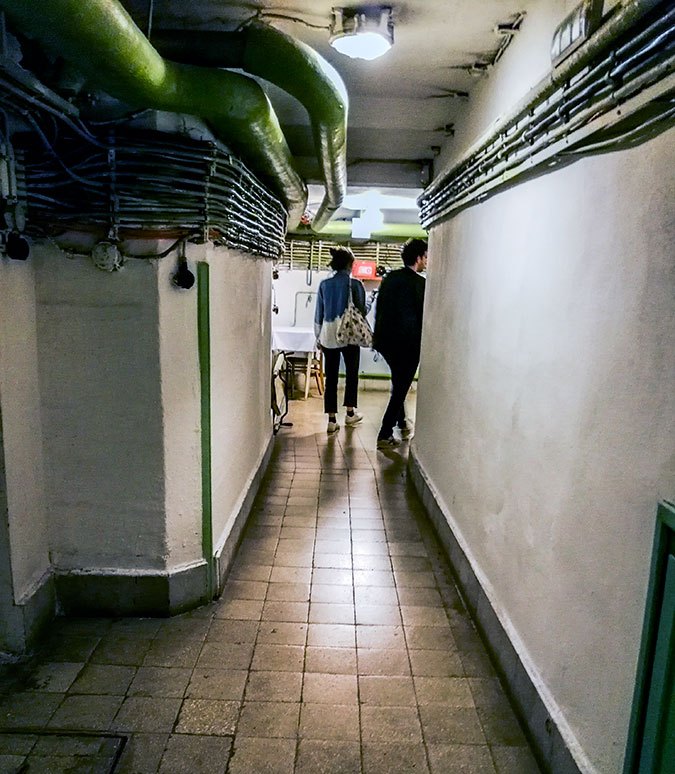
Sinister corridors and ventilation systems:
A captain of the medical service tending to a wounded man:
This is a small treatment room; note how thoroughly every detail is worked out — you feel completely immersed in those times:
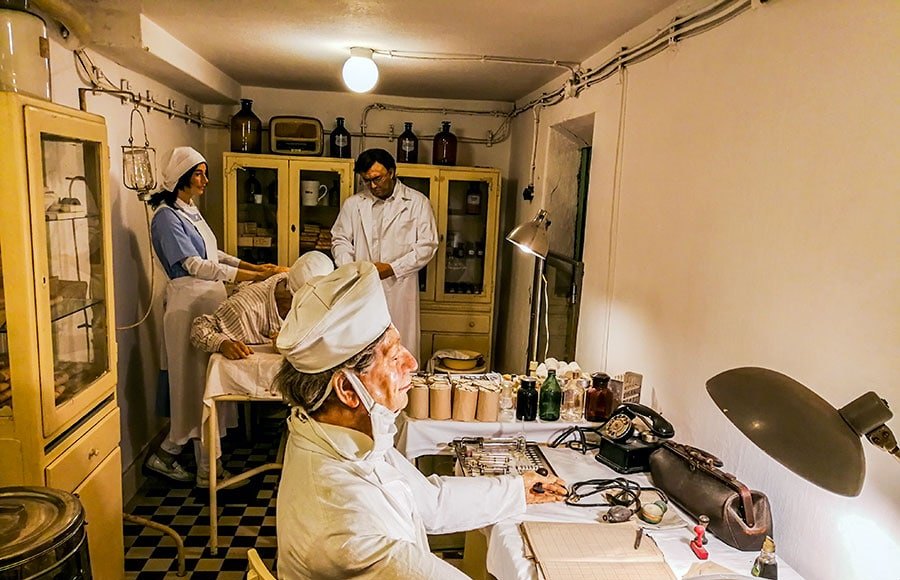
The operating theatre. The hospital was considered equipped to the very latest standard — it had an X-ray machine and good lighting:
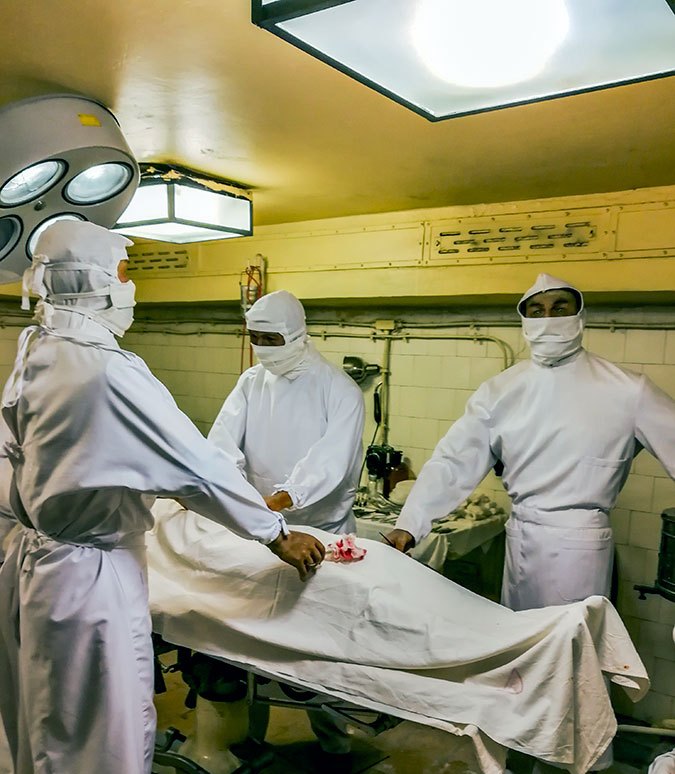
After the hospital corridors we come to the actual nuclear bunker. The lighting here is much worse, but the exhibition is all the more interesting. Evacuation plans for the population hang on the walls. According to the museum, during the Cold War doctors and nurses came here every year for civil-defence exercises, and the two Ganz diesel engines with their generator are still in working order.
The rooms used to be strictly secret; photography is now forbidden. The second part of the museum holds genuine stocks of medicines, gas masks and diagrams showing how to use them; several halls are devoted to nuclear weapons, and there are exhibits from Hiroshima (little pieces of melted children’s toys, crockery and so on).
One hall recreates the fighting that took place here in 1945 — there are even models of the dead. Photos on the walls show how Budapest looked at that very moment: destroyed bridges, buildings…
All of this gives you the feeling of standing at the scene of these catastrophes, sensing the pain, the grief, the fear, the horror… I’d recommend it to history lovers and thrill-seekers. The impressionable had better give it a miss; children under 6 are not admitted at all, and the museum does not recommend it for children under 12.