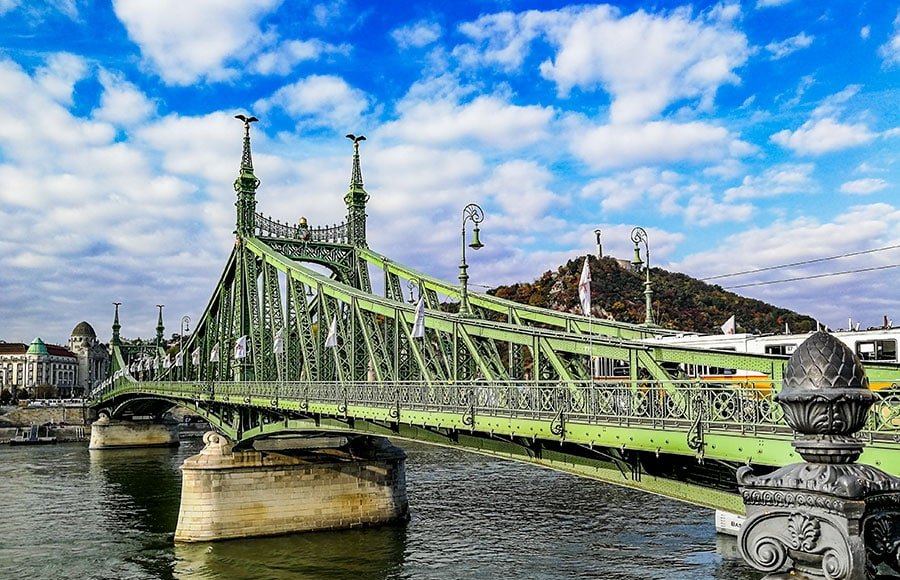
Liberty Bridge in Budapest is arguably the most distinctive of all the city’s bridges. It is painted green, which sets it apart from the rest. Below I will explain why it changed colour, when it was built, and which original adornment of the bridge we will never see again. Let’s begin!
1. A brief history
In 1893 it was decided to build an additional bridge near Customs Square (Fővám tér). A bathhouse with medicinal mud baths was even demolished to make way for the construction — it stood on the site of today’s Gellért Square.
Construction began in 1894 and was completed in 1896, when Budapest was lavishly celebrating the millennium of the Hungarians taking possession of their homeland. The Emperor of Austria-Hungary himself attended the festivities, and it was he who hammered the last, symbolic rivet into the base of the bridge. The rivet bore the emperor’s initials, but sadly it did not survive to the present day — it was stolen by an unknown thief back in the 1950s.
During the Second World War this bridge, like the others, was blown up by the retreating Nazis. It was rebuilt fairly quickly, however, reopening in August 1946 as the very first of the city’s bridges to be restored — and it was then that it received its current name.
There was, though, one difference from the original: it was painted grey rather than green, as the right colour was not available and there was no money to buy that much paint. Only in 2007–2009 did a reconstruction give the bridge back its original appearance and green colour, while the road surface and tram tracks were also renovated.
Despite its considerable weight, the bridge looks remarkably light when seen from a distance and is a worthy ornament of the city.
2. Practical information
2.1. Where it is
The bridge stands right at the foot of Gellért Hill. If you look north from Buda Hill on the map, three bridges come one after another: first the Széchenyi Bridge, then the Elisabeth Bridge, and finally Liberty Bridge.
The address of the bridge is Budapest, Fővám tér 1093, 1118 Hungary.
Location on the map:
2.2. How to get there
You can walk here from the Gellért Baths or from Budapest’s Central Market — the bridge is right next to both, so getting here will certainly not be a problem.
You can also use public transport (a single BKK ticket is valid on both the metro and trams; as of October 2026 it costs 500 forints):
- By metro, take line M4. The stops you need are Szent Gellért tér and Fővám tér, which are on opposite banks of the river.
- By tram: line 2 runs along the embankment — get off at the Fővám tér M stop. Trams 47 and 49 run directly across the bridge, from Fővám tér to the Szent Gellért tér – Műegyetem stop on the Buda side.
You can also get here by taxi — use a ride-hailing app (if you plan to get around Budapest by taxi, install the Bolt app straight away). That way you will know the cost of the ride in advance.
Another option is a hop-on hop-off bus. This format lets you ride around the whole city and get off at any stop that interests you, and every passenger has an audio guide in a language they understand. Operators offering these tours include Big Bus and City Sightseeing; their routes and prices differ, so check the current details when booking.
An evening cruise on the Danube is another lovely way to see the bridge: you can take in all of Budapest’s bridges in one trip, beautifully illuminated, and the boat’s route also passes under Liberty Bridge. A particularly good option if you are in Budapest with your other half.
2.3. When to visit
You can walk across the bridge at any time. If you come over the Christmas and New Year holidays, bear in mind how transport runs: on 24 December daytime BKK services finish at around 16:00, on 25–26 December and 1 January a holiday schedule applies, and the operator publishes the detailed timetable as a separate news item in December (in 2025, on 17 December) — check bkk.hu a week before your trip.
3. The bridge in photos
The bridge is adorned with so-called turuls — “heralds of the gods”. You can also see a stylised crown of St Stephen, the first king of Hungary:
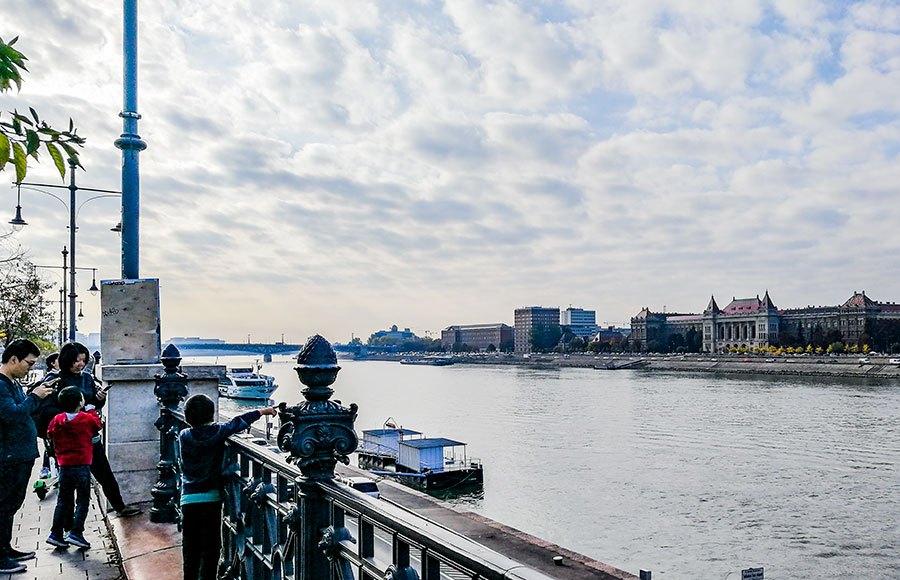
Below you can see the moorings for pleasure boats:
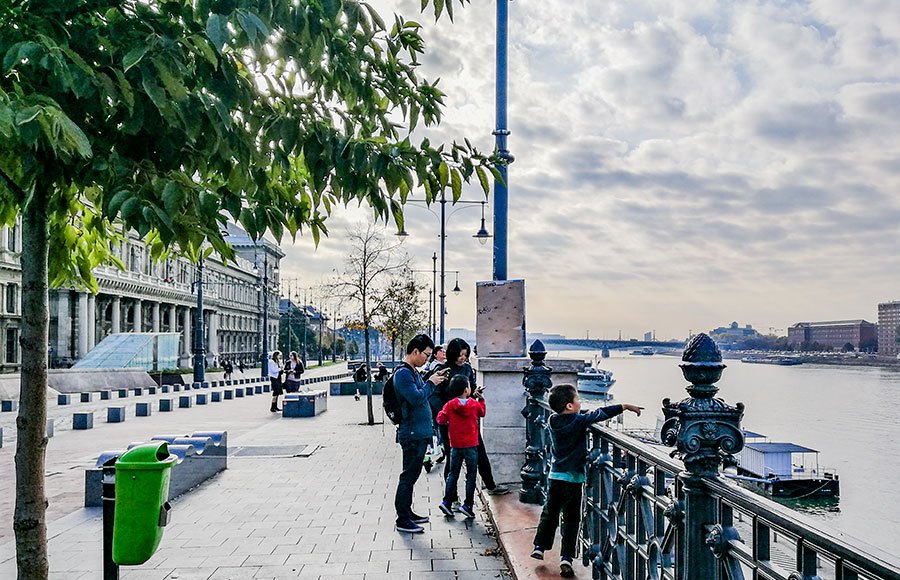
There are always plenty of tourists on the Danube embankment photographing Budapest’s bridges:
4. Conclusions
A very interesting bridge with a difficult history — like all of Budapest’s bridges. Its unusual colour adds to its originality, as does the fact that it was restored to its original appearance. It is good that the tram tracks are still here: you can close your eyes for a moment, hear the rattle of a tram and imagine yourself at the beginning of the 20th century, when this bridge had just been built.
And what were your impressions? Which Budapest bridge did you like the most? Do you enjoy strolling across bridges in the evening, or do you prefer to see them from a cruise boat? I look forward to your comments!
That is all for today — I hope you found it interesting. See you next time!