Today I’ll look at how the MilanoCard tourist card works in 2026, what it costs and who genuinely saves money with it — and who doesn’t. The card includes travel on city transport, a taxi credit and discounts at several museums. Let’s do all the sums at current prices — with real arithmetic, not by eye.
Updated 9 September 2026. This article was written from a personal trip in 2019 and has been fully recalculated: the card’s tariffs, transport fares, museum prices and the list of bonuses were all checked again against the official websites of MilanoCard, the transport operator ATM, Milan city council and the museums themselves. All figures below are as at 9 September 2026; on 17 October 2026 we re-checked them against the same sources (the MilanoCard website, ATM fares, museum price lists) — nothing had changed.
Tourist cards are very popular with travellers. The FirenzeCard, for example, was a great help to me, though it works on a completely different principle. For those heading to Rome, there is the Roma Pass. Each card offers different possibilities, but all of them give worthwhile discounts.
1. What is MilanoCard
I really like the idea of tourist cards. They are time-limited (usually three days at most), but they help you build a solid plan for visiting the museums that interest you.
The tourist card in Milan runs from 1 to 7 days. The easiest way to get around the city is by metro and tram, so being able to buy a card and stop thinking about finding and buying tickets is worth a great deal. And if all you need is transport, a separate tourist card is not necessary at all: as at 17 October 2026 you pay in Milan’s metro and surface transport with an ordinary bank card at the metro turnstile or the validator on board — a journey costs €2.20, and from the fourth journey in a day the system itself stops charging at €7.60 (the payment rules are covered in detail in section 5).
This is not the FirenzeCard, which lets you visit almost all of the city’s museums free. Here you get discounts and bonuses. Pay attention to the terms of every bonus offer: in some of them the deal applies only to the first 20 tourists, or even the first 2 people.
Let me be clear about the scale straight away, because the count here is in single digits, not hundreds. Today’s MilanoCard museums page lists eleven entries: Milan’s civic museums, the Leonardo Museum (Leonardo3), the San Sepolcro crypt, Armani/Silos, the Duomo rooftop, Gallerie d’Italia, the Pinacoteca Ambrosiana with the Codex Atlanticus, the Bagatti Valsecchi Museum, the STEP FuturAbility District, the Branca Tower and the Museum of Senses. That is the entire circle of partners.
The up-to-date list is always on the official website — the line-up of partners changes, and it is worth checking immediately before buying. But bear one thing in mind: the card’s own site shows outdated prices in places. It still lists the Branca Tower at €6, for example, even though the tower’s operator has long sold the ticket for €9. An attraction’s price is more reliably checked on the museum’s own website.
And let me correct a common misconception at once: the Milan card works only in Milan. Its operator issues similar cards for another fifteen or so cities — Rome, Venice, Florence, Naples, Barcelona, Vienna and others — all of them on the shared ConetPass platform. But these are separate cards, bought separately: a MilanoCard gets you neither travel nor discounts in Rome or Venice.
2. Useful information
2.1. Card options and prices
There are now six tariffs, not three, and they are counted in days, not hours. Prices from the card’s official website as at 9 September 2026 (tickets for individual museums and city tours are easy to browse on Tiqets, but the MilanoCard itself is no longer sold there — more on that below):
- 1 day — €15 (previously €8);
- 2 days — €25 (previously €14);
- 3 days — €30 (previously €19);
- 4 days — €36;
- 5 days — €41;
- 7 days — €55.
In other words, over seven years the card has nearly doubled in price. And note one small detail that costs real money: “3 days” does not mean 72 hours. The one-day card is valid for exactly 24 hours from first validation and the two-day card for 48, but the three-day card expires at midnight on the third day, whenever you activated it. Activate it at 18:00 and a third of the tariff goes to waste.
There are combo fares that bundle the card with a visit to the Duomo complex. You no longer need to go anywhere to buy them: there is no office on Via Silvio Pellico on the card’s website, and the combos are sold online:
- 2 days + Duomo rooftop access — €40;
- 3 days + Duomo rooftop access — €43;
- 3 days + six of the city’s civic museums — €35;
- 3 days + the Leonardo Museum (Leonardo3) — €38;
- 3 days + a day ticket for the Bus Open Tour — €40.99.
Only keep in mind: the card gives no discount on the Duomo, and cannot. MilanoCard states plainly in its terms that it is not an official reseller of the Veneranda Fabbrica del Duomo and buys cathedral tickets at market price, like any intermediary. With a combo you are paying for the convenience of a single order, not for a discount. One more detail: a Duomo ticket bought through the card must be downloaded only on the day of the visit.
The Duomo ticket includes:
- a visit to the Cathedral;
- the Duomo Museum (Royal Palace);
- rooftop access by lift;
- the archaeological area;
- a visit to the Church of San Gottardo.
The combo with a visit to the Church of Santa Maria delle Grazie (home of Leonardo da Vinci’s Last Supper) no longer exists: that site is not in the card’s current circle of partners at all. A ticket to the refectory costs €15 (ages 18–25 €2, under 18 free) and must be bought separately. The rules there are strict, and today they matter more than the price: booking is compulsory for everyone without exception, including infants and free-admission categories; the ticket is named; no more than five tickets per person per year are sold; the date cannot be changed and the ticket cannot be returned; you get 15 minutes with the fresco, and you must arrive half an hour before your slot or your entry is forfeited.
Is it worth it? Let’s do the sums, because at today’s prices the answer is surprising. Duomo rooftop access by lift costs €18, on foot via the stairs €16. Two days of travel paid by bank card costs at most €15.20, and a three-day ATM ticket is €15.50. Adding it up: the same services bought separately come to about €33 against €40 for the two-day combo, and €33.50 against €43 for the three-day combo. In other words, for the convenience of a single order you pay an extra €7–10.
2.2. Where and how to buy the card
Where and how can you buy the MilanoCard?
MilanoCard has disappeared from Tiqets. The card’s product page there has been taken down and redirects to the city’s general showcase, and it no longer appears among Milan’s city cards and passes — other cards are sold instead. So Tiqets remains handy for tickets to specific museums and tours, but buy the MilanoCard itself on the official website. There is nowhere else to get it.
Another option is to order through the app or on the official website (the site has both Italian and English versions):
- On the site you fill in the form and pay. Bank cards only — American Express is not accepted.
- You give your arrival date and time, and also choose the point where you will collect the transport ticket: the list of collection points is shown at exactly this step, and there is no longer a separate page for it on the site.
- The card arrives by email and in the app — today it is advertised as “100% digital”; there is no plastic any more. You can activate it within 12 months of purchase.
Separately, about children, because the internet is full of confusion about ages and about “entering on a parent’s card”. No parent’s card is needed. Under the official fare rules of the operator ATM, children and teenagers under 14 travel free on all of Milan’s city transport in their own right — on inspection they need only a document confirming their age. In the city’s civic museums, under-18s also enter free. So there is no need to buy a card for a child, and the seller itself admits as much: its website says in so many words, “MilanoCard isn’t worth it for children”.
This is what the offer looks like on the official website:
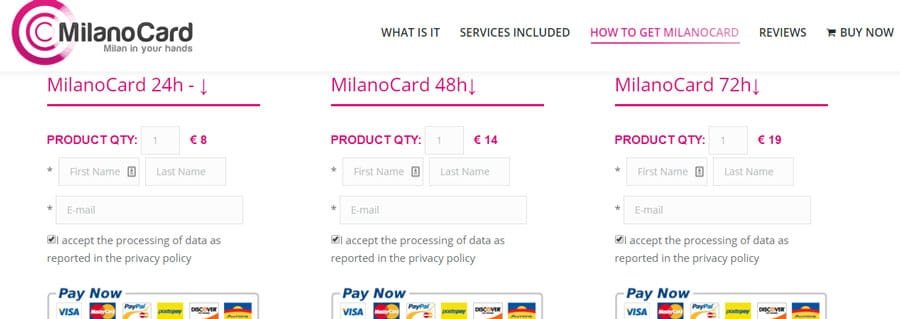
When buying, you choose straight away the day and hour from which the card will be valid, and confirm this when activating it in the app. The advice here is important: activate the card in the morning so you don’t lose the night. And one more thing to know before paying: there are no refunds. Legally this is not a tourist service but a “multi-purpose voucher”; you have no right of withdrawal, and the terms state that cancelling or not using the card means forfeiting 100% of the price. If you don’t travel, the money is lost.
2.3. Where to collect the transport ticket
The card itself is digital, but the transport ticket that comes with it still has to be collected in person — this is arguably MilanoCard’s biggest trap, and in seven years it has not gone away. You choose the collection point when confirming the order, and its opening hours are shown there too; today there is no general list of points on the card’s website. The ticket you receive must be validated for every journey — showing your phone to an inspector is not enough. Below are the points where I collected my card in 2019: some of them still operate, but before travelling, rely on what you are shown when placing the order.
- at Malpensa Airport, Terminal T1, between Gates 7 and 8. Open every day from 08:00 to 21:00
- at Malpensa Airport, Terminal T2. Open every day from 08:00 to 22:00.
- at Orio al Serio Airport (Bergamo). In the arrivals area — you will see a large advertising poster. Open every day from 06:00 to 13:00.
- at the tourist centre on Piazza del Duomo (at the end of the Galleria Vittorio Emanuele II)
- at the tourist centre at Milan Central Station (this is where I collected mine).
2.4. The tourist office at Milan Central Station
It is at Piazza Duca D’Aosta, 1. By metro, ride to the Centrale stop.
By surface transport, get off at the Piazza Luigi di Savoia stop. I deliberately do not list route numbers: in central Milan they are regularly reshuffled because of roadworks, and lists from old guidebooks quickly stop being accurate. It is simpler to open the ATM app or giromilano.atm.it and see what is running today.
You need the Milano Visitor Centre — a small kiosk. It is inside the Milano Centrale building, on the ground floor at the end of the western corridor.
The tourist centre at Milano Centrale:
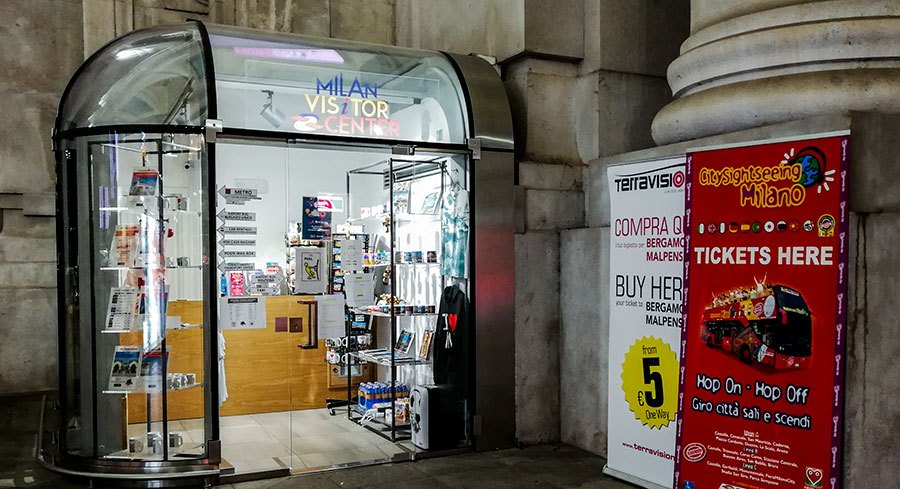
The office is open every day:
- 09:00 to 14:00
- 15:00 to 19:00
2.5. Official website
The official website of Milan’s tourist card: www.milanocard.it
3. What the card includes
3.1. Public transport
Travel on city transport is included in the price of the card — the main thing is to keep an eye on its validity period. This covers zones Mi1–Mi3, that is, Milan and its immediate suburbs.
Included:
- the metro;
- buses, including the X73 to Linate Airport;
- trams;
- urban trains within the zone.
What the card does not include, as people usually discover on the spot: regional trains beyond the city zone. A separate story is Rho Fieramilano, the terminus of the red line where exhibition-goers head. The card’s own old FAQ says it is not covered, but the operator’s fare table contradicts this: on the ATM website (checked 17 October 2026) Rho Fieramilano station is treated as zone Mi3, an ordinary Mi1–Mi3 ticket from Milan is valid there, and no single or day tickets cheaper than that fare are sold in Milan now. While the sources disagree, the safer option for a trip to Rho is to pay separately — with a €2.20 single or a bank card at the turnstile.
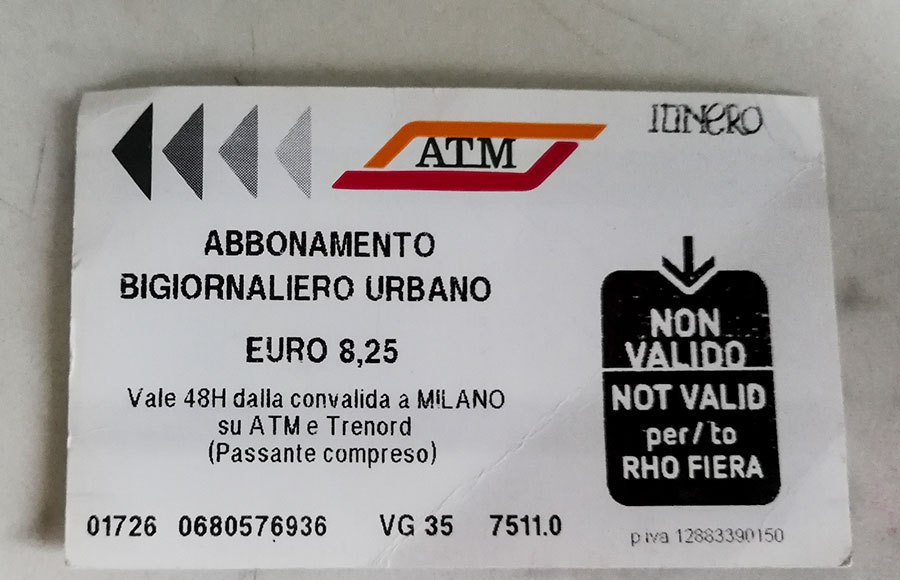
At the tourist centre I was given 2 transport tickets (one for 24 hours, the other for 48):
The cardholder gets a discount on bus travel to the airports of:
- Malpensa;
- Linate;
- Bergamo Orio.
Worth it if you plan to use public transport intensively.
3.2. Museums
Here are the discounts for all the most popular sights:
|
Museum |
Current ticket price |
What MilanoCard gives |
|
Pinacoteca di Brera |
€20 (“La Grande Brera”) |
no discount — Brera has left the circle of partners |
|
Leonardo da Vinci Museum (Leonardo3) |
€16 |
€11 — a saving of €5 (31%) |
|
Branca Tower |
€9 |
17% off — about €7.50 |
|
Pinacoteca Ambrosiana |
€20 (single ticket with the San Sepolcro crypt from 1 October 2026) |
€15 — a saving of €5. The museum is closed on Wednesdays |
|
Poldi Pezzoli Museum |
€15 |
no discount. Closed on Tuesdays |
|
La Scala Museum |
€12 |
no discount; YesMilano City Pass holders enter free |
|
The Last Supper (Cenacolo Vinciano) |
€15; ages 18–25 €2; under-18s free |
no discount; booking compulsory for everyone |
|
Duomo rooftop |
€18 by lift, €16 on foot |
no discount: the card resells the ticket at market price |
|
The city’s civic museums |
Sforza Castle, Museo del Novecento and the Natural History Museum €10 each; the Aquarium and GAM €8 each; the Archaeological Museum €5 |
not included in the basic tariff — only in the €35 combo |
Notice what is no longer in this table. Brera, Poldi Pezzoli, the La Scala Museum, the Last Supper, San Siro, Ca’ Granda, the Sant’Ambrogio museum, “Leonardo’s garden” and the Roman Forum once appeared on MilanoCard lists — none of them is in today’s circle of partners. Exactly three working discounts remain in the basic card: Leonardo3, the Pinacoteca Ambrosiana and the Branca Tower. Together they give about €11.50 — remember this figure; we will need it in section five when we calculate whether the card pays off.
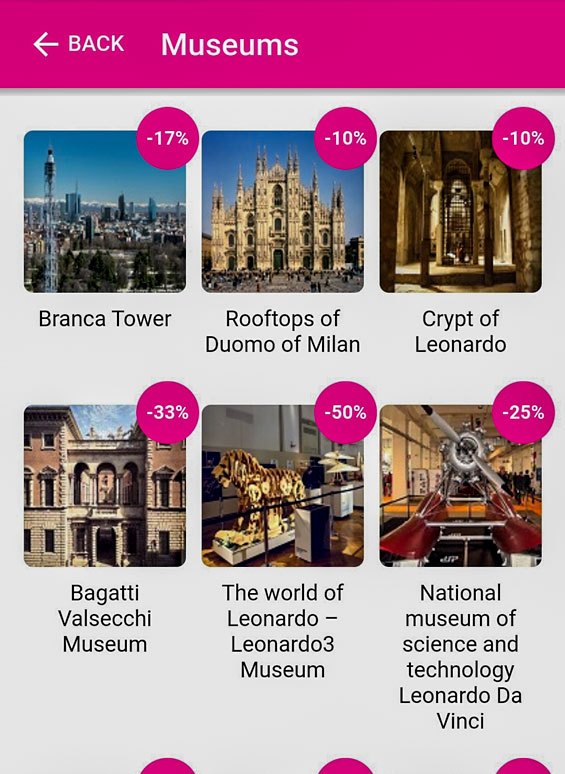
See, the app contains all the information about bonuses and discounts:
There are discounts not only on sights; there are other bonuses too:
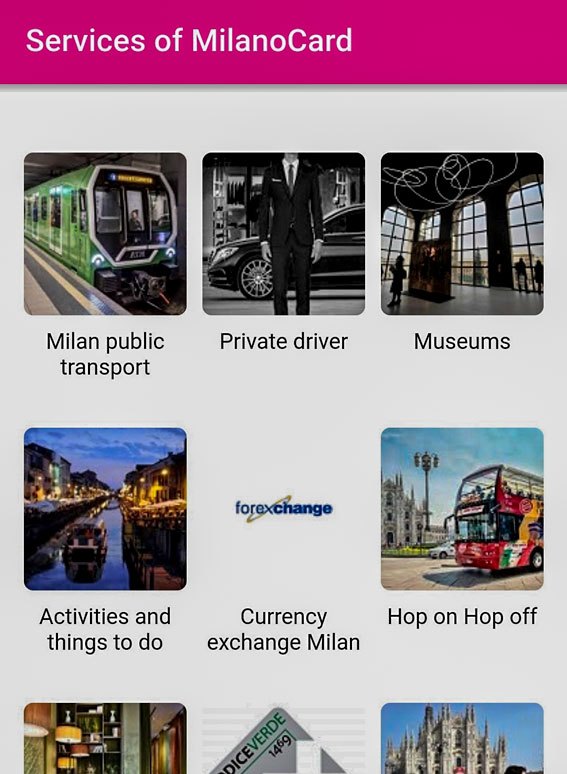
There are discounts on hotels, tours and shopping:
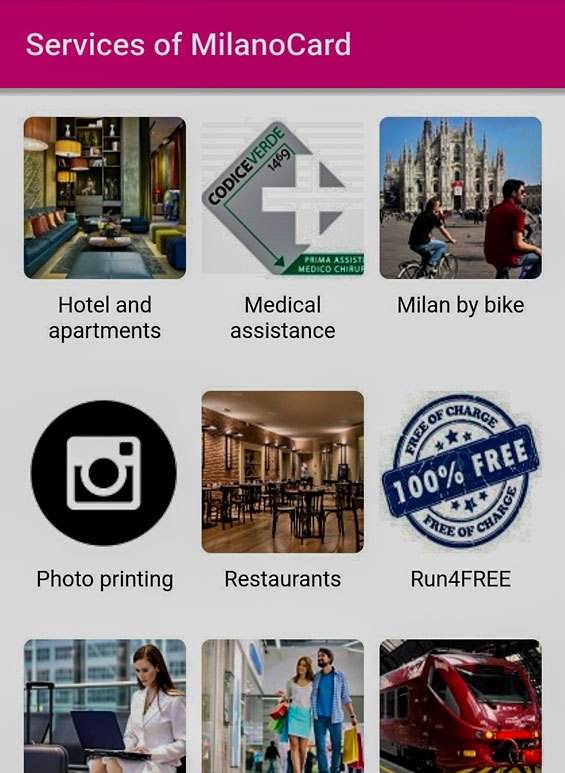
3.3. Free bonuses
Besides transport, the card includes:
- a €5 credit for your first taxi ride — no longer with Uber, as before, but with the WeTaxi service. The promo code must be entered when registering in the app, in the “Codice di Affiliazione” field: skip this step and the credit will not be applied, and it cannot be obtained afterwards;
- Uber Lime bike-share;
- a free audio guide to the city and a guide to Milan’s bars and restaurants;
- discounts on airport shuttles to Malpensa and Orio al Serio, and on Flixbus intercity coaches;
- a left-luggage service, a free drink at the GUD Milano bar, discounts at a pharmacy.
And, to be honest about what the card no longer includes, even though plenty of write-ups still list it. Free ascent of the Branca Tower is gone — only a 17% discount remains. The free “first twenty” access to the rooftop of the Galleria Vittorio Emanuele is gone too: the Highline viewing terrace closed in 2019 and only reopened in February 2026; today admission costs €15, and the word Highline does not appear on the MilanoCard site at all. The panettone cake at Malpensa, the Codice Verde medical line and the coaches to the Vicolungo and Franciacorta outlets have also vanished from the card’s pages.
3.4. Other discounts
The card once came with a scattering of small restaurant and shop discounts. Today MilanoCard’s services pages list none of them: neither the €35 lunch at Ca’ Granda, nor the €15.90 pizza on the Highline roof, nor the free pasta at Eataly, nor 20% off dinner at Blue Note. The restaurant section remains, but it is simply a selection of partner establishments: each has its own changing terms, so they should not be factored into any value calculation.
The Forenxchange currency-exchange discount and 10% off bike hire at Aws Bici have also disappeared from the card’s pages. Instead of hire, the basic tariff now includes Uber Lime bike-share — use that instead.
The 10% discount on the hop-on hop-off bus has become a separate combo fare: a three-day card plus a day ticket for the Bus Open Tour costs €40.99. Whether that is good value depends on the price of a day bus ticket on the day you buy — compare before paying.
The 15% discount on Milan–Rome tickets no longer exists, but Flixbus has appeared among the partners: the card gives a discount on its intercity coaches.
I advise checking the site immediately before departure — new long- and short-term discount offers and various extras appear there often.
4. Rules for using the card
- There is no longer any choice between plastic and the app: the card is billed as “100% digital” and arrives by email and on your smartphone.
- In the app it is easy to track how much time is left before it expires.
- You will still have to go to a collection point for the transport ticket. In seven years this rule has not changed by a single word, and it is the one that most often wrecks plans: a digital card on your phone does not replace the paper ticket.
- The transport ticket must be validated for every journey.
- The card is named and non-transferable: you cannot hand it to your companion on the second day.
And one more thing worth knowing in advance: the seller accepts no responsibility for partners — the terms say it acts merely as a “collector and promoter” of their offers. If a museum refuses to honour a discount, there will be no one to complain to.
5. Is the card worth it?
Is it worth buying the tourist card? I used to answer “yes” almost without thinking. Having recalculated everything at current prices, I now answer differently: the basic MilanoCard in 2026 is a losing proposition for the average tourist. Let’s count together — the numbers are simple.
Step one: what does the same thing cost without the card? Milan transport has gone up in price, but nothing like as much as the card. A 90-minute single costs €2.20, a day ticket €7.60 and a three-day ticket €15.50. That €15.50 is the honest transport-only alternative to the three-day card.
Step two: what is left to recoup? The three-day card costs €30. Subtract transport: 30 − 15.50 = €14.50. That is exactly how much in discounts and bonuses you need to use just to break even.
Step three: how much does the card actually give in discounts? Three working discounts remain in the basic tariff:
- Leonardo Museum (Leonardo3): €11 instead of €16 — a saving of €5;
- Pinacoteca Ambrosiana: €15 instead of €20 — a saving of €5;
- Branca Tower: 17% off a €9 ticket — a saving of about €1.50.
Add them up: 5 + 5 + 1.50 = €11.50. And that is assuming you get round all three sites in three days. Against the €14.50 needed, that is €3 short. The card has not paid for itself.
There is exactly one way to push it into profit: genuinely use the €5 WeTaxi credit. Then 11.50 + 5 = €16.50 against €14.50, and you are €2 up. Two euros over three days is not the kind of saving worth planning anything around.
And now the most common scenario. Someone arrives for a weekend and goes to the Duomo, Sforza Castle and the Museo del Novecento. With a MilanoCard they do not get a single discount. The Duomo has no discount at all — the card itself states that it is not a reseller of the Veneranda Fabbrica and simply resells tickets at market price. The civic museums are not in the basic tariff; they come only in the €35 combo. Bottom line: they paid €30 instead of €15.50 and lost €14.50.
The one-day card is the same picture in miniature: €15 against a €7.60 day ticket — a €7.40 overpayment that must be clawed back with a single visit to Leonardo3 or the Ambrosiana plus a taxi ride.
And the decisive point, which removes the strongest old argument for the card. For years the main argument in its favour ran like this: it saves you from wrestling with ticket machines demanding coins and from kiosks where nobody speaks English. That problem no longer exists: in Milan’s metro and surface transport you pay with an ordinary bank card directly at the turnstile — or with a phone or a watch. No registration is needed and there is no commission. Better still, an automatic daily cap applies: from the fourth journey in a day the system itself switches you to the €7.60 day fare and charges nothing more that day. So even without any ticket at all, a day of intensive travel costs at most €7.60.
Just remember two things, or paying by card will cost more than a ticket. First: in the metro you must touch your card both on entry and on exit. Forget on exit and an extra €1.30 is charged; touch only on exit and not on entry, and €5 is taken as two separate charges on different days. On trams and buses you need to touch out only on lines 121, 130, 140, 165, 166 and 327. Second: one card — one passenger. Two people cannot travel on one card, and do not hold a wallet with several cards up to the reader — it will charge the wrong one. The money does not leave immediately: the charge arrives the next day or later, and appears on your statement as “Cless Ticket ATM Milano”.
And one more detail that can make any card worthless: on the first Sunday of each month Milan’s civic museums, the Pinacoteca di Brera and the Last Supper are free for everyone, and on the second Tuesday of the month the civic museums are free for everyone under 25. If your trip falls on such a day, there is no point buying a card for the museums.
A separate warning about closing days, or a one-day card may be wasted. On Mondays the Pinacoteca di Brera, the Last Supper and the Highline are closed; on Tuesdays the Poldi Pezzoli; on Wednesdays the Pinacoteca Ambrosiana. On the Ambrosiana in particular: the internet still circulates advice to “go on Wednesdays for the discount”, but on Wednesdays this museum does not open at all — “Mercoledì chiuso” says its opening-hours page.
Who the card still suits. Someone who genuinely travels around the city a lot, is going specifically to Leonardo3 and the Ambrosiana, is happy to fuss with a WeTaxi promo code and call a taxi — and who values one order instead of five separate purchases. For everyone else, the €15.50 three-day ATM ticket or simply your own bank card at the turnstile is cheaper.
6. The museum card
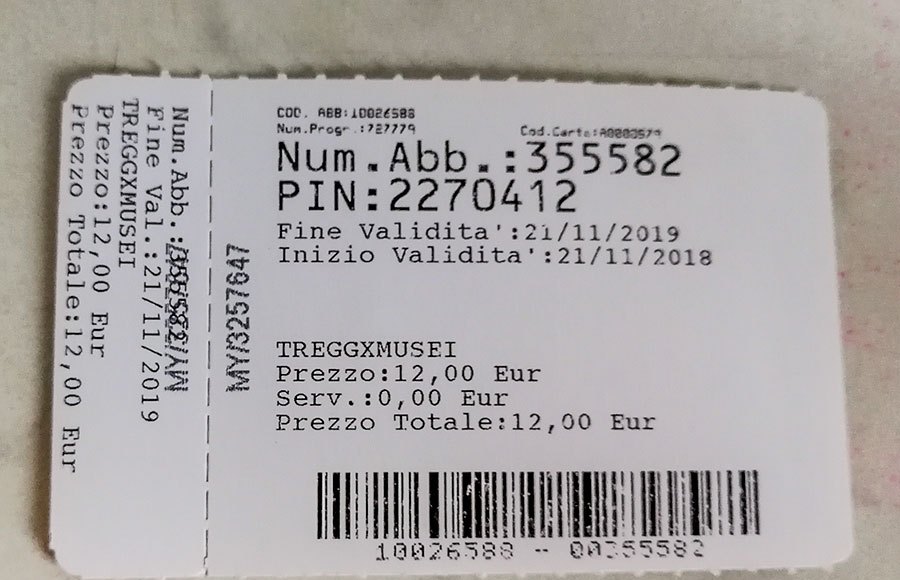
An unpleasant surprise was that many museums stopped accepting the MilanoCard (even though the app said they accepted it), and for several museums you have to buy a separate Milan museum card (though that still works out good value).
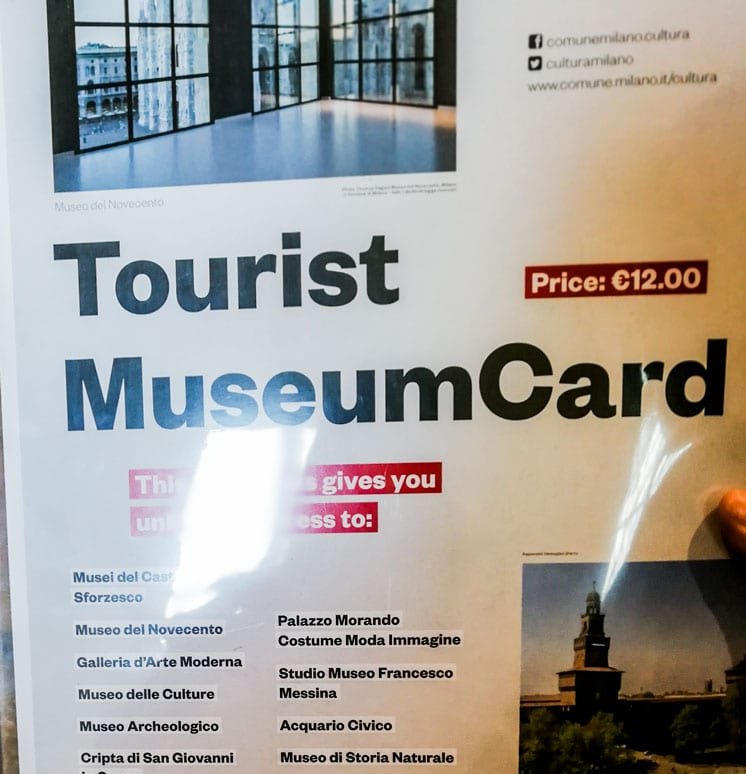
And this is what the museum card looks like:
And from the other side:
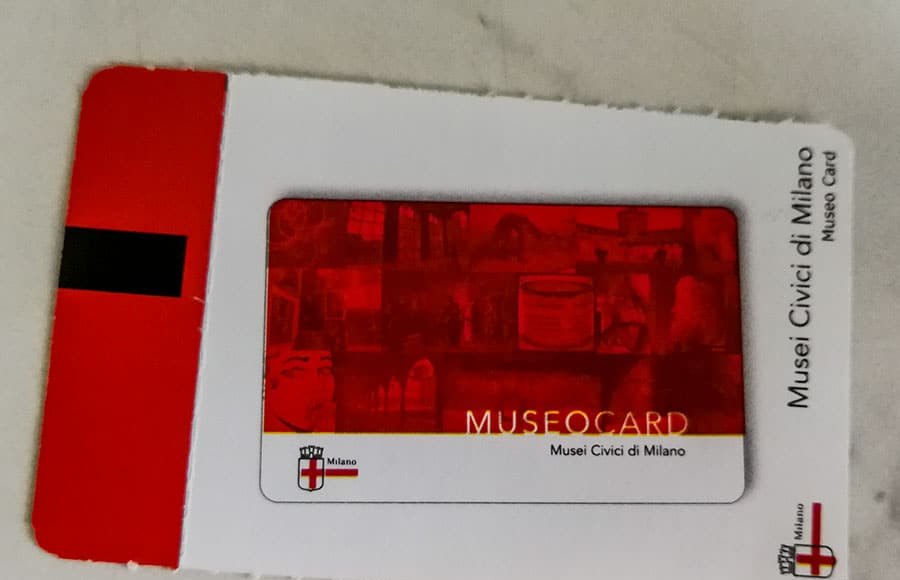
The Tourist Museum Card is alive but has gone up in price: today it costs €20 instead of the former twelve. It is valid for three consecutive days, counted from the first entry, and must be used within a year of purchase. The list of museums has changed too: Milan now has six paid civic museums, and the card gives one entry to each:
- Sforza Castle Museums — €10;
- Museo del Novecento — €10;
- Natural History Museum — €10;
- Civic Aquarium — €8;
- Gallery of Modern Art (GAM) — €8;
- Archaeological Museum — €5.
Prices rose on 10 May 2026, when the city council revised the civic museums’ tariffs. Concessions improved at the same time: a reduced ticket now costs half the full price rather than 60%, teachers enter free, and an “open ticket” appeared with entry on any day within a year. Children and teenagers under 18 always enter free.
There are also venues with free entry: the Boschi Di Stefano house-museum, Palazzo Moriggia with the Museum of the Risorgimento, the permanent collection at MUDEC and Palazzo Morando. But the “Renaissance Museum”, “Fashion Museum”, “Museum of Culture” and the crypt of San Giovanni in Conca are not in today’s official list at all, and the studio of the sculptor Francesco Messina is temporarily closed. So any older lists of this card’s museums can safely be forgotten.
You can buy the card at one of the museums listed:
And now the most interesting part, which for some reason almost nobody mentions. The city has a second museum card — the Milano Museo Card — and it costs €15, that is, less than the “tourist” one at €20. It gives exactly the same thing: one entry to each of the six paid civic museums. Only it is valid not for three days but a whole year from the date of purchase, and on top of that gives 20% off exhibitions at the Royal Palace, PAC and Fabbrica del Vapore.
The difference between the cards comes down to just two things. The Milano Museo Card is named: you must show a document at inspection, and it cannot be passed to someone else. The Tourist Museum Card is a bearer card and can be handed to a companion. That is all. If you are travelling as a pair and plan to visit museums separately, the tourist one is more convenient. In all other cases the €15 annual card is better value than the €20 tourist one, even if you are in Milan for only two days.
Both pay for themselves quickly. Visiting all six museums individually costs €51 (10 + 10 + 10 + 8 + 8 + 5), so the annual card saves €36. The €15 Milano Museo Card breaks even after just two €10 museums; the €20 Tourist Museum Card gives exactly zero on the same two and only starts saving from the third. The Archaeological Museum alone now costs the minimum five euros; all the rest are €8–10.
7. The main competitor: YesMilano City Pass
MilanoCard’s main competitor today is the YesMilano City Pass, the city’s official card, and on one important point it simply beats it. YesMilano is the only Milan card that gives genuine entry to the Duomo complex, including the terraces. MilanoCard gives no Duomo entry at all; it merely resells the ticket at market price.
There are three tariffs:
- Flash — €39.90: one day of transport, one Duomo activity of your choice, one further activity of your choice, free museums and discounts of up to 30%;
- Standard — €60: three days of transport, the Duomo with rooftop access on foot, all six civic museums and one premium activity of your choice;
- All Inclusive — €90: three days of transport, the Duomo with rooftop access by lift, the six civic museums, the Leonardo da Vinci Museum of Science and Technology, the La Scala Museum, Leonardo3, the Bagatti Valsecchi Museum, the Pinacoteca Ambrosiana with the San Sepolcro crypt, the Poldi Pezzoli Museum, Villa Necchi Campiglio, the ADI Design Museum, Galleria Campari, the Triennale, the panoramic walls of Sforza Castle, the Diocesan Museum, the Highline and the Museum of Senses.
Let’s calculate as honestly as we did for MilanoCard. Standard at €60: the same services bought separately — 15.50 (three days of transport) + 22 (Duomo with rooftop on foot) + 20 (Tourist Museum Card) = €57.50. The card costs €2.50 more but adds a premium activity, so it comes out roughly at zero. And if instead of the tourist museum card you take the annual one at €15, buying separately comes to €52.50 — and Standard loses by €7.50. There is no sense in the middle tariff.
All Inclusive at €90 is a different matter. Just eight items from its list bought separately cost: Duomo by lift 26 + transport 15.50 + civic museums 15 + La Scala 12 + Leonardo3 16 + Ambrosiana 20 + Poldi Pezzoli 15 + Highline 15 = €134.50. And that is without the other ten sites. The saving is more than forty euros — the only genuinely large benefit among Milan’s cards. But it is real on one condition: you must actually get round eight or more sites in three days. If your plan is more modest, All Inclusive turns into an expensive, handsome pass.
Indirect confirmation that YesMilano is the more serious card: the La Scala Museum admits its holders free, while MilanoCard does not appear in its list of concessions at all.
And one more card worth knowing about if you are coming to Lombardy for a long time or visit several times a year — the Abbonamento Musei Lombardia: an annual pass to 240 museums in the region for about €52 (€30 for ages 15–26, €20 for under-14s, €42 for over-65s). It gives free entry to both the Pinacoteca Ambrosiana and Leonardo3. A tourist on a two- or three-day visit will not recoup it, but a regular Milan visitor well may.
8. Conclusions
In 2019 I bought a 72-hour card for €19 and did not calculate the benefit then — for me it paid for itself on transport alone. Today the same tariff costs €30, and the three-day ATM pass €15.50, and the card no longer pays for itself on transport alone: to break even you need another €14.50 in discounts, while the maximum the card can give is €11.50.
MilanoCard’s main inconvenience remains the same: it is not an “all-inclusive” card but a set of scattered discounts you have to tot up yourself. An “all-inclusive” card now exists in Milan, but it is called YesMilano.
The transport ticket for the card can be collected right at the airport to save time, but collection points do not work around the clock — check your point’s hours when placing the order.
As for the free offers that still circulate in reviews, forget them entirely: the viewing terrace above the Galleria Vittorio Emanuele is free with the card neither for the first twenty visitors nor for anyone else — entry costs €15. Free ascent of the Branca Tower has also been withdrawn; only a 17% discount remains.
My current conclusion is short. The basic MilanoCard at €30 for three days is not worth buying: it does not pay for itself. If you need only transport, take the three-day ATM ticket for €15.50 or simply pay with your own bank card at the turnstile — from the fourth journey in a day the system itself stops charging at €7.60. If you need museums, take the annual Milano Museo Card for €15: it is cheaper than the €20 tourist one and gives the same thing. And if your plan is packed, with the Duomo and eight to ten sites in three days, the only card with real savings is the YesMilano City Pass All Inclusive.
Milan transport has gone up in price: a 90-minute single costs €2.20, a day ticket €7.60 and a three-day ticket €15.50. A pleasant detail few know: bicycles, scooters, Segways and monowheels are carried free on the ATM network, as are pets.
And if museums are what interest you, it will turn out exactly as it did for me: one MilanoCard will not be enough and you will have to buy a museum card as well. Only now you know which one, and why the annual one is cheaper than the tourist one.
Have any of our readers used the MilanoCard? Tell us about your experience. Do you think there is any point in buying it at all?