What can any exotic country — even the poorest — boast? Amazingly tasty tropical fruit, of course! Believe me, you cannot buy fruit like this back home at any price, because what reaches the shops tastes nothing like genuinely ripe Thai fruit.
Today I have decided to write a very “tasty” post. Meet the fruit of Thailand — photos with names, descriptions and approximate prices. Reading on an empty stomach is not recommended!
About the prices in this article. We collected them on our trips, so they are 2015–2018 prices. They have changed over the years — and not in the way you might think. The final sections of the article give current prices for 2026, a calendar of seasons by region and the rules on taking fruit home, including the myth of the “eleven fruits banned from export”.
1. Familiar fruit
1.1. Pineapple
The pineapple is one of the most popular fruits in the world, and even in much colder countries it is no longer exotic. But in Thailand these amusing-looking fruits have a completely different, incomparable taste!
What is pineapple good for? It thins the blood, breaks down fats, removes excess fluid from the body and lowers blood pressure. And a glass of pineapple juice instantly relieves nausea after a heavy meal or on a plane.
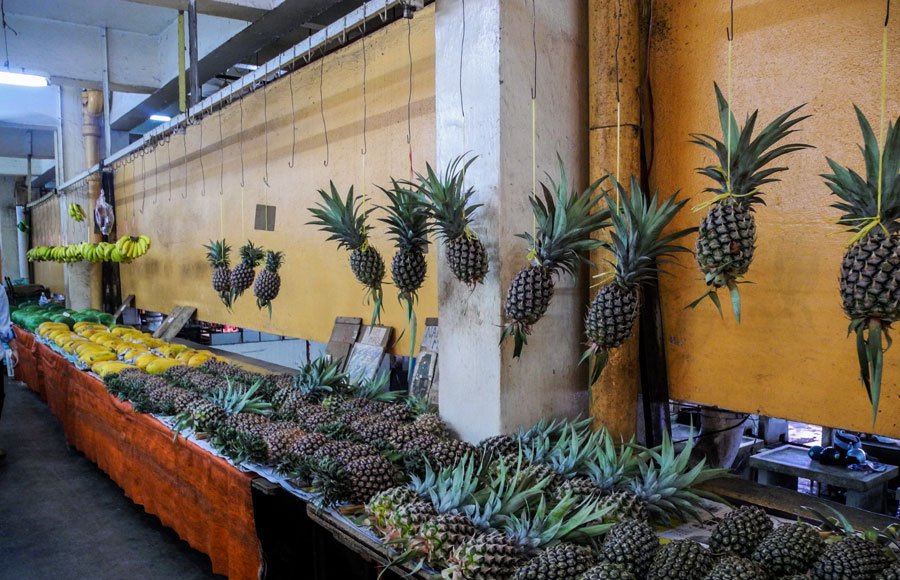
Thailand offers tourists several pineapple varieties. The most popular is the classic Tard Sri Thong, or Phuket Pineapple. The elongated fruits are easy to recognise by their skin — bright yellow and very prickly. And the super-sweet flesh has a density that reminds us of sauerkraut.
Pregnant women should not eat pineapple — it can trigger a miscarriage.
Pineapples grow in a very unusual way — in grass. And many other exotic fruits grow in ways just as surprising.
Price: 20–30 baht each.
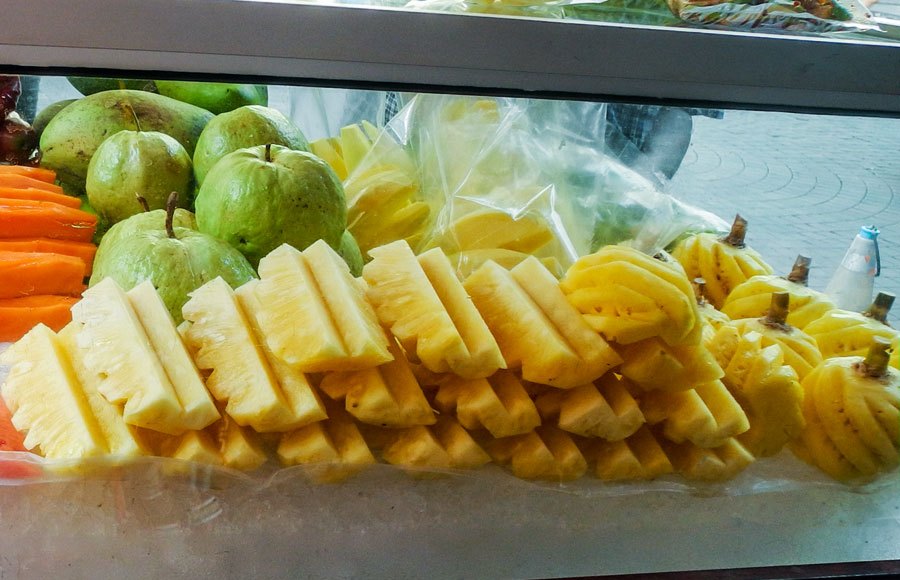
Very small pineapples can be had for 10 baht, but we usually bought a peeled and sliced pineapple for 20–30 baht a bag:
1.2. Banana
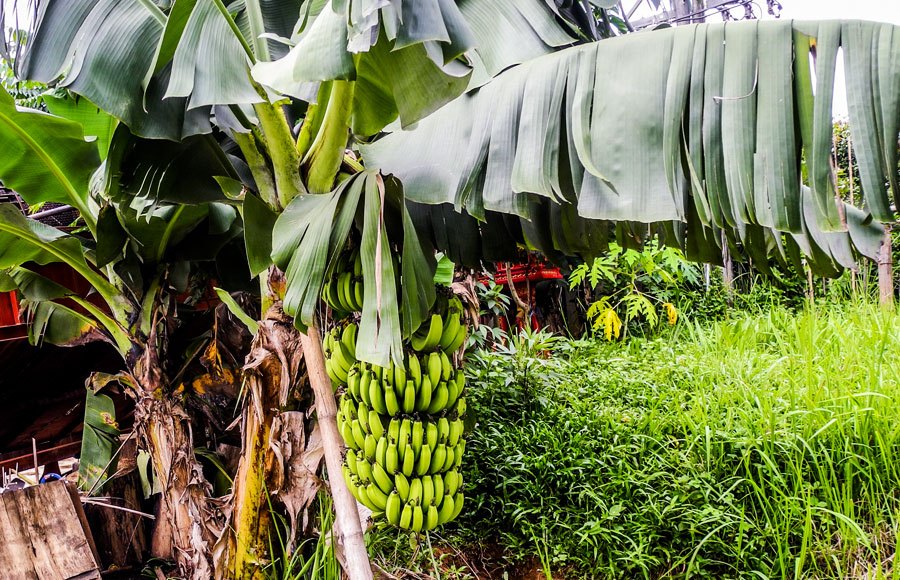
Bananas grow like weeds in Thailand and cost pennies.
Bunches of bananas in the garden:
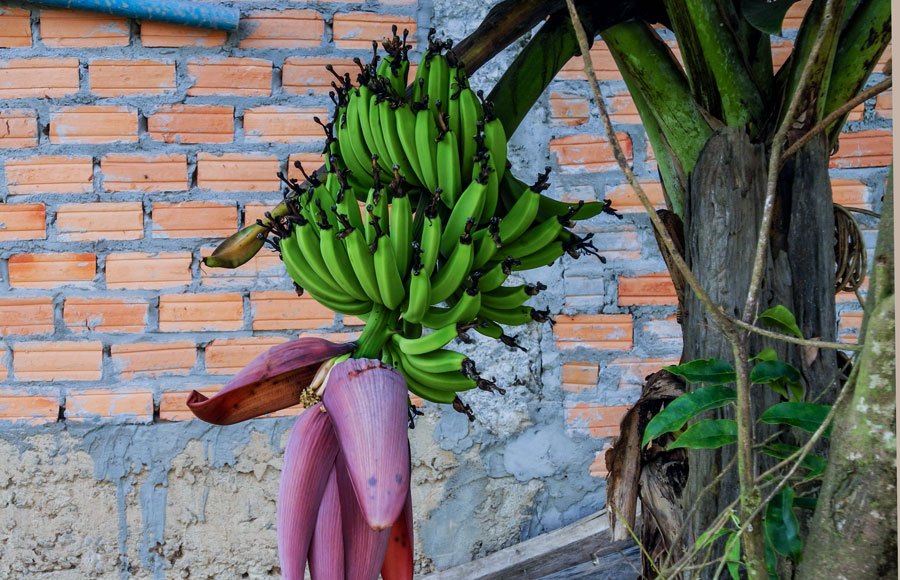
Incidentally, it is not only the bananas themselves that are eaten, but their flowers too:
Do you think it is silly to spend money on something you can buy at home? Ha! I promise that after Thai bananas you will not touch the ones back home for a very long time (that is certainly what happened to me — it took me ages to get used to the bananas sold back home again).
There are dozens of banana varieties here, and they are all INCREDIBLY tasty! My favourites were short, plump little bananas with bright-yellow, juicy flesh and a strong aroma. Their texture is nothing like ordinary bananas — more like a cream you could eat with a spoon. Unfortunately, I only managed to try those once, in Cha-Am.
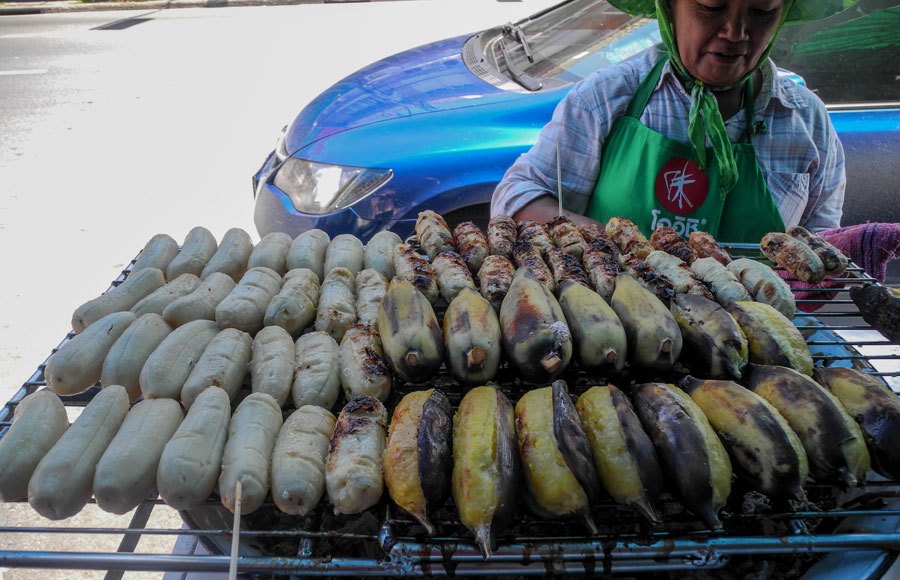
Do you think bananas are eaten only raw and in desserts? Wrong! They are also grilled, like corn on the cob:
Thanks to their unique composition (loads of vitamins and trace minerals), bananas are believed to stimulate brain activity and to produce the happiness hormone!
Price: 20–40 baht per bunch.
1.3. Pomegranate
Pomegranate season in Thailand runs from August to October. Pomegranate trees grow everywhere here: along roads and beside houses and car parks.
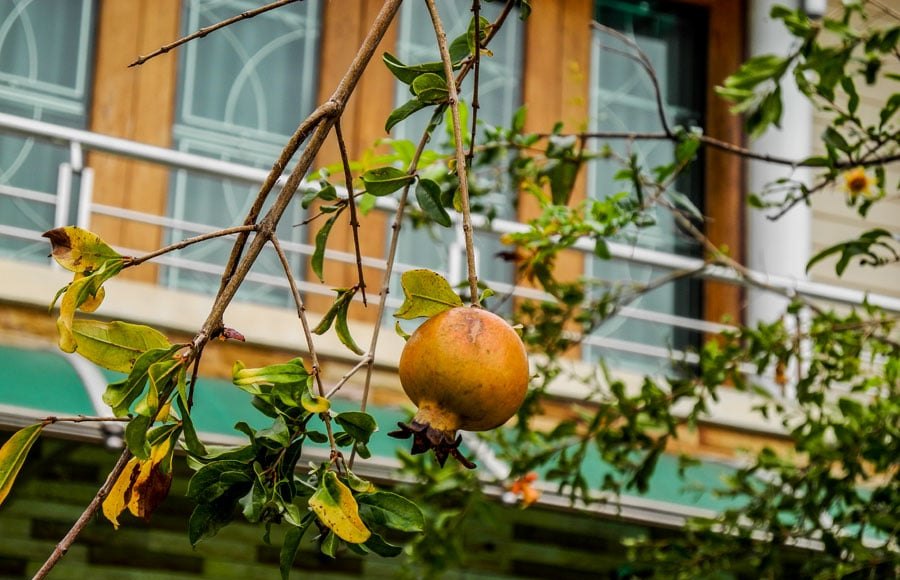
It seemed to me that the Uzbek and Turkish pomegranates sold back home are tastier than Thai ones. But maybe we were just unlucky. The pomegranate juice, though, is delicious! No sugar, preservatives or colourings. In Bangkok, in Chinatown, it is sold almost all year round.
Pomegranate is ideal for fasting days and essential for vegetarians (it can replace meat in many components). And the little sweet-and-sour seeds (incidentally, fruits with large seeds are the sweetest) are an excellent antiseptic and promote blood formation.
1.4. Watermelon
Thai watermelons are a delight — always very sweet! The most popular varieties are small 2–4 kg melons with a dark rind and red flesh, and watermelons with a light-green striped skin and… yellow flesh. Yellow watermelons look very unusual! But they taste simply sweet, without the distinctive watermelon aftertaste.
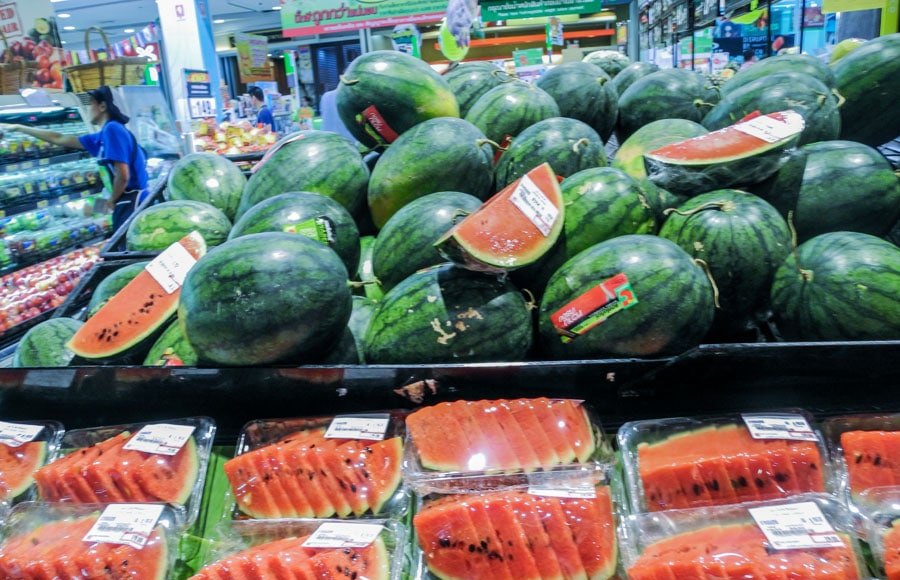
Both red and yellow watermelons are rich in vitamins C and A. This fruit — technically a berry — is successfully used to treat liver and kidney diseases (though the fruits must be of the highest quality), heart defects and even… male infertility!
Price: from 20 baht per kg (or per bag of peeled watermelon).
2. Exotic fruit
2.1. Dragon fruit
Dragon fruit is also called pitahaya or pitaya. In Thailand it comes in two versions: with bright-crimson or white flesh.
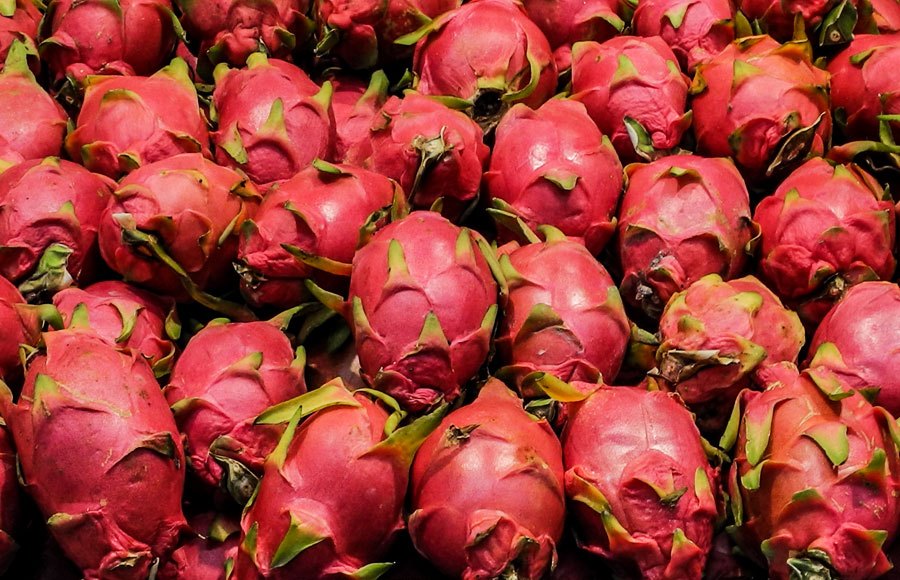
To be honest, the “dragon’s heart” looks much brighter than it tastes. At first it seemed completely tasteless to me. But a couple of months later, having tried every possible fruit, dragon fruit remained one of the favourites — it quenches thirst beautifully in the heat and works as a light breakfast or snack: it is not as cloying as many other fruits and does not become boring over time. You can take a dragon fruit to the beach and eat it there with a spoon! The flesh is very convenient to eat if you cut the fruit in half:
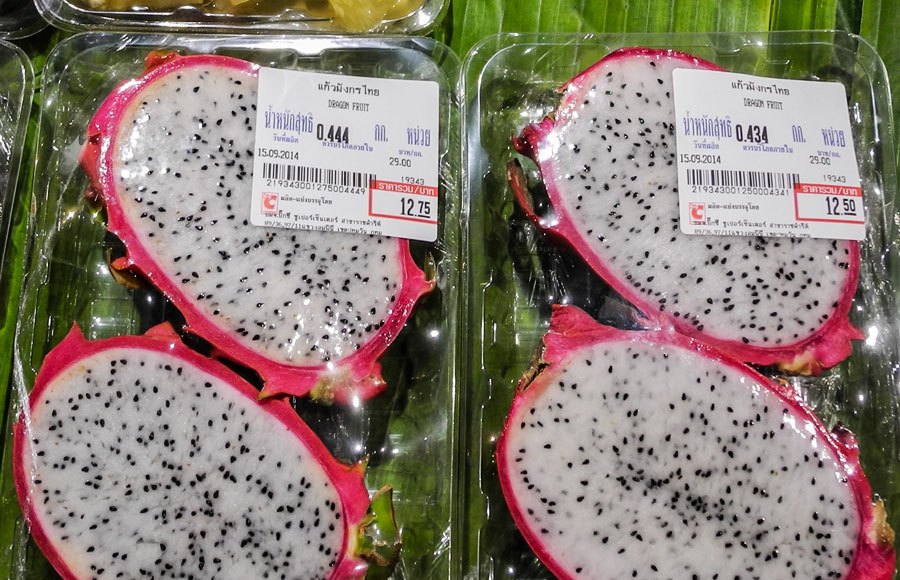
Pitahaya combines brilliantly with any tropical fruit! Its high concentration of vitamin C, phosphorus, iron and calcium helps keep our bones and teeth healthy and strong.
Price: 55–70 baht per kg.
2.2. Jackfruit
The largest fruit in the world (it can weigh up to 30 kg) is usually sold in Thailand already peeled and cut up. Moreover, between the “segments” the jackfruit contains a sticky latex that can only be washed off with vegetable oil.
Here is how it grows:
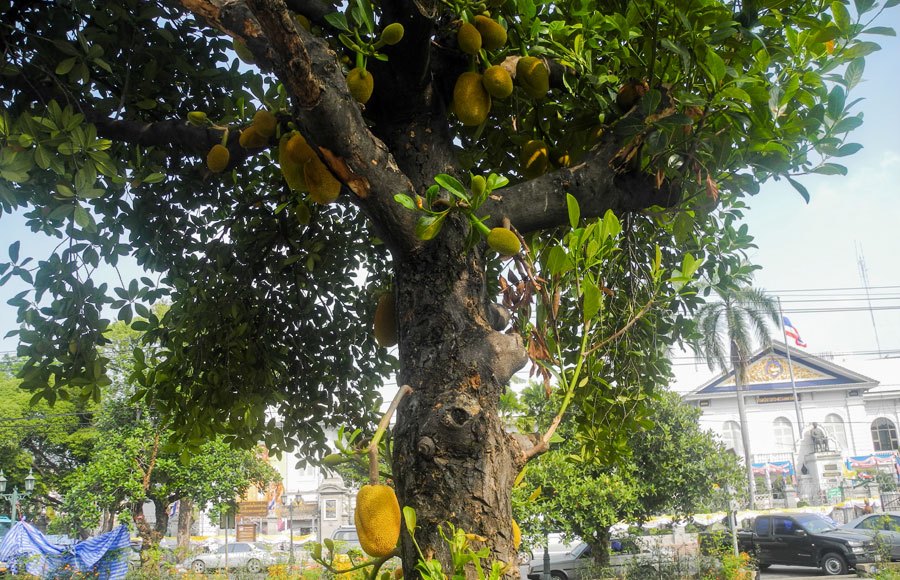
Each jackfruit segment (and there are between 100 and 500 in every fruit) hides a large stone. Thais collect these stones and fry them like chips.
Jackfruit is very aromatic, and its taste recalls chewing gum, melon and gummy sweets all at once. Interestingly, the fruit’s texture can vary widely: crunchy, rubbery or stringy, for example. All in all, jackfruit is an acquired taste — I am not particularly keen on it, for instance, but Vova simply adores it.
This is what peeled jackfruit segments look like (on the left):
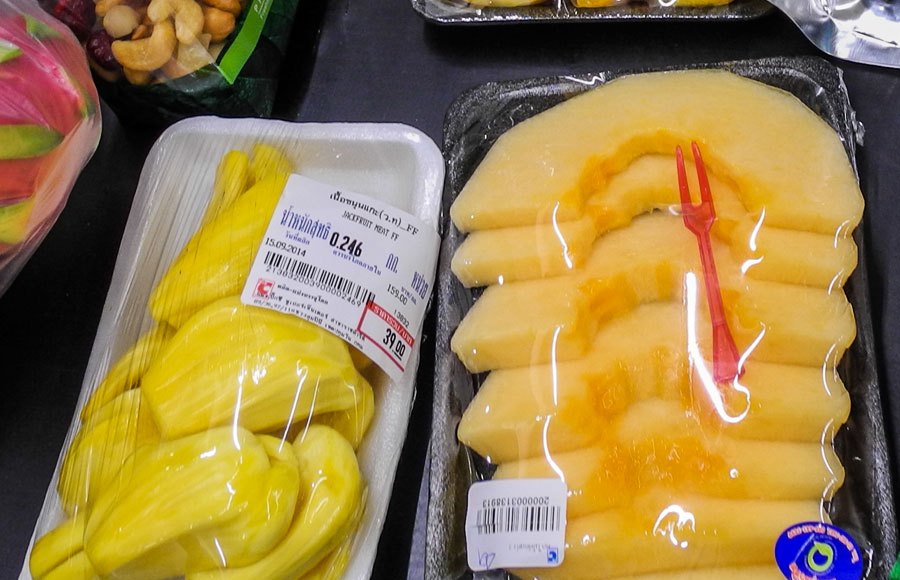
Jackfruit flesh contains a great deal of potassium and vitamin A. The fruit is low in calories but quite filling. That is why in some Asian countries it is even called “bread for the poor”.
Price: 50–120 baht per kg.
2.3. Lychee
The taste of these juicy little berry-like fruits recalls a cocktail of currant and strawberry. They grow in Thailand, Vietnam, China and Cambodia. But Thai lychees (their season falls in May–June) are considered the tastiest!
The little balls grow in clusters, like grapes. They have a thin, tender red skin (easy to peel by hand), mega-juicy, sweet translucent flesh (like a firm grape) and a hard stone in the centre of the fruit. Of all the similar “jelly-like” fruits (longan, rambutan), the lychee is my favourite — so juicy and sweet, with a slight sourness. It is a pity the lychee season lasts such a short time, and out of season they are not sold even at inflated prices. Only canned lychees are sold (you can get those back home too), but their taste is quite different.
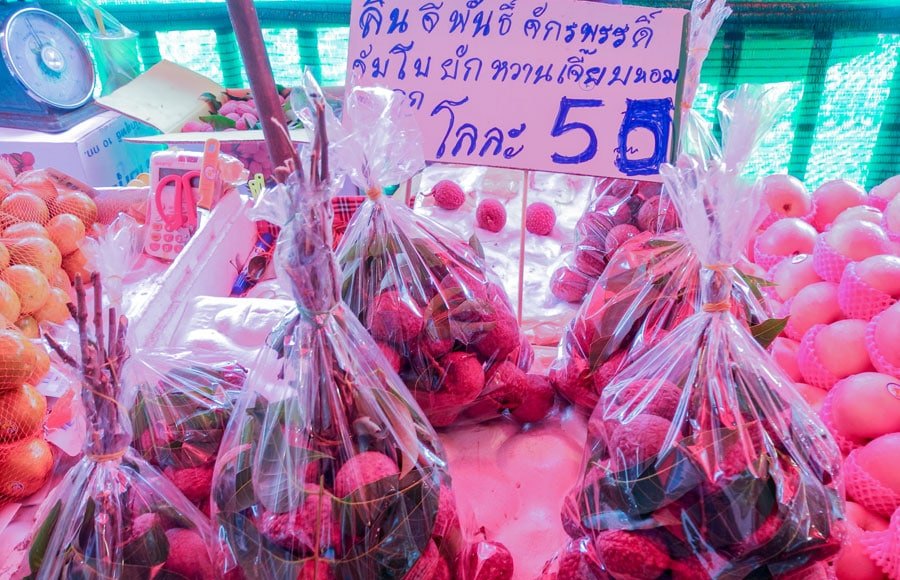
In Southeast Asia, lychees are famous for their invigorating effect. They restore strength beautifully and even “rejuvenate” slightly (thanks to antioxidants and vitamins).
Price: 20–80 baht per kg.
2.4. Guava
They say that a ripe, soft guava tastes like a mixture of raspberry and strawberry. But in Thailand this fruit is eaten mostly unripe (firm), with spices (yes, for some reason Thais love fruit with hot red chilli!). Guava, on the other hand, is sold here all year round. I came across two varieties: with pink and with white flesh.
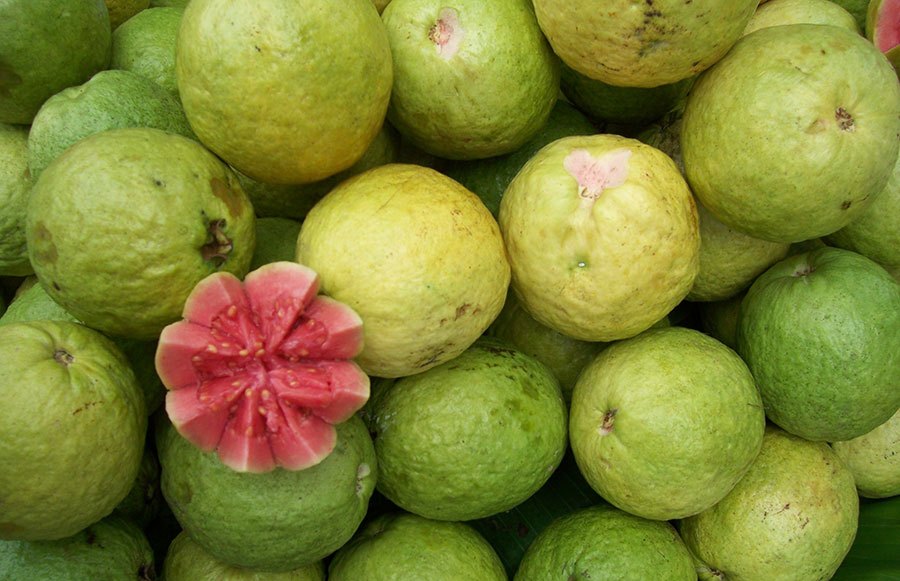
The taste reminded me of a pear with a light strawberry aroma. Guava juice is tastier than the fruit itself — but only freshly squeezed; the taste of the cartoned juices sold back home does not even remotely resemble fresh fruit.
Incidentally, every variety of this fruit has many small and very hard seeds. In principle, guava can be eaten like ordinary apples and pears, but the stone-hard seeds make you bite and chew with caution.
Guava’s benefits lie in its antispasmodic, bactericidal, astringent and antimicrobial properties. This fruit normalises blood pressure, stimulates the heart, improves digestion and is very good for breastfeeding mothers and babies. It contains potassium, iodine, selenium, iron and B vitamins.
Price: from 10 baht apiece.
2.5. Pomelo
In my opinion, pomelo tastes very much like grapefruit, but in an “improved” version: less bitterness, more sweetness. It is easy to recognise by its thick yellow or green rind. And inside, the segments can be anything: white, pink, yellow or green.
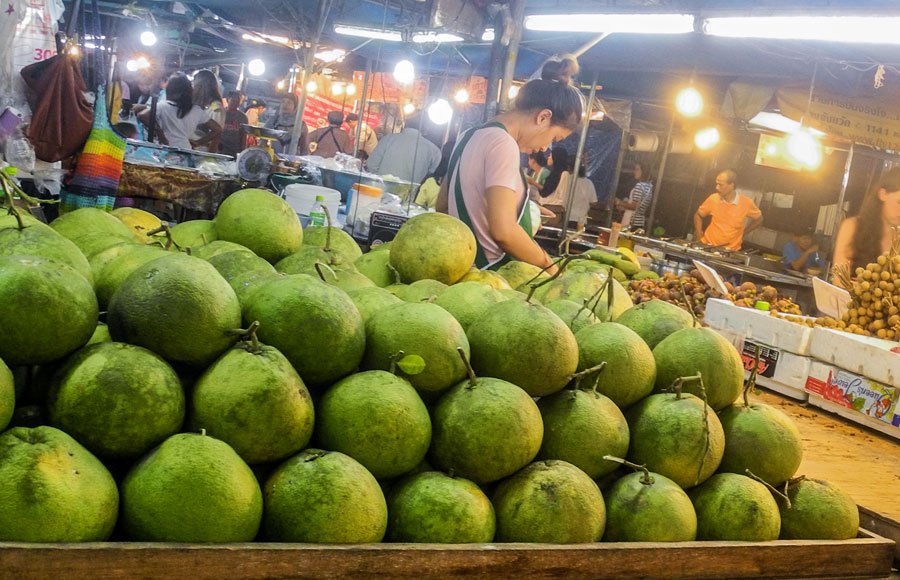
The antioxidants in pomelo successfully fight the development of cancer cells, potassium supports the heart, and vitamin C strengthens the immune system.
It is convenient that you can buy the fruit already peeled of rind and membranes — of all citrus fruits, pomelo became my favourite.
Price: 50–80 baht per kg (or 40 baht for a peeled fruit).
2.6. Longan
From Thai, longan translates as “dragon’s eye”. Under the thin skin lies a pinkish or white “eyeball” with a stone — the “pupil” — inside. Longan grows in clusters and tastes like grapes with a hint of musk.
One longan berry is a light-brown ball the size of a walnut. The skin of this fruit is thin and hard, but it peels quite easily — it cracks when you bite into it.
Longan is a great pick-me-up and restores strength. Incidentally, if you buy a whole cluster of longan, the seller will most likely let you taste one berry. I did not like longan at all — too cloying. On the plus side, it is sold all year round.
Price: from 20 baht per kg.
2.7. Carambola
Carambola is called the star fruit because of its unusual shape. Sliced, it produces several pretty little stars used to decorate the dessert table.
Here it is, in the middle on the right:
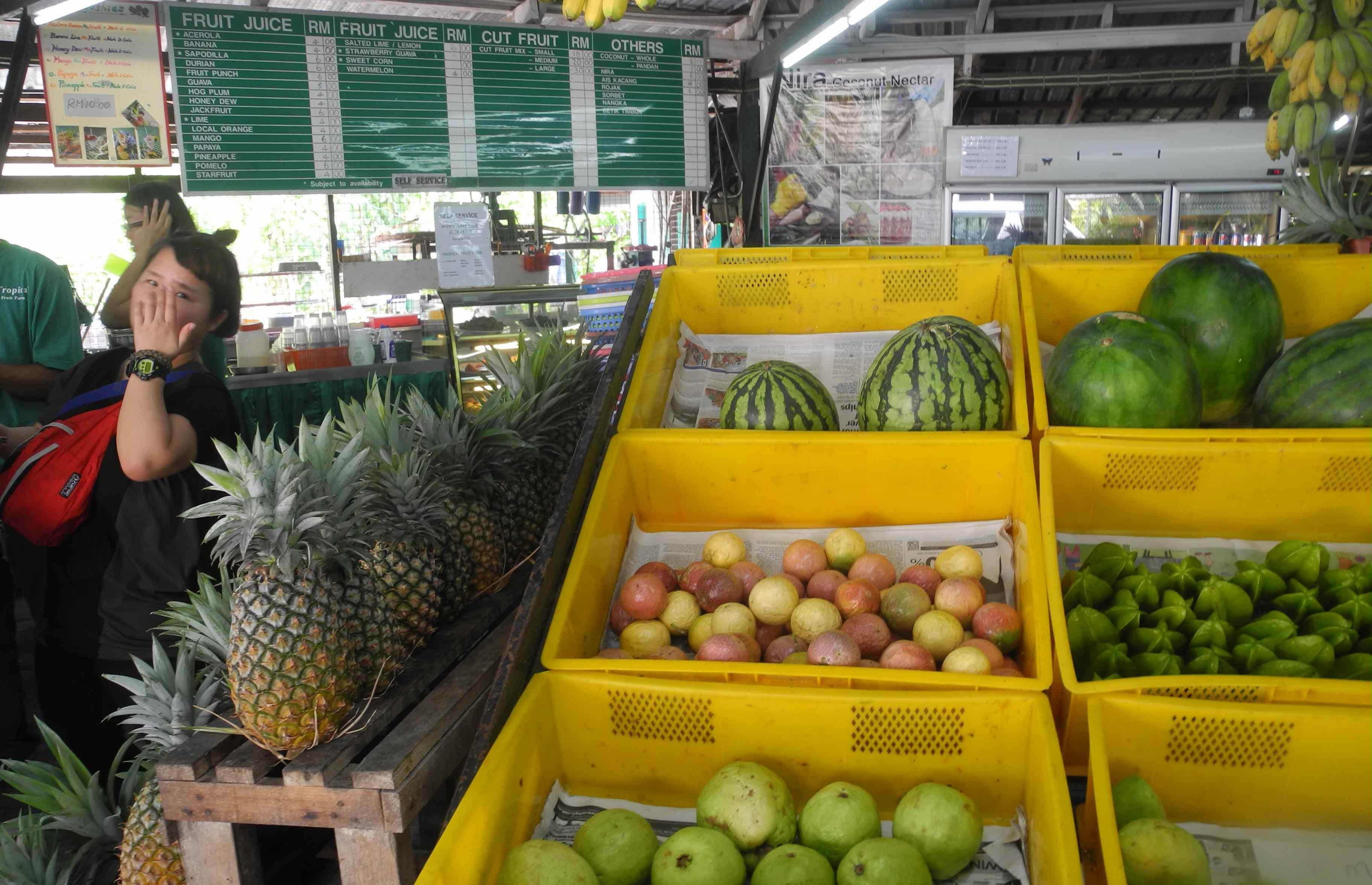
Unfortunately, carambola’s taste is nowhere near as bright as its appearance. The flesh is juicy and sourish, but completely bland.
Carambola contains a huge amount of oxalic acid! It is said to be an excellent hangover remedy. In Thailand the fruit is sold from October to December. Incidentally, carambola’s closest relative is common wood sorrel.
Price: 50–70 baht per kg.
2.8. Tangerine (Thai mandarin)
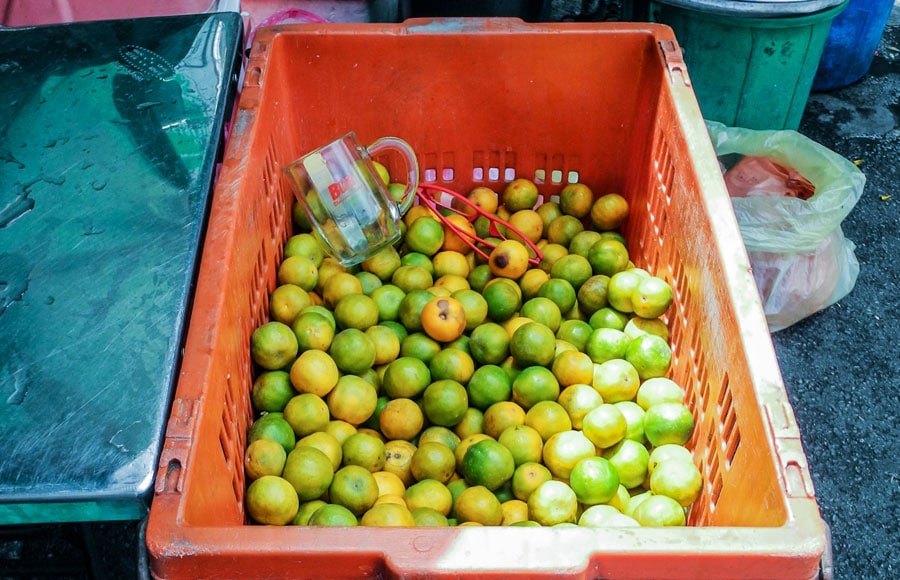
To be honest, the Thai mandarin differs little from its Georgian or Spanish “relatives”. Except that it is larger, and the colour of its skin can be anything: brown, crimson, orange, green or yellow. It is very odd to peel a completely green tangerine and find bright-orange flesh inside.
Price: 20–80 baht per kg.
2.9. Longkong
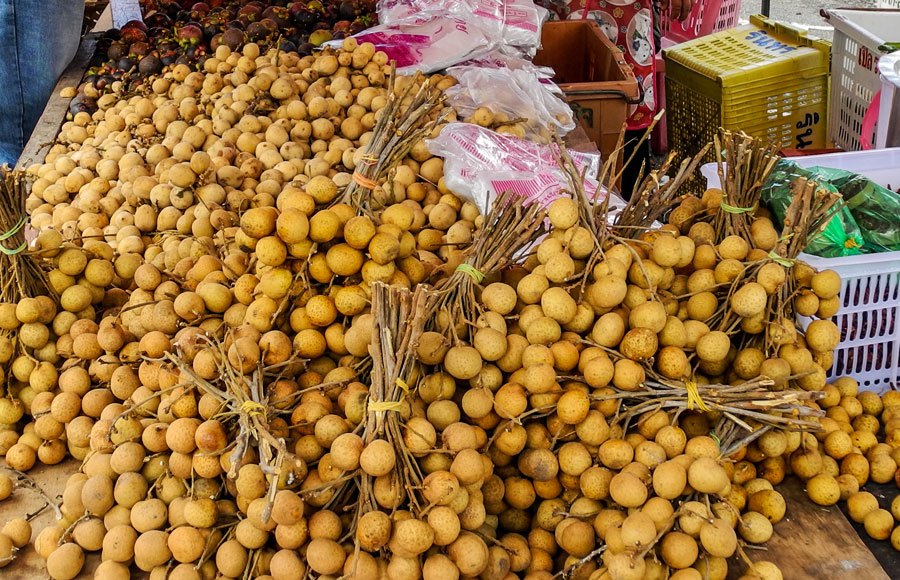
This white-beige fruit goes by different names: duku (the large variety), langsat (wild and sour-tasting) and longkong (the sweetest and tastiest variety). It grows in clusters, like grapes — only not on the tree’s branches but on the trunk itself! And the fruits look like small white potatoes.
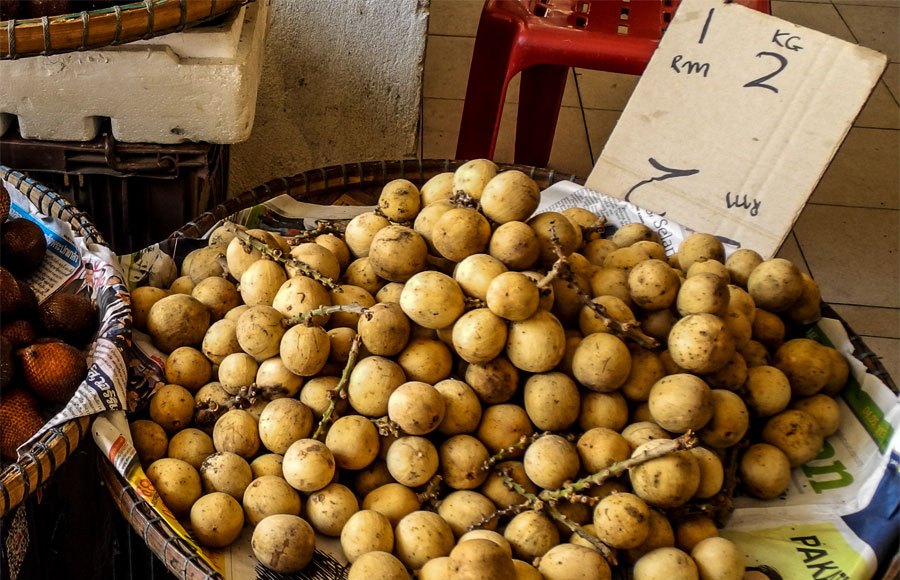
Inside each fruit are several segments (as in garlic). Some segments have stones, others do not. Be careful with the stones: if you accidentally bite one, its sharp bitterness instantly — and lastingly — overpowers the taste of the fruit itself.
This is what longkong looks like peeled:
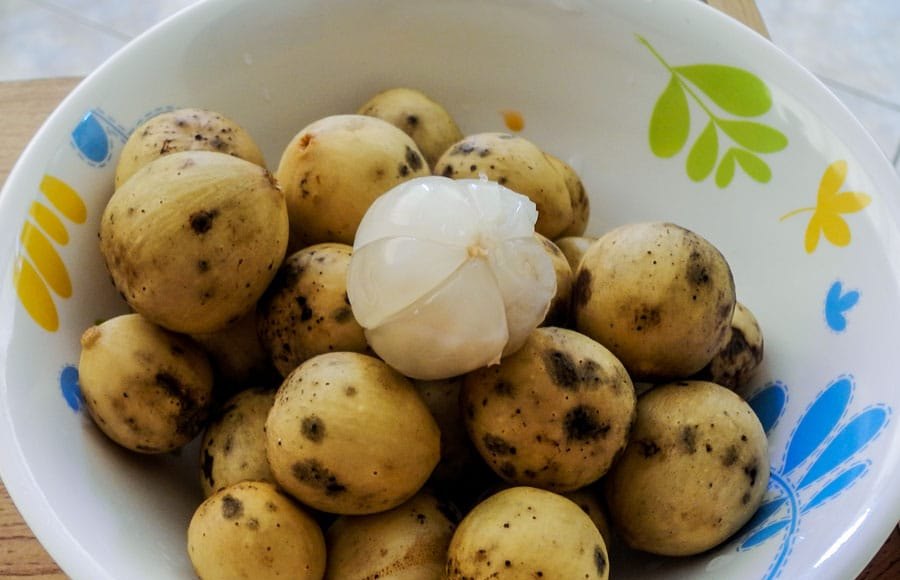
Longkong tastes sweet with a light sourness; it is very tender, with a slightly stringy texture — simply stunning. Every time we saw it on sale, we bought it without fail! The fruit contains high concentrations of vitamins C, B2 and B1, phosphorus and calcium, so it is not only tasty but healthy too.
The fruit’s skin contains a very sticky substance, so it is better to peel it with gloves — otherwise you will walk around with sticky hands for ages; it does not wash off with anything.
Price: from 30 baht per kg.
2.10. Papaya
Papaya looks like a courgette crossed with a pumpkin. And many tourists think it is a vegetable, not a fruit. And not without reason! Depending on ripeness, papaya is used both as a vegetable (green papaya makes a tasty salad) and as a fruit.
The yellow “courgettes” are papaya:
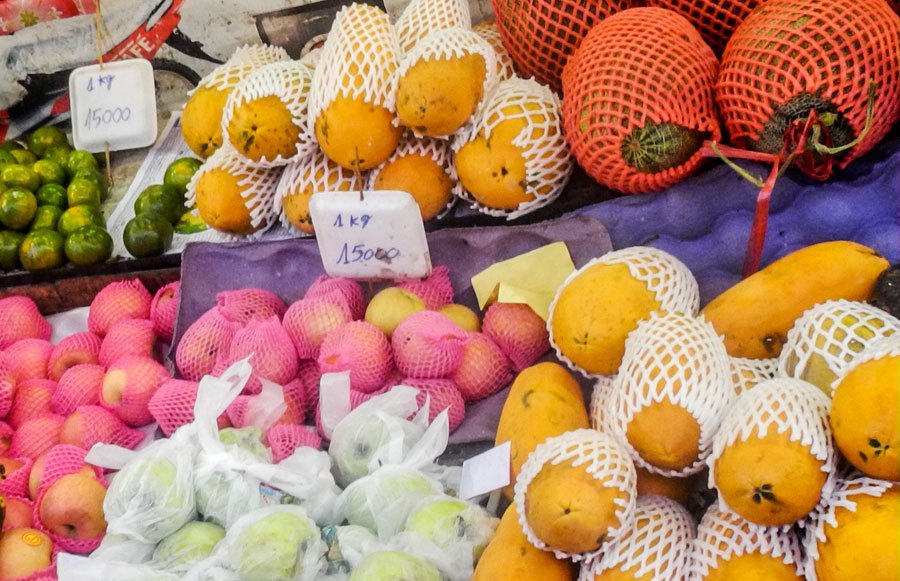
In taste and texture, papaya reminded me of boiled carrot. It does not sound very appetising, but in fact ripe papaya is very tasty and does not become boring.
Other varieties are said to occur too: with shades of coffee and chocolate, with an apricot flavour and even floral notes.
In Thailand papaya is sold all year round. Here it is very juicy and filling (you eat and drink at the same time). It gives lots of energy and is digested quickly, but it can cause bloating. Though it usually stops short of an upset stomach.
Unripe green papaya is not recommended for pregnant women.
Cut open, a ripe papaya looks stunning — bright orange with black round seeds. But the seeds must be removed, so only the orange flesh remains. You can buy it already peeled, which is what we did:
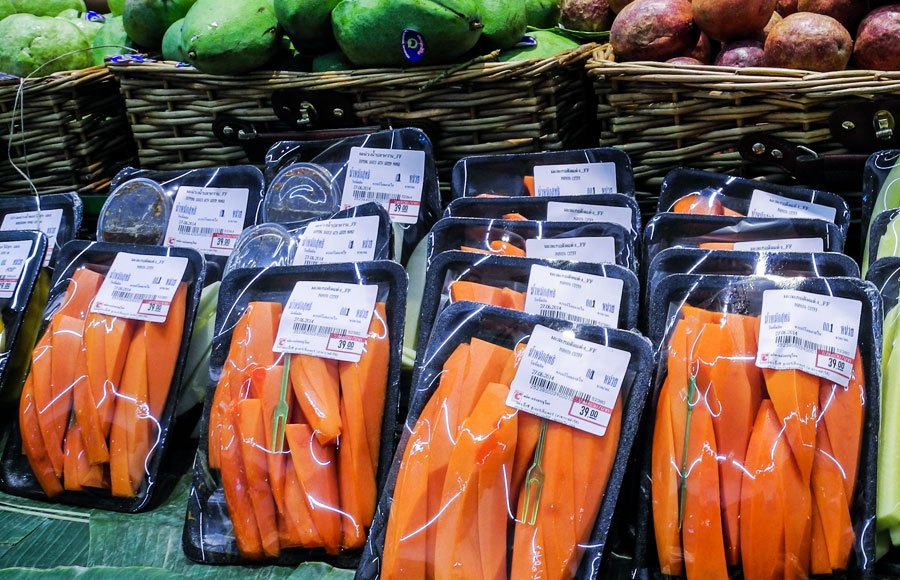
Price: 20–40 baht per kg.
2.11. Rambutan
This hairy “hedgehog” is not only fun to look at but very tasty: sweet with a hint of berry jelly and the texture of gummy sweets. It can be red and green, round and oval, fresh and canned. Incidentally, a rambutan’s spikes are actually very soft, and you cannot hurt yourself on them!
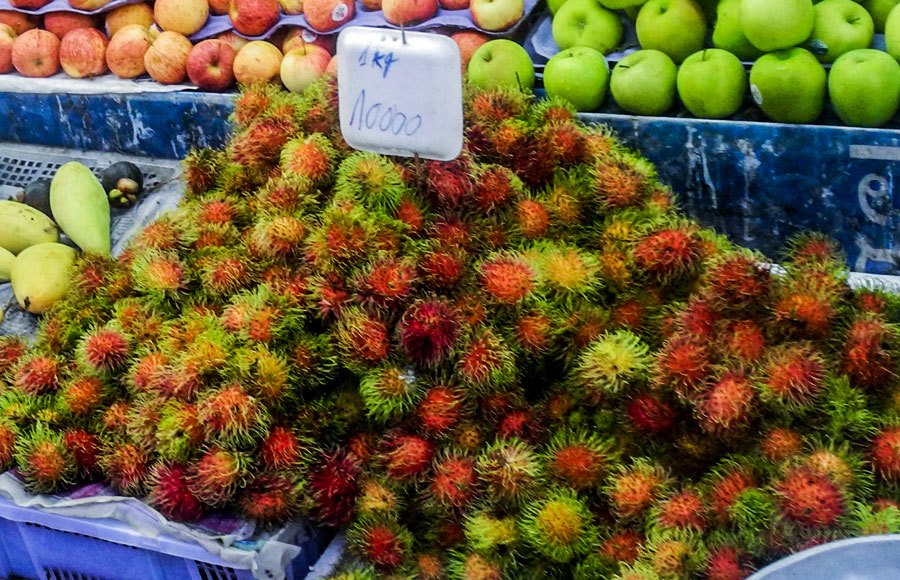
It is hard to go wrong choosing a rambutan — they are almost always ripe and quite tasty. The amusing little fruit gently cleanses the body, normalises digestion and promotes skin regeneration.
Price: 10–70 baht per kg.
2.12. Rose apple
The rose apple looks more like a bell pepper than an apple. Incidentally, this fruit can be not only pink but also green or red.
The rose apple is one of the most “convenient” tropical fruits: no skin to peel, no stones inside. The fruit is juicy (quenches thirst well) but rather tasteless.
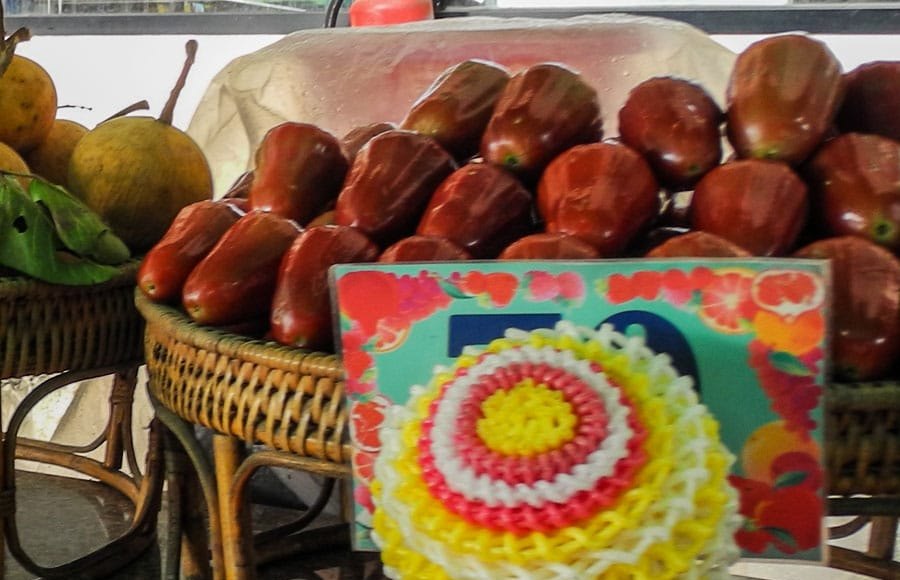
To try it, you can take a skewer with peeled, sliced rose apple:
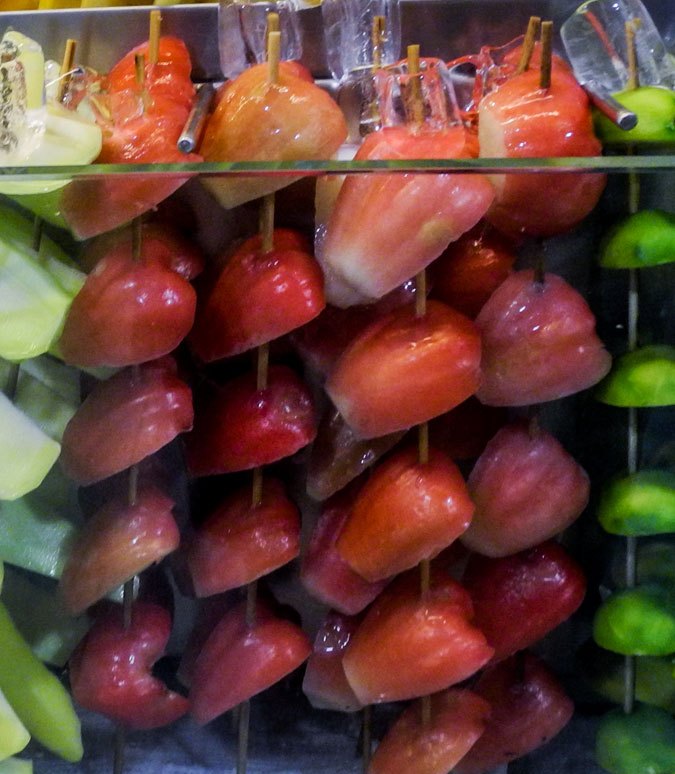
In Thailand the rose apple is sold all year round: both in markets and in supermarkets. But the peak season is in spring, when literally every stall and counter is piled high with these watery fruits.
The fruit is notably low in calories. So it can be eaten both by those on a diet and by diabetics (rose apple slightly lowers blood sugar).
Price: from 10 baht per kg.
2.13. Salak (snake fruit)
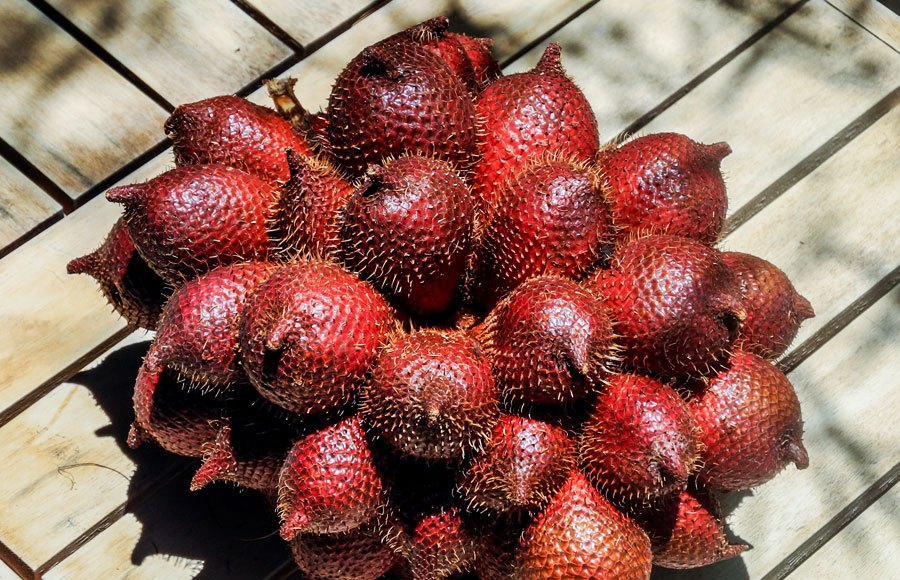
This fruit also has many names: sala, salak, salakka and, of course, snake fruit. But to my surprise I recently learnt that salak and snake fruit are different subspecies of the same plant. The first grows in Thailand (very prickly skin and flesh with a sour note):
The second — in Malaysia and Indonesia (smooth “snakeskin” and very sweet flesh):
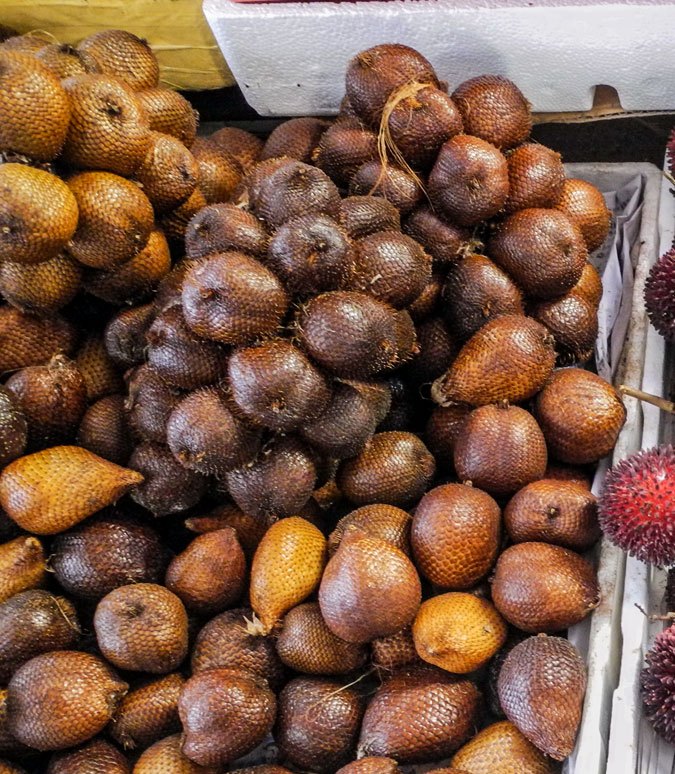
The taste of Thai salak cannot be compared to any other fruit! The fruit is very soft, juicy and tasty, and it smells of — what do you think? Valerian! How do you choose the right salak? The fruits should be even and undamaged. An overripe salak is no longer tasty, but a ripe one is stunning — one of my favourite fruits.
It is not easy to peel — the skin is just too prickly — but the taste repays all the effort! You can buy it already peeled, incidentally; this is what it looks like:
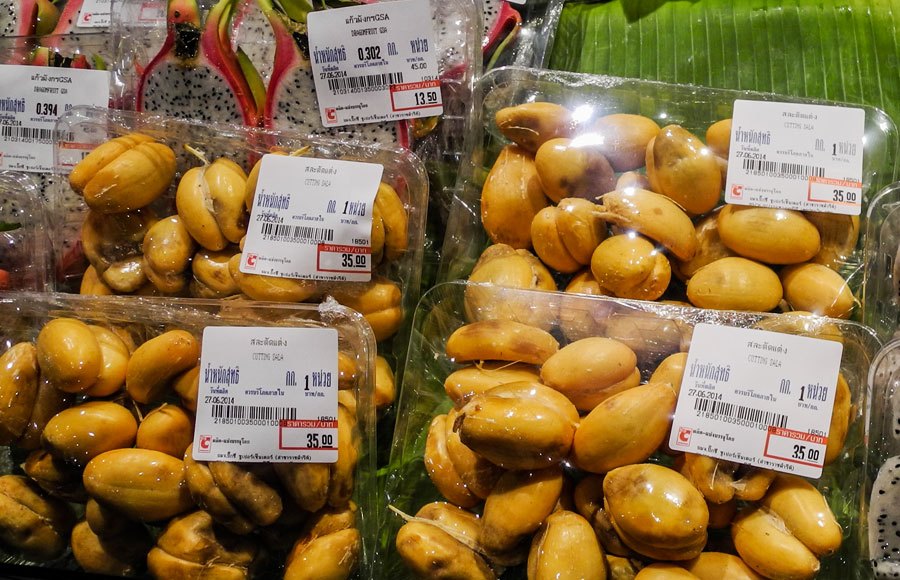
Incidentally, you will not find salak like Thailand’s anywhere else! So if you get the chance, be sure to try this prickly fruit!
Price: 30–80 baht per kg.
2.14. Sapodilla (chikoo)
Sapodilla looks like a bald kiwi or a small potato. The taste vaguely recalls a pear with a toffee — very sickly-sweet. Depending on the variety, chikoo flesh will taste of ice cream with caramel, toffee, chocolate, dates or coffee.
Sapodilla can be round, or elongated like this:
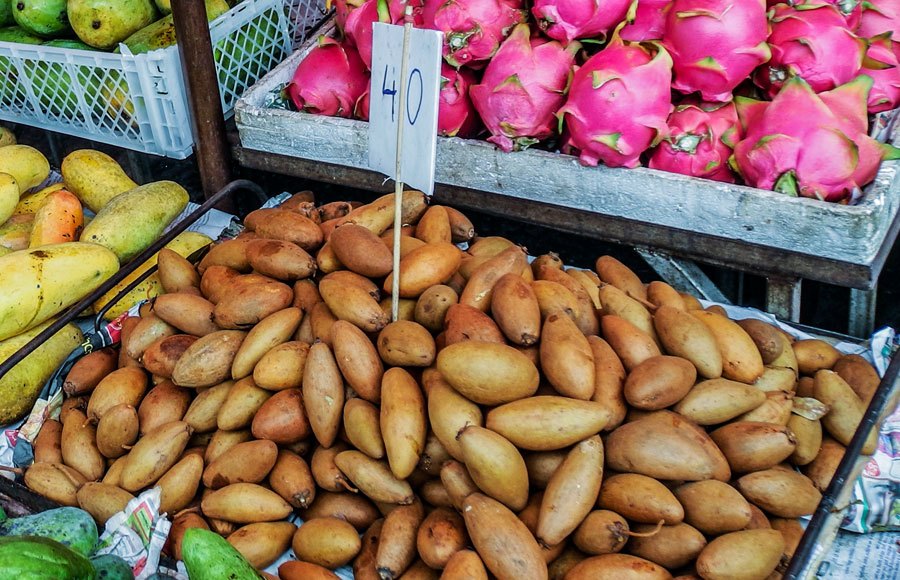
Sapodilla contains heaps of vitamins (especially C and A), as well as potassium, magnesium, iron and calcium. In Thailand chikoo is sold all year round.
Peeled sapodilla looks like this:
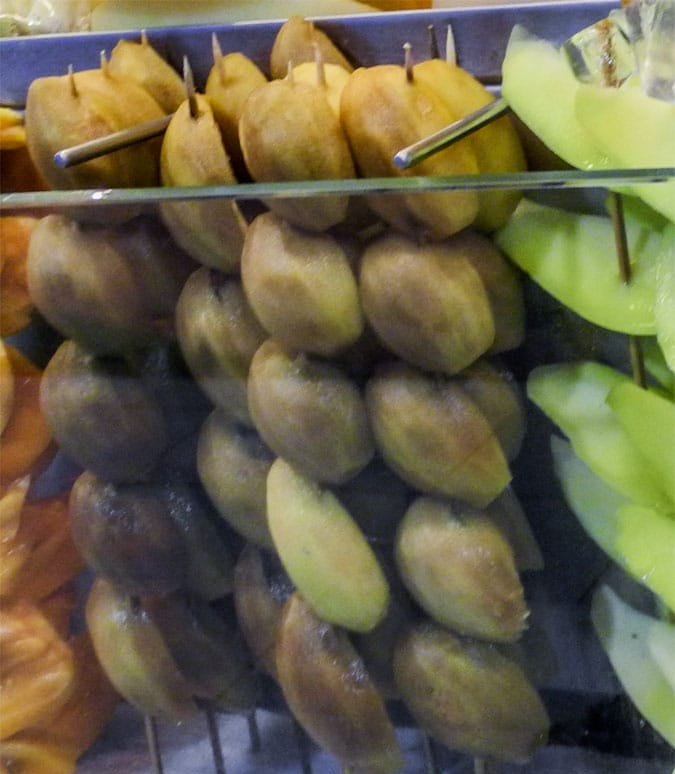
Unfortunately, this fruit spoils very quickly. Even in the fridge, the fruits keep for literally a couple of days.
Price: 50–60 baht per kg.
2.15. Tamarind
Another very odd-looking fruit — like a huge pod. Break the fragile shell-skin and beneath it you find a fruit like a dried date or a toffee. Officially, tamarind (or Indian date) belongs to… the legumes. But probably because of its sweetness, the whole world is used to treating it as a fruit.
On the left are green, unripe tamarind pods; the brown ones on the right, in the net, are ripe and sweet:
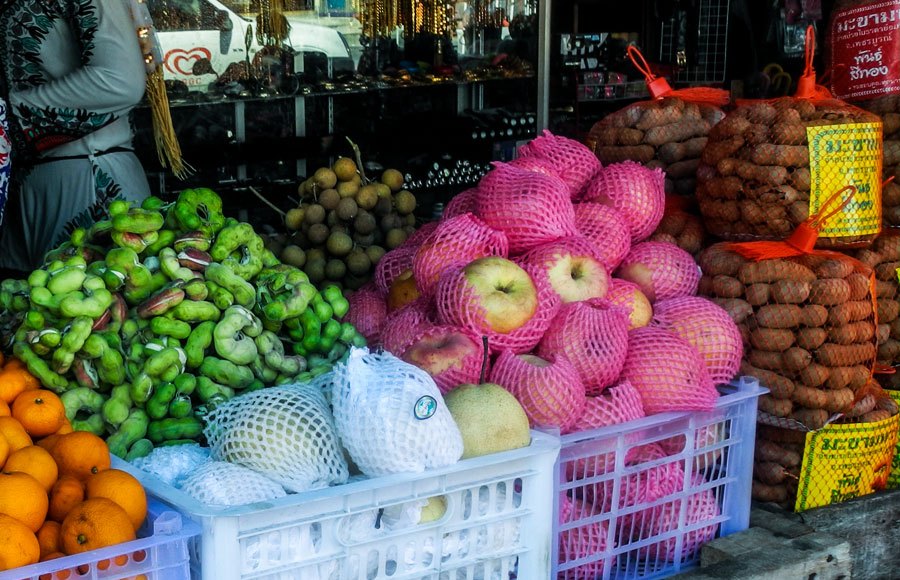
It is sweet but not juicy at all — more like a dried fruit. Fruitarians and raw-foodists eat tamarind instead of sweets. In Thailand, tamarind paste is added to almost every dish: meat, sauces and desserts alike.
Price: 100–120 baht per kg.
2.16. Young coconut
Everyone knows that inside a young coconut the cavity is filled with a clear, slightly sweet liquid that quenches thirst brilliantly and is, in general, mega-healthy!
In composition, coconut water (not to be confused with coconut milk or oil!) is similar to breast milk and lymph. It contains almost the whole group of B vitamins and half the periodic table (from iodine to fluorine). In “old” coconuts this priceless water gradually turns, little by little, into an emulsion and flesh.
A coconut trimmed on all sides — all that remains is to chop a hole, and you can drink:
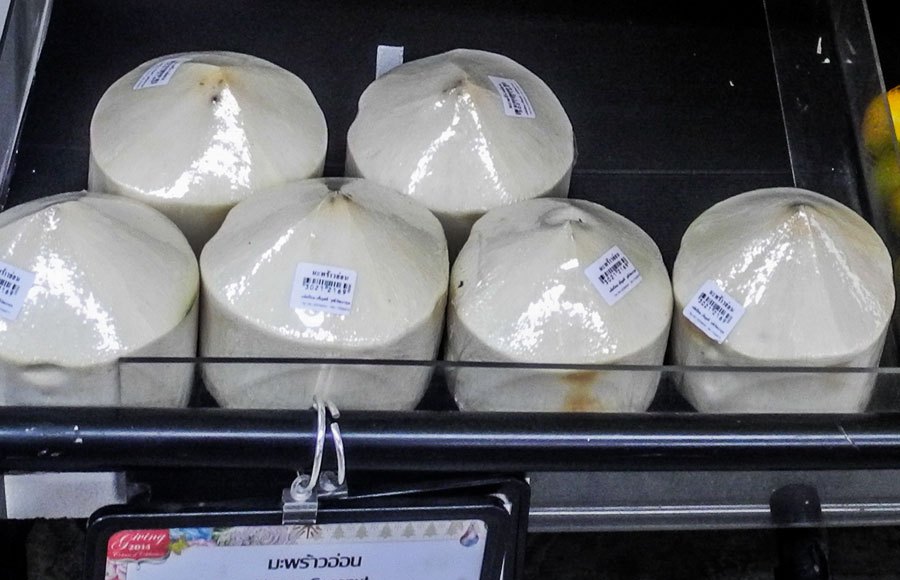
Doctors recommend drinking young coconut water during lactation and pregnancy, for colds and lowered immunity, for thyroid diseases and atherosclerosis. Coconut juice is an acquired taste: back home, coconut was one of my favourite fruits (well, nuts), but in Thailand I could not bear even the smell of coconut water — just too distinctive. Vova, though, drank coconut juice almost every day — he liked it that much.
And we came across giant coconuts like these in the Philippines:
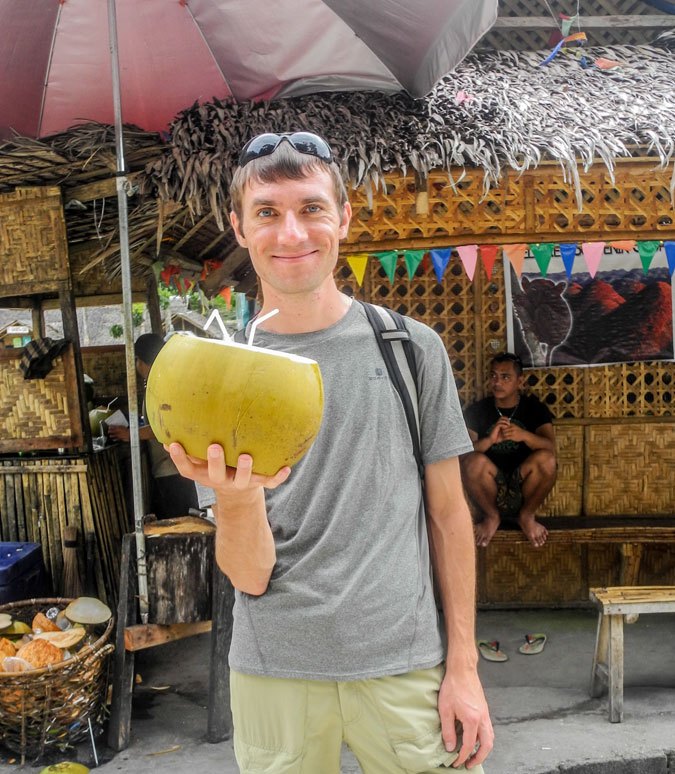
Price: 10–30 baht each.
2.17. Marian plum
The Marian plum is also called gandaria or maprang. The orange or yellow fruits taste like mango, while the flesh’s texture recalls a plum. The mango-plum can be eaten unpeeled.
The Thai plum is rich in potassium, chromium, copper, glucose and vitamins A, B, P and C. But maprang is more often eaten not raw but in compotes, sauces and jams.
2.18. Chrysophyllum (star apple)
Chrysophyllum does not look like a star at all. Except perhaps in horizontal cross-section — and even that is a stretch.
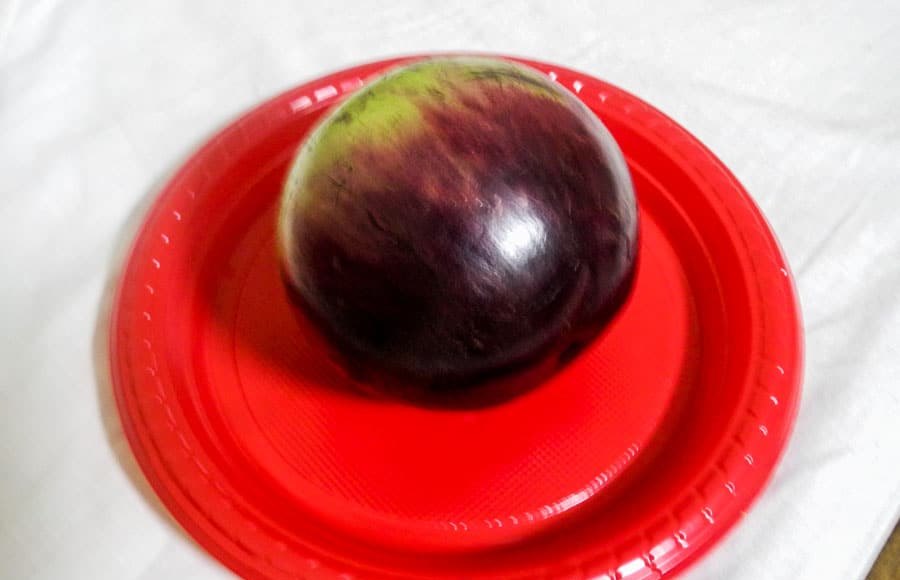
The fruit is cut in half and the flesh eaten with a spoon. Or you can do it differently — gently squeeze the fruit, cut a hole in its top and drink the delicious juice, which tastes somewhat like sweetened milk.
The fruit cut open:
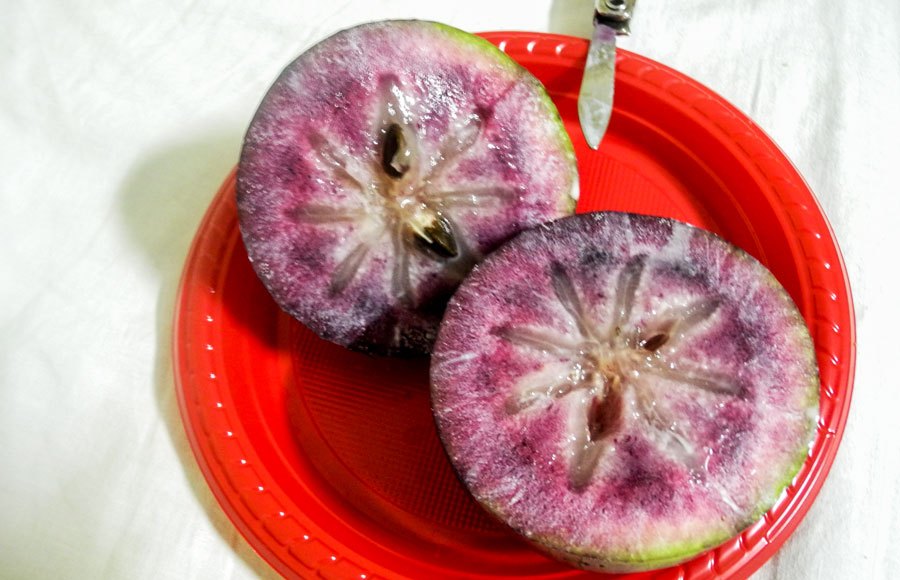
Incidentally, star apple is an excellent remedy for colds and sore throats.
2.19. Santol
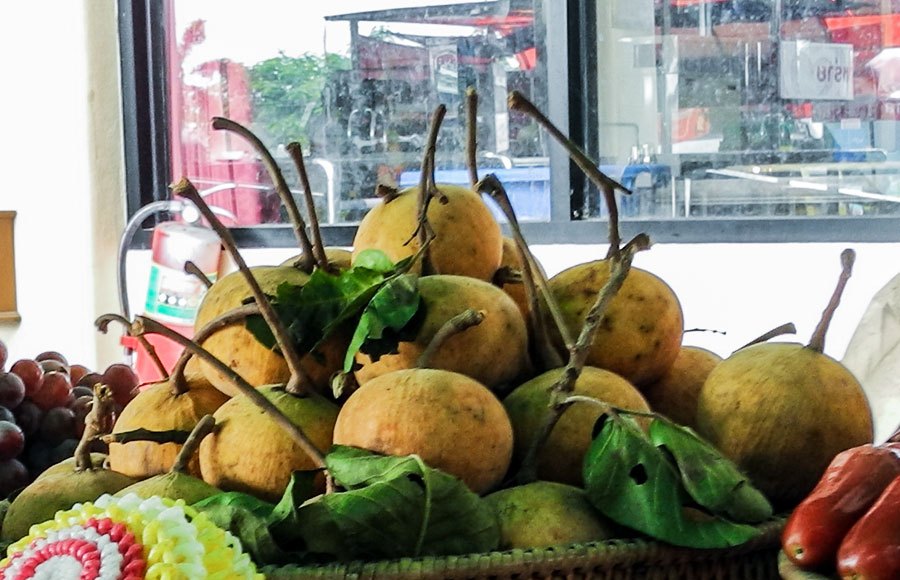
Santol is called the Thai apple in Thailand — and you will not find it everywhere. If you find it, try it! The fruit does not look very appetising. But under the plain hard skin hide white segments with a delicate sweet-sour taste…
3. The tastiest fruit in Thailand — our top 6
3.1. Durian
The durian fruit (an average durian is the size of a football) is often called the king of fruits. Its aroma is, to put it mildly, distinctive (it recalls rotten raw onion, dirty socks and a sewer all at once). Even the description sounds unappetising. That is why the fruit cannot be brought into hotels, public transport, office buildings or supermarkets.
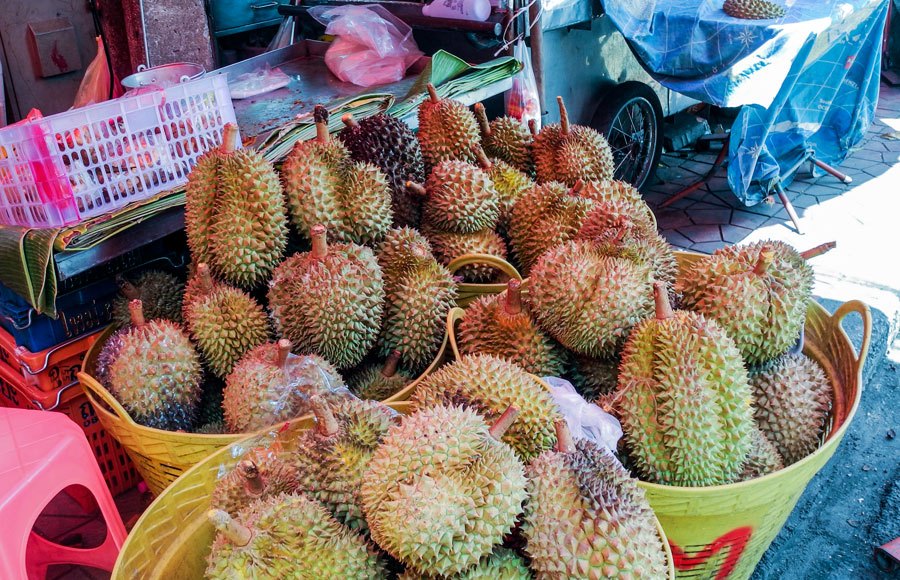
If you close your eyes (or rather, your nose) to the strong reek, durian’s taste is incredible! It recalls custard cream with pineapple, banana and strawberry. Though, of course, it all depends on whether you get a good durian. Everyone who tries durian immediately splits into two opposite camps: some cannot stand it and cannot understand how anyone can eat such a thing, while others consider it the tastiest of fruits. We belong to the second category — to me, durian tastes like the most delicious cake imaginable.
Small durian is not as tasty:
We have tried many different durian varieties, and truly tasty ones were far from common. It is best to buy a whole durian: once it has sat open for a little while, it starts to stink terribly and the taste deteriorates very quickly. A durian that has sat around has exactly the rotten-onion taste that all durian-haters talk about. So if you did not like it the first time, you may simply have got a stale one. When buying a durian, be sure to ask the seller to choose the tastiest fruit for you. And when he cuts it open slightly, touch the flesh — it should be soft but not slimy; that will be the tastiest fruit. An unripe durian tastes hard and crunchy, with no sweetness yet, while an overripe one is slimy and stinks like rotten onion. The tastiest is medium-ripe.
Incidentally, it is quite hard to peel — the spikes are very hard and sharp. It is better to ask the same seller to peel your durian.
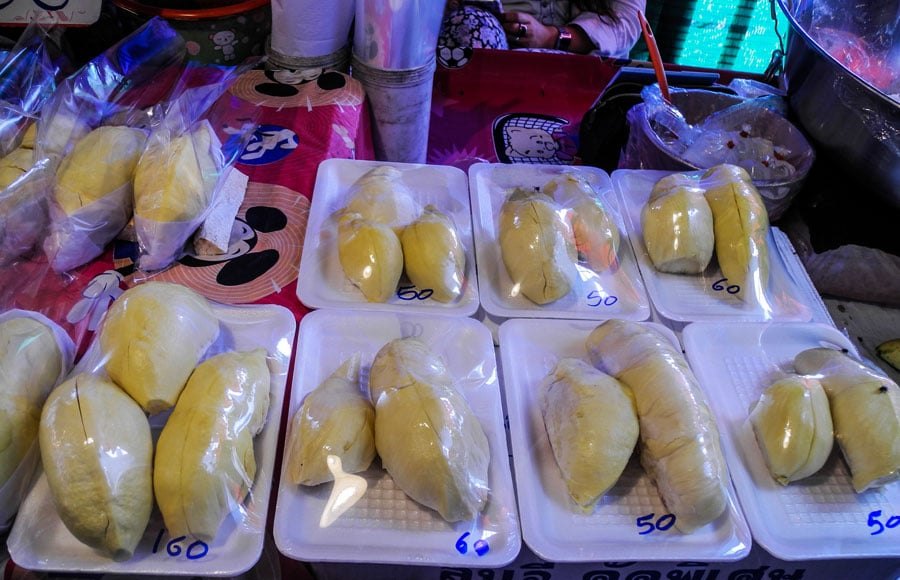
You can buy it peeled, but it is better to wait until the seller starts peeling — and buy immediately:
It is called the king of fruits for its unique composition. Durian flesh contains a whole complex of B vitamins. And its vitamin C concentration is higher than in citrus fruits! The fruit is also very nutritious — one segment can keep you full for half a day.
However, durian must not be eaten by people with high blood pressure, or by pregnant and breastfeeding women (since it raises body temperature). And you should not mix it with alcohol either!
On the other hand, durian is recommended for diabetics, as the organic sulphur it contains — which gives it that smell — promotes insulin production.
Durian grows like this:
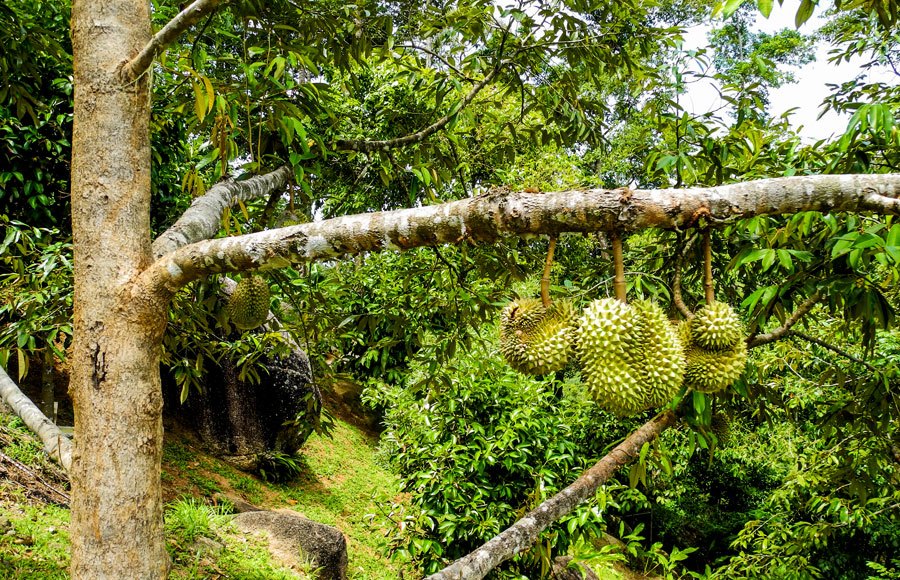
Price: 80–120 baht per kg. But in season on Samui we bought durian from trucks at 40 baht per kg.
3.2. Mangosteen
The mangosteen looks like a little round aubergine. Inside, it has sweet white segments with the taste of peach and citrus. Mmmm…
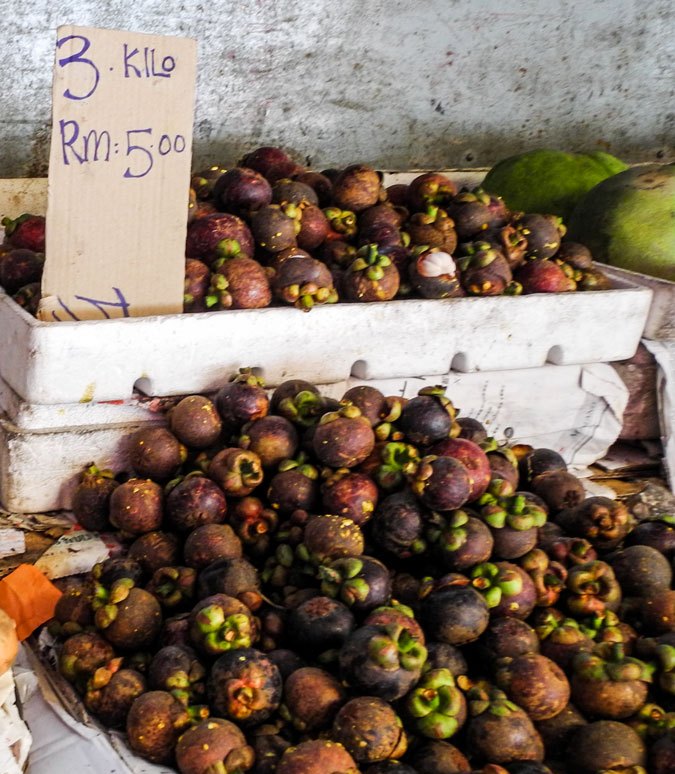
I love its taste madly — light, tender, airy. And you can eat a kilogram or two of mangosteens at a sitting. You will not feel ill, and your tongue is guaranteed not to be burnt by fruit acid. In my view, this is the single tastiest Thai fruit. It is a pity it is not sold all year round; the season lasts roughly from May to July.
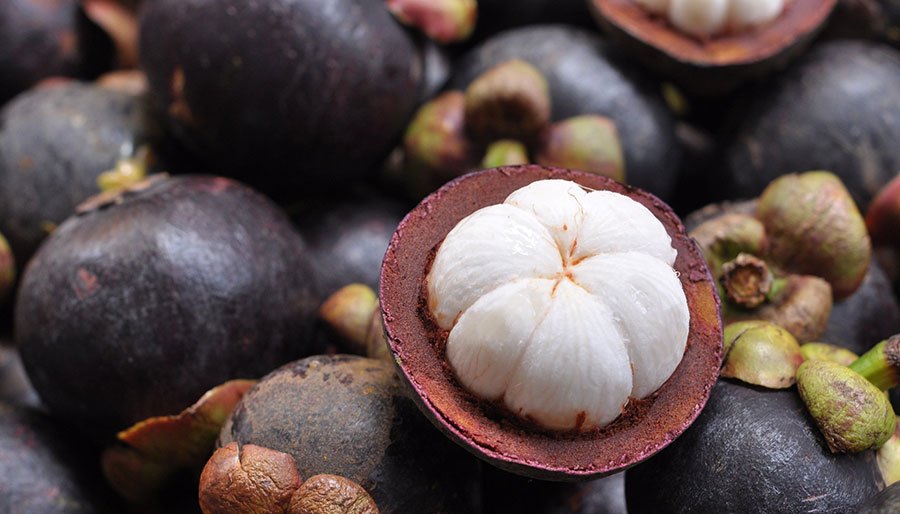
Incidentally, the mangosteen (another name for it is mangostan) contains heaps of useful substances. Among them are rare xanthones — ruthless killers of cancer cells. When choosing a mangosteen, take soft fruits; they are the tastiest.
When you peel a mangosteen, be vigilant — black ants live in some fruits! Once I opened a mangosteen and whole hordes of ants ran out of it — you should have heard the screaming!
Price: 40–80 baht per kg. But at the very height of the season we bought 7 kg for 100 baht — that is, just 15 baht per kg!
3.3. Mango
In Thailand this sweet, juicy fruit is sold all year round, though the price changes a lot at different times. The peak season falls in April–June.
Peeled and sliced mango: top centre — unripe, with spices; bottom — mega-ripe and sweet:
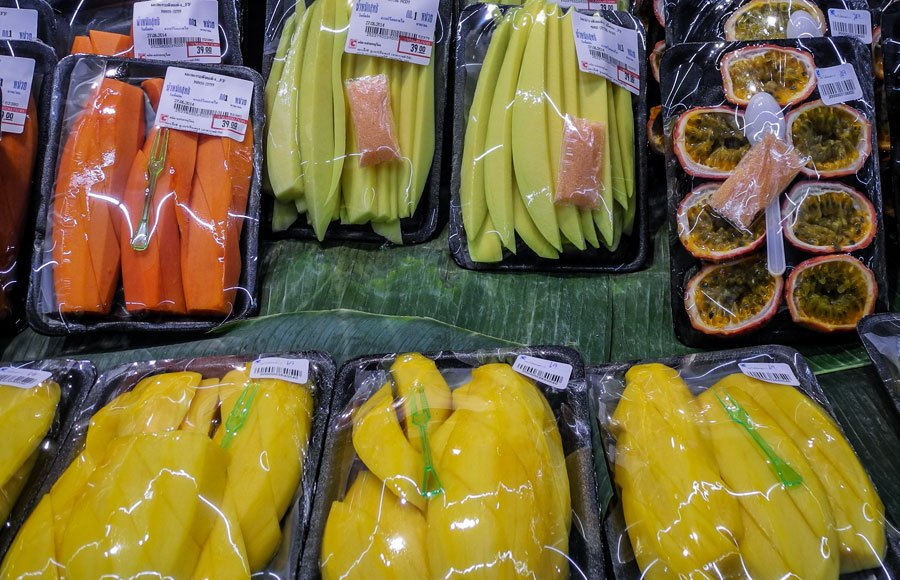
One of the favourite Thai treats — mango sticky rice (mango and sticky rice in coconut syrup):
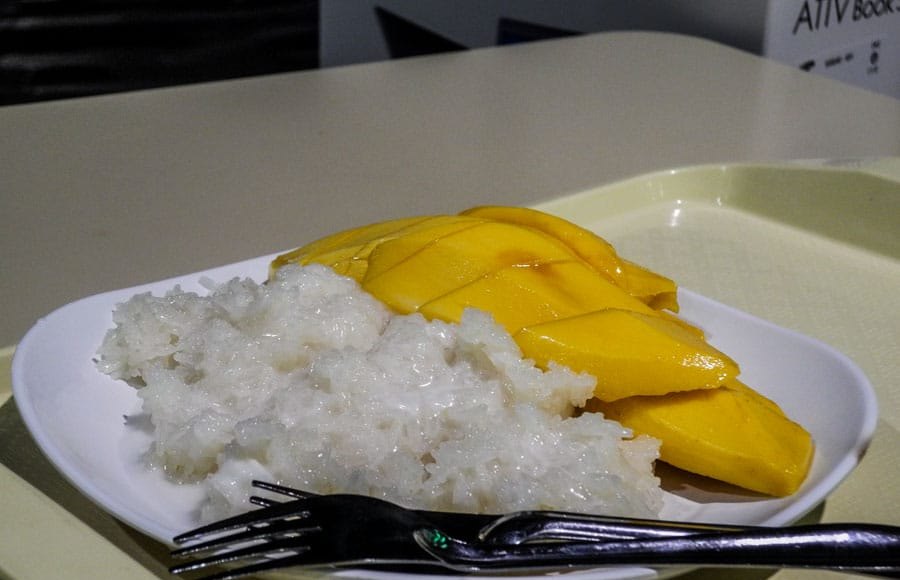
Mango contains a large amount of vitamin A, which helps with eyesight problems. Mango also cleanses the liver beautifully, speeds up weight loss, increases the elasticity of blood vessels and relieves both diarrhoea and constipation.
The tastiest fruits (whether green or yellow) are definitely soft to the touch. We diced the flesh onto a plate, or scored it into cubes and turned it inside out:
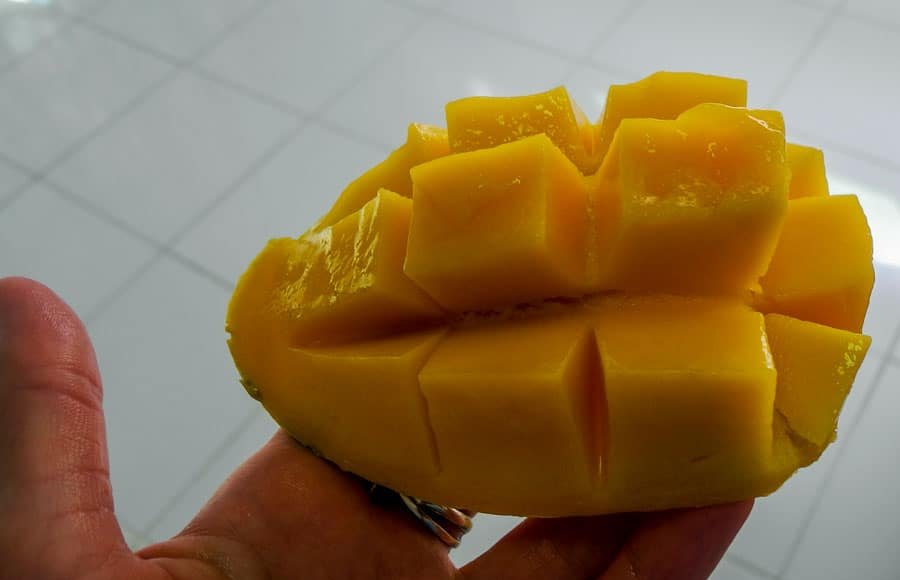
You can also cut it as in the picture above and slice off all the flesh in one motion with the rim of a glass, so that the skin stays outside while all the flesh ends up inside.
My favourite mangoes are the elongated, light-yellow ones:
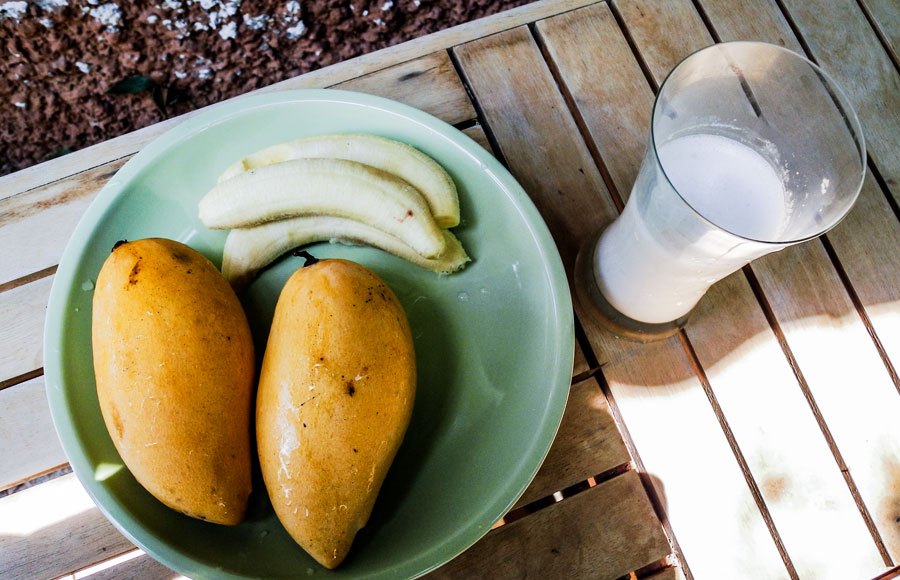
Price: from 20 to 120 baht per kg.
3.4. Sugar apple (noina, cherimoya)
Sugar-apple flesh is grainy — sweet with light pine notes. The peak season is in summer, but in Thailand noina is sold all year round; the tastiest fruits are sold in summer. Under the dense skin (almost like a mandarin’s) hides a tender cream with seeds that can be eaten straight with a spoon.
When you buy a ripe noina, it is very important not to pack it with other fruit but to carry it separately, as it squashes very easily.
The fruits look like huge fir cones:
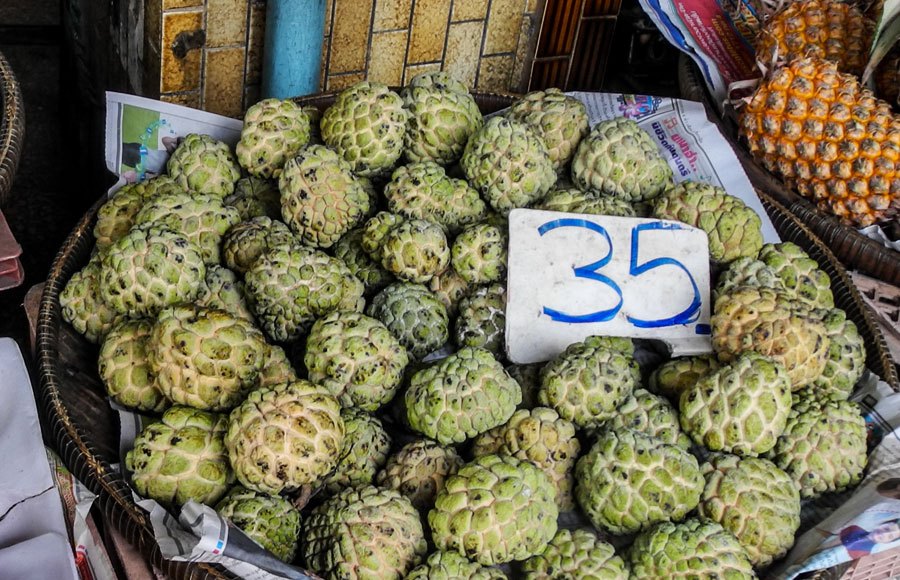
A ripe noina looks like this inside:
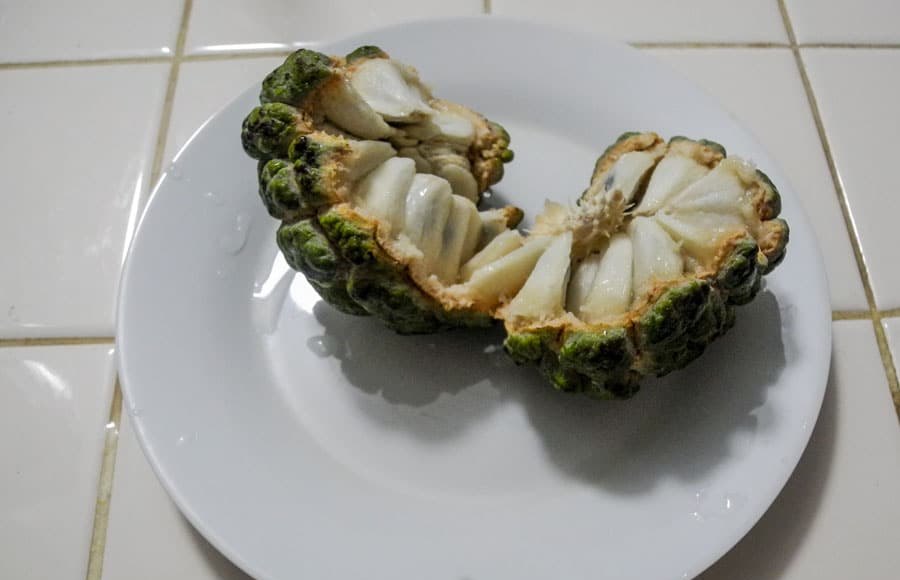
Cherimoya has a high concentration of fibre, vitamins A and C, and also magnesium, copper and potassium. Local people use sugar apples to treat such serious ailments as dysentery, diarrhoea and stomach ulcers.
The fruit is very nutritious and filling (94 kcal per 100 g). And the taste is simply extraordinary!
Price: 30–90 baht per kg.
3.5. Passion fruit
Passion fruit is a very interesting and tasty fruit. The most intensely flavoured is the purple passion fruit, with its rich sweet-sour taste. You will recognise the smell of passion fruit at once — it is exactly the aroma of multifruit juice blends.
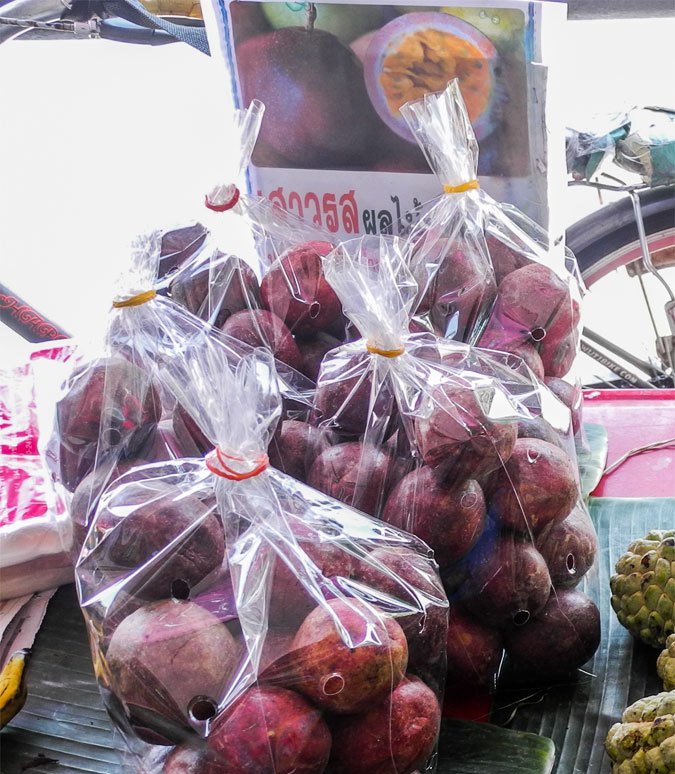
Under the thick shell (green or purple) hides tender, juicy, fragrant jelly with small seeds that has to be scooped out with a spoon. Delicious!
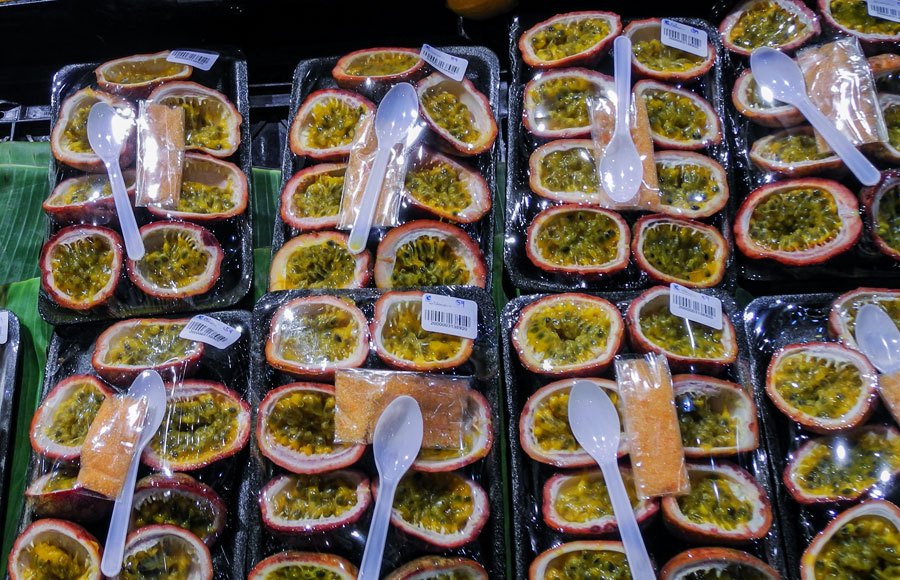
In the photo it is sold with spices, but that is more for locals. We recommend eating it without spices, at least the first time.
Passion fruit helps with insomnia and is good for the skin.
Price: 80–120 baht per kg.
3.6. Soursop
The taste of soursop (guyabano or guanabana) is unlike any other fruit. It feels as if you are eating real yoghurt! Snow-white fibres, like candyfloss, are generously soaked in sweet-sour juice. Incidentally, some fibres are so coarse they cannot be chewed (but that is the exception rather than the rule).
The whole fruit:
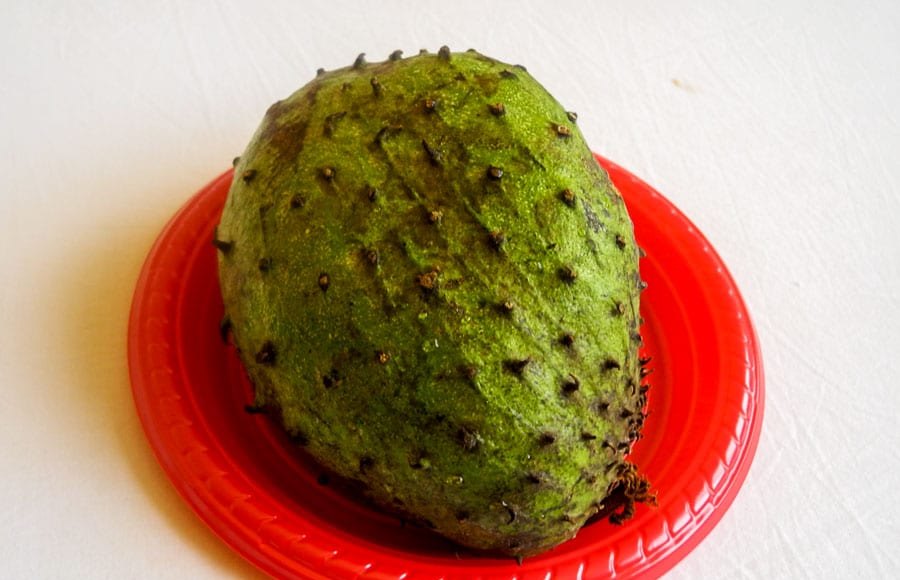
And cut open — real yoghurt:
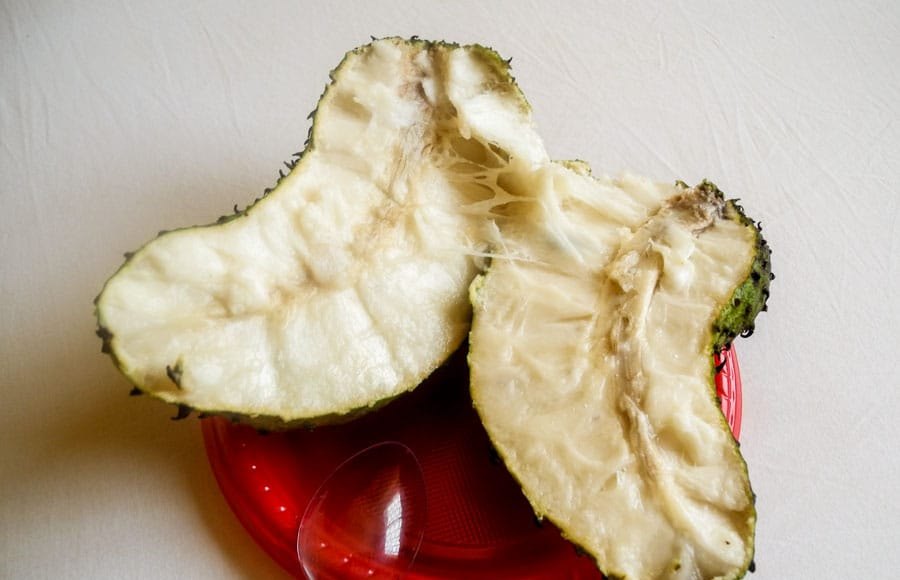
Soursop smells amazing! It is very hard to find in Thailand, but if you see it, buy it without fail — it is simply an incredible fruit.
4. Which fruit when: a calendar by region
This is the most useful thing we can add to the article. Almost every guidebook writes “durian season is summer”, and a traveller who arrives in Phuket in July or in Chanthaburi in May comes away empty-handed. In fact, the season of one and the same fruit shifts by two months between Thailand’s regions.
According to the Thai agricultural calendar BioThai (updated in April 2026):
- Durian, mangosteen, rambutan. The east of the country — Chanthaburi and Rayong — May and June. The south — July and August.
- Lychee. The centre — April. The north, around Chiang Mai — May to July.
- Longan. The north — August. In the east it is grown out of season and sold in December and January.
- Longkong. The east — July and August; the south — September and October.
- All year round you can buy coconut, banana, pineapple and papaya.
The calendar’s compilers themselves caution that this is the period of peak harvest for the main varieties in the main growing zones; timings differ for particular areas, and some varieties fruit several times a year.
If you are travelling in high season, from November to March: coconut, banana, pineapple and papaya are sold all year round, and among the seasonal fruits at that time it is worth looking for carambola (sold from October to December) and longan from the east of the country — it is grown out of season there and sold in December and January. Winter is not the season for durian, mangosteen and rambutan: if you do come across them, they will most likely cost more than in summer.
5. What fruit costs in 2026
The main thing that has changed since our trip is not what everyone expects. Durian has not gone up in price — it has been getting cheaper for the second year running: the nationwide average price has fallen to about 90 baht per kilogram. The reason is that the 2026 harvest grew by 21 per cent in one go, while exports barely changed — Vietnam took part of the Chinese market. The government even promised to buy durian from farmers at no less than a hundred baht.
At the same time, at a tourist stall in Pattaya the same durian easily costs 300 baht per kilogram. The difference between farm and resort is three- to fourfold — and that matters more than any average figure.
Where to buy cheapest
- Farmers’ pick-up trucks — the cheapest of all. Mango at four kilograms for 100 baht; mangosteen and rambutan at three kilograms for the same hundred.
- Local markets — Rompho and Thepprasit in Jomtien, Or Tor Kor and Chatuchak in Bangkok.
- Supermarkets — more expensive than markets, but predictable. Choice mango in a shopping centre costs 120–250 baht, against 20–60 at a farmers’ market.
- Tourist stalls — you overpay threefold. At the market by Mike Shopping Mall, mango goes for 60–80 baht, mangosteen for 100, lychee for 150.
Retail price benchmarks for 2026: durian 100–200 baht per kilogram, mangosteen 40–120, mango 30–100, rambutan 35–80, dragon fruit 20–100, papaya 30–70, coconut 25–60 each and 70–120 on the beach, watermelon 20–40.
Prices depend heavily on season and place, so we give ranges rather than exact figures. We could not find any published 2026 price lists from the supermarket chains.
6. What you can take out of the country without a fine
The article did not originally have this section, yet this is the question readers ask most often.
The myth of the eleven banned fruits
A list of eleven fruits that are supposedly “banned from export from Thailand” circulates online: durian, pomelo, grapes, longan, lychee, tamarind, coconut, salak, pineapple. The list is real — it hangs on the Suvarnabhumi Airport website. But it is not about that.
In the Thai original these are “phanthu phyt sanguan” — protected planting material. Article 30 of the Plant Act bans the export of saplings, cuttings and seeds of these crops, so that they do not end up with rival producers. The punishment is up to three years or four thousand baht. Fruit you intend to eat does not fall under this ban.
Bringing fruit INTO Thailand, though, really is banned
Hardly anyone writes about this — which is a shame. Fresh fruit without a phytosanitary certificate violates Thailand’s plant quarantine law: up to a year in prison, a fine of up to 20,000 baht, or both. The banned list is exactly what a traveller packs for the road — bananas, mango, papaya, pineapple, coconut.
Durian on the plane and in the hotel
Everyone writes about the durian ban on planes, in hotels and on the metro, but we were unable to verify it from primary sources: we found no confirmation on carriers’ official pages, and everything else is retellings in blogs. So, honestly: check with your own airline and your own hotel. The simple rule works everywhere — a tightly packed fruit that does not smell raises almost no questions.
Incidentally, from 1 September 2026 to 31 August 2027, seven Thai airlines carry a box of fruit up to 10 kilograms free of charge in checked luggage. But there are two caveats: this applies only to domestic flights from twenty regional airports (Suvarnabhumi and Phuket are not on the list), and durian is excluded from the offer.
What survives the journey and what does not
Firm mango without dents, slightly unripe pineapple, pomelo, hard guava and tamarind in its dry shell all travel well. Rambutan, lychee, ripe mangosteen, peeled jackfruit and soft noina travel badly.
And which tropical fruits do you love? Maybe you have tried other fruits I do not know about? What do you like most? Share in the comments!
Subscribe to our updates, and do not forget to share interesting posts with friends on social media!