I think that for anyone travelling around Turkey, one of the most vivid impressions is the cotton mountains of Pamukkale — snow-white travertine terraces formed by hot springs on a mountainside. When you are there, it seems as if nature has gone mad: the air temperature is +35 °C, yet you are standing on what looks like a snow-covered peak. The snow-white hills dazzle your eyes, while streams of hot spring water scorch your feet…
When I was planning our trip around Turkey, I did not yet know what the final route would be or which towns would be the most interesting to visit — but Pamukkale was an absolute must. That is why the route turned out to be not entirely straightforward: to reach Pamukkale from any resort town, you have to make a big detour into central Turkey.
Excursions are offered from every resort, but we wanted to go independently, to enjoy the beauty of these places to the full. In the end we decided to travel to Pamukkale after Kuşadası, and then go on from Pamukkale to Izmir. We ended up making a 400 km detour — but it was worth it!
1. At a glance
What are the Pamukkale travertines? They are snow-white limestone terraces on the slope of Mount Pamukkale — a unique natural formation made of travertine, the stone that hot spring water leaves behind. In 1988, Pamukkale and the ruins of the ancient city of Hierapolis were added to the UNESCO World Heritage List. As of September 2026, entry for foreigners costs 30 euros and the gates open at 8:00 — details below, in the “Practical information” section.
How did Mount Pamukkale come into being? Hundreds of thousands of years ago, severe earthquakes created fissures in the rock, through which natural geothermal springs began to flow. The water in the springs is supersaturated with calcium salts, which form solid calcium deposits as it evaporates. Over time, these deposits formed the snow-white mountain itself and the small terraces filled with water. The snow-white material that covers the whole of Mount Pamukkale is called travertine — a very fragile rock. Interestingly, travertine is found not only in Pamukkale: the largest travertine deposits are actually in Italy, which is where the term “travertine” comes from.
Translated from Turkish, Pamukkale means “cotton castle”. I have never seen cotton fields in bloom, but they say the fields turn a snow-white colour, and Pamukkale looks very similar.
2. Practical information
2.1. Where it is and how to get there
Pamukkale is in Denizli Province, so the easiest way is to travel first to the large city of Denizli and then take a local minibus to Pamukkale.
Pamukkale itself is a tiny village, so you can walk to the travertines from anywhere. But I recommend staying in a hotel as close as possible to the main travertine entrance, so that early in the morning you can get inside as quickly as possible.
Entrance location on the map:
2.2. Opening hours
As of early October 2026, winter hours are in effect. According to the reserve’s listing on the website of the Turkish Ministry of Culture and Tourism, muze.gov.tr, the South and North gates open at 8:00 and close at 18:00, and the ticket office is open until 17:00. The page of the Denizli Provincial Directorate of Culture and Tourism says that day tickets at the gates are sold until 18:00, but it is better to count on 17:00. The lower pedestrian entrance from the village, where you climb straight up the travertines, is open from 8:00 to 17:00 — after 17:00 you can no longer get up the mountain this way. There is currently no night-time visiting: in 2026 it ran only from 1 June to 1 October. In winter, Cleopatra’s Pool is open from 8:00 to 17:30. In summer the hours are longer, but the date of the switch to the summer schedule has not yet been published, so check it before your trip.
2.3. Admission prices (prices as of September 2026)
A ticket to the travertines and Hierapolis costs a foreign visitor 30 euros — a single ticket covers both places. Turkish citizens enter with a Müzekart museum card. The Hierapolis Archaeological Museum (a small building) is now free. Swimming in Cleopatra’s Pool is paid separately: 600 lira for foreigners over 12, 300 lira for children aged 7–12, and children under 6 swim free. After reconstruction, the pool reopened on 1 May 2026. According to local press reports, from 1 April 2027 the entrance ticket will go up to 35 euros.
Park tickets are sold at the ticket offices by the entrances, and can be bought in advance on the official website of the Turkish Ministry of Culture and Tourism, muze.gov.tr. Tickets for Cleopatra’s Pool are bought inside, at its own ticket office — MuseumPass cards are not valid there.
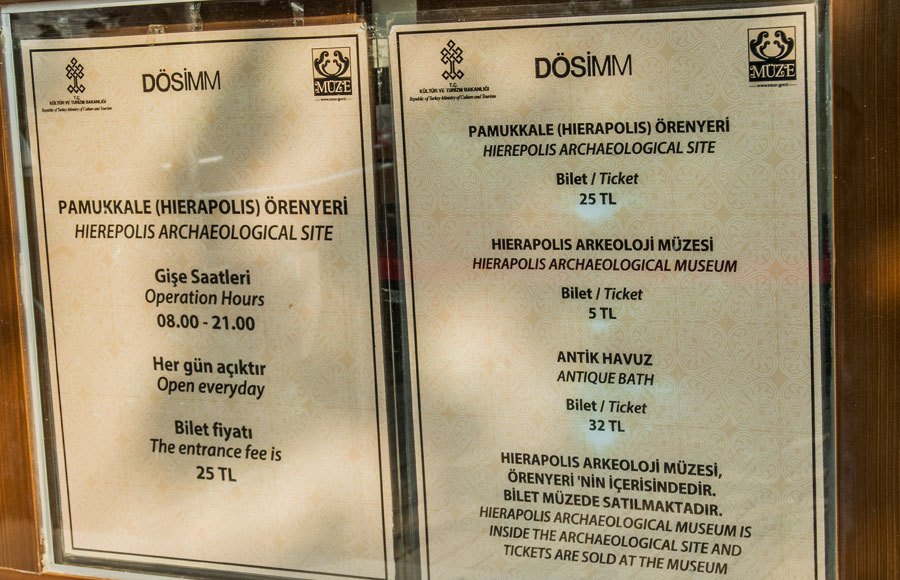
This is what the price board looked like at the time of our visit — prices are different now (see above):
3. A photo walk around the Pamukkale travertines
And now, at last, let us see what this stunning natural monument looks like!
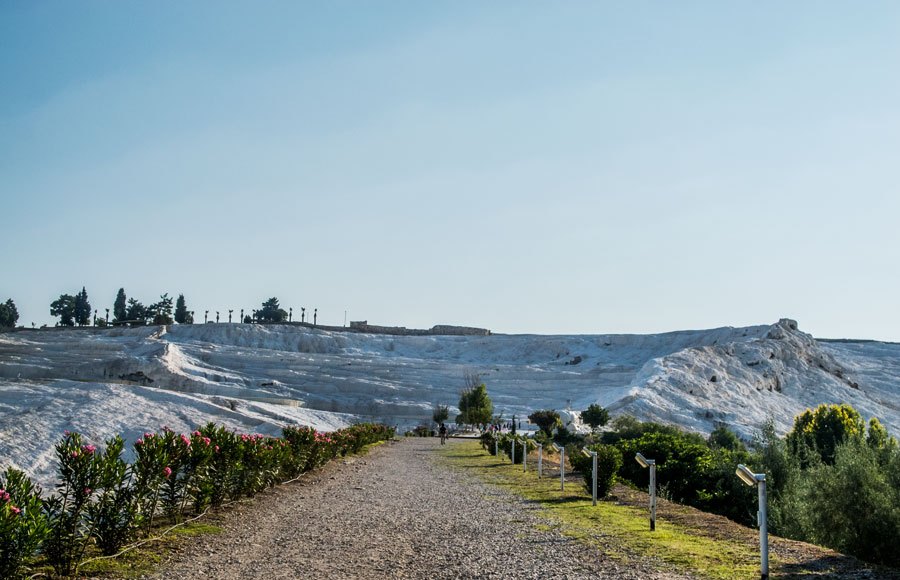
From the main road, a path like this leads to the travertine entrance, with the huge mountains of Pamukkale visible in the distance:
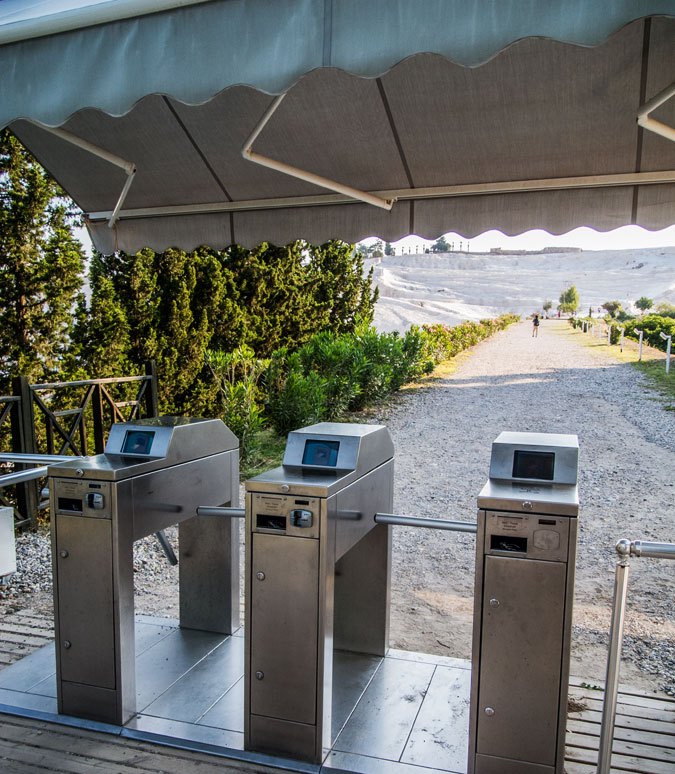
After the ticket offices, we go through the turnstiles with our tickets:
I have read on forums that some budget travellers find loopholes to avoid paying for entry — for example, they arrive before the travertines officially open, at around 6:00–7:00 in the morning. But other sources write that guards are now on duty at the entrance from sunrise.
Some people write that you can walk around the travertines and get onto the site from the other side. While walking around Pamukkale, we went quite a long way from the main entrance, but there were no paths or even remotely convenient approaches to the travertines. So if you have somehow managed to get in for free, do describe your experience in the comments.
And here the travertines begin. You are not allowed to walk on them in shoes, so as not to damage the fragile structure — so off come the shoes and on we go:
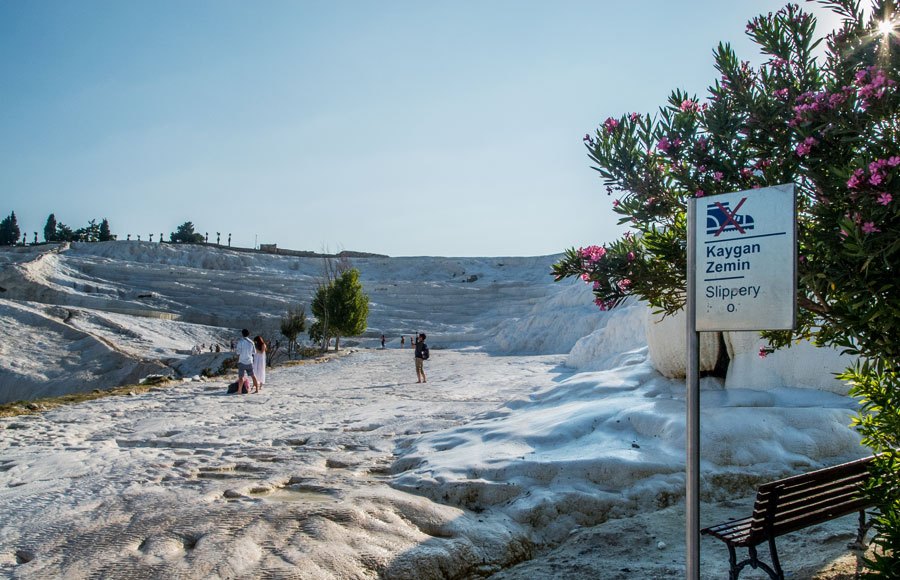
Early in the morning there are few people on the travertines — a Chinese couple was having a photo shoot; the pictures will probably turn out fabulous!
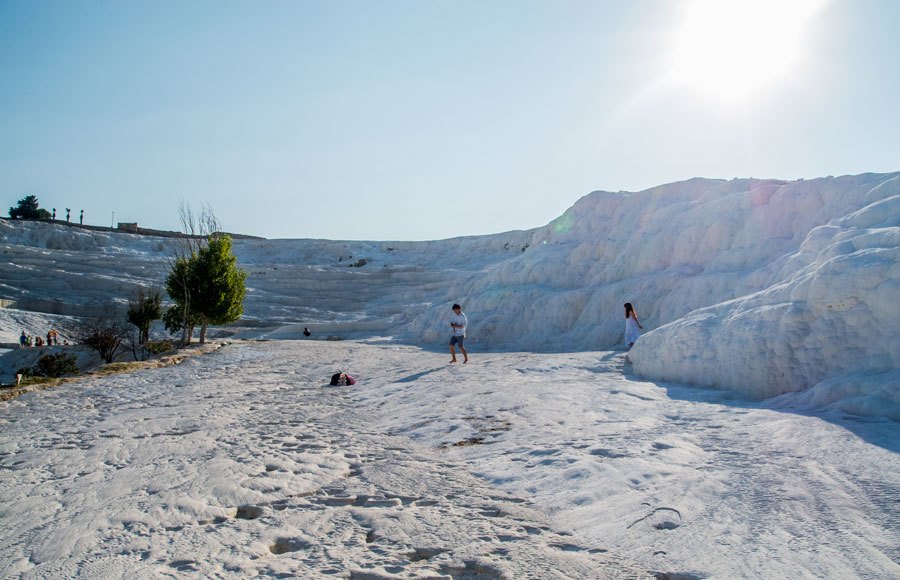
It is hard to believe that all of this is calcium deposits and not ice at all:
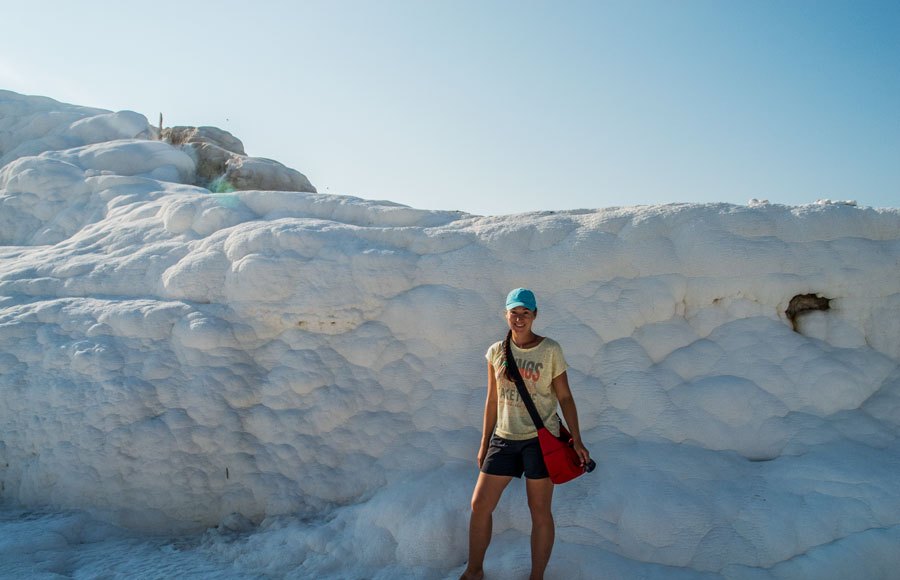
By the way, the travertines are quite cool in the morning; they are warm only in the places where spring water runs. Here, for example, in the shade, the surface is cool:
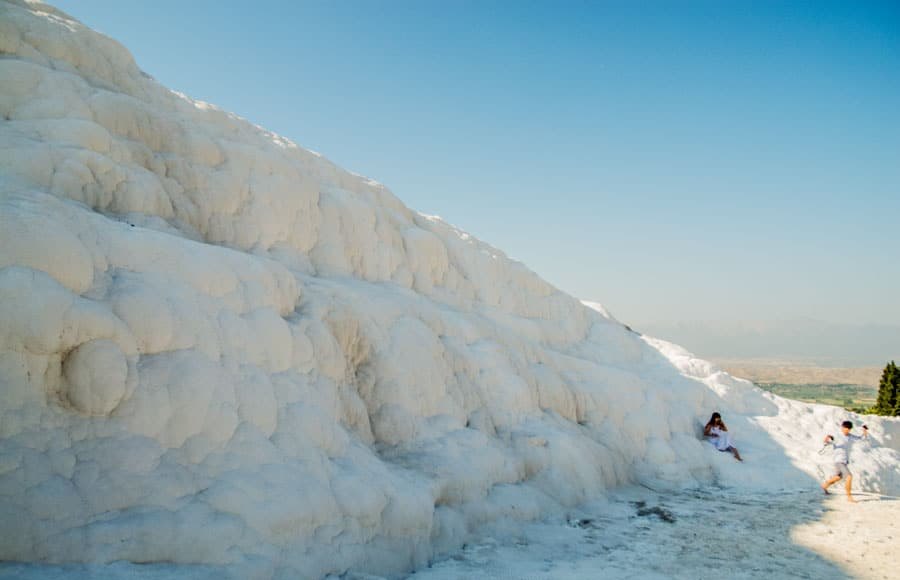
You can warm your feet in this little stream — the water is as hot as in a bath:
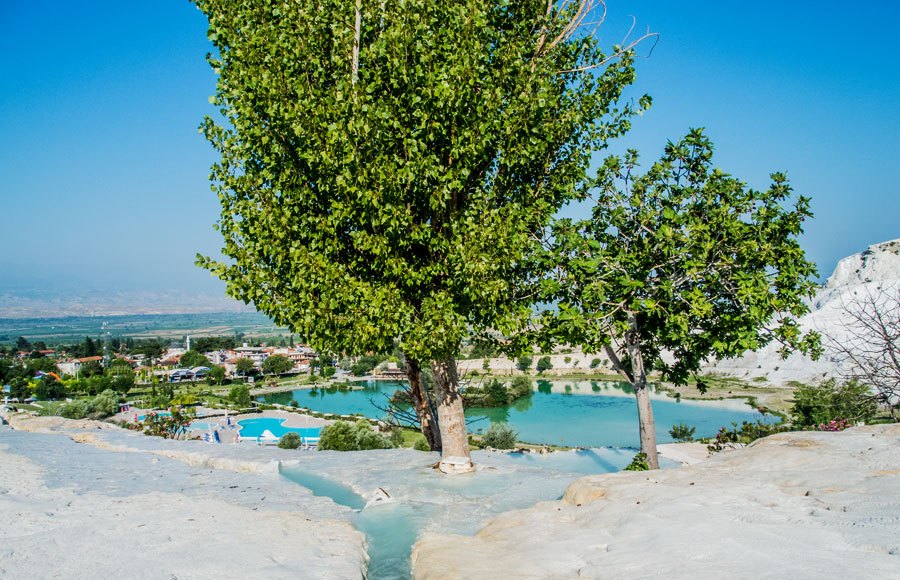
And here is one of the travertine pools with thermal water:
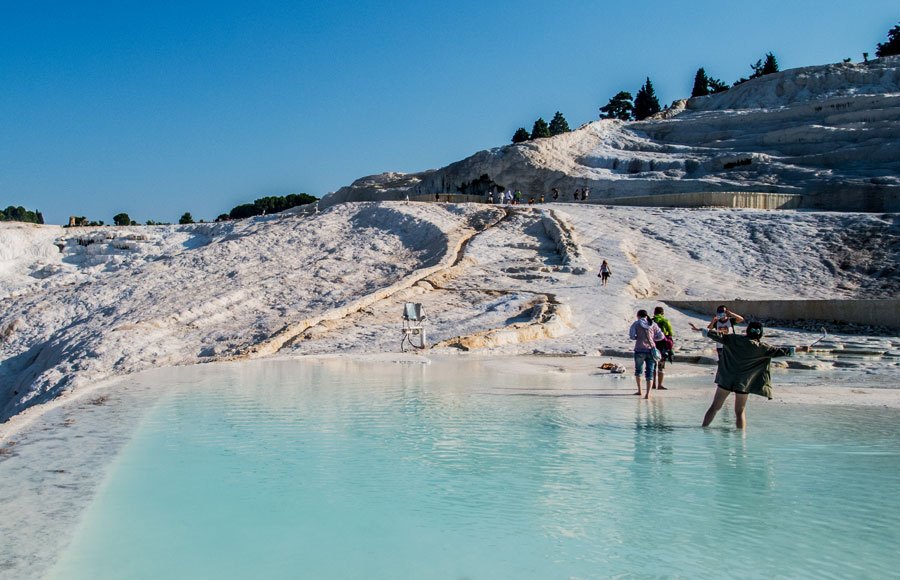
These pools feel strange — calcium salts gather on the bottom and gradually begin to thicken, turning into a jelly-like mass. It feels as if you are walking on some kind of warm, sticky dough. But be careful — there can be small stones on the bottom that you cannot see at all, because the water is not transparent:
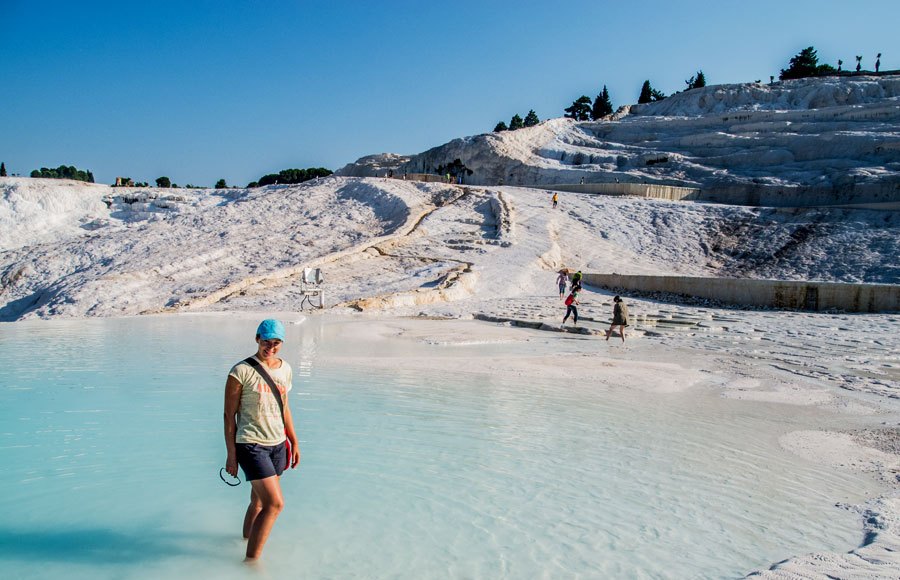
The pools are not deep at all — no more than half a metre even in the deepest places:
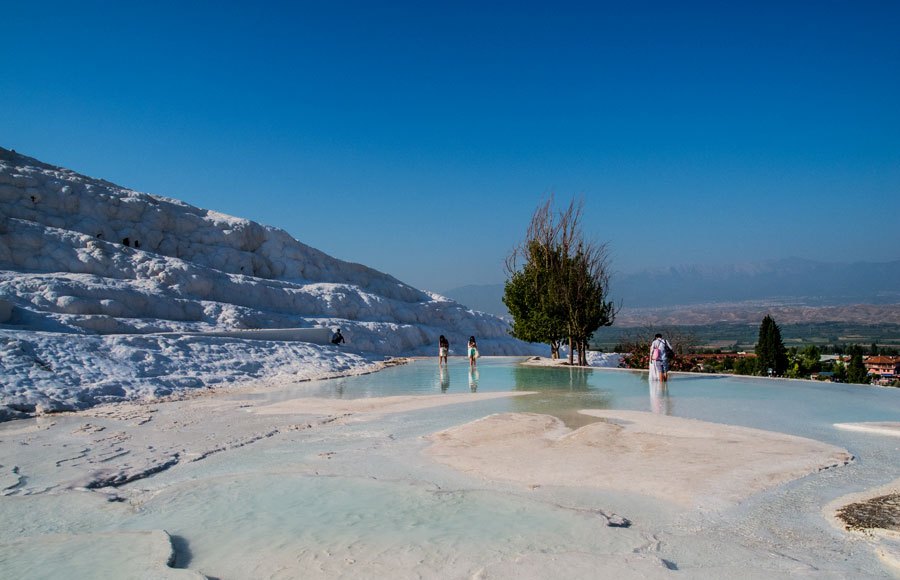
There are no special paths up the mountain; you simply have to climb higher and higher. It looks very slippery here, with water running over it too:
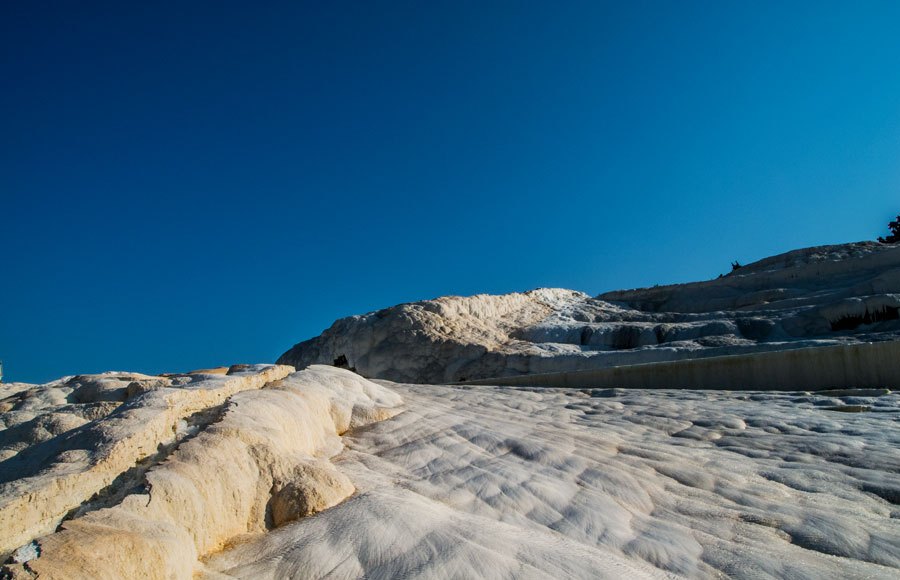
But in fact the surface is not slippery at all — it is even slightly rough, so walking is very easy:
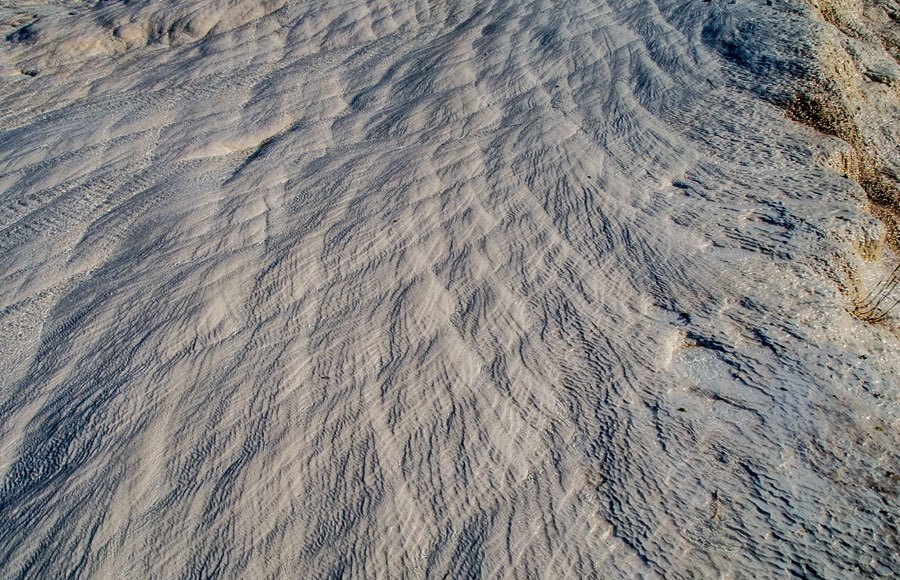
Look at these fairytale landscapes! Don’t they look just like icicles?
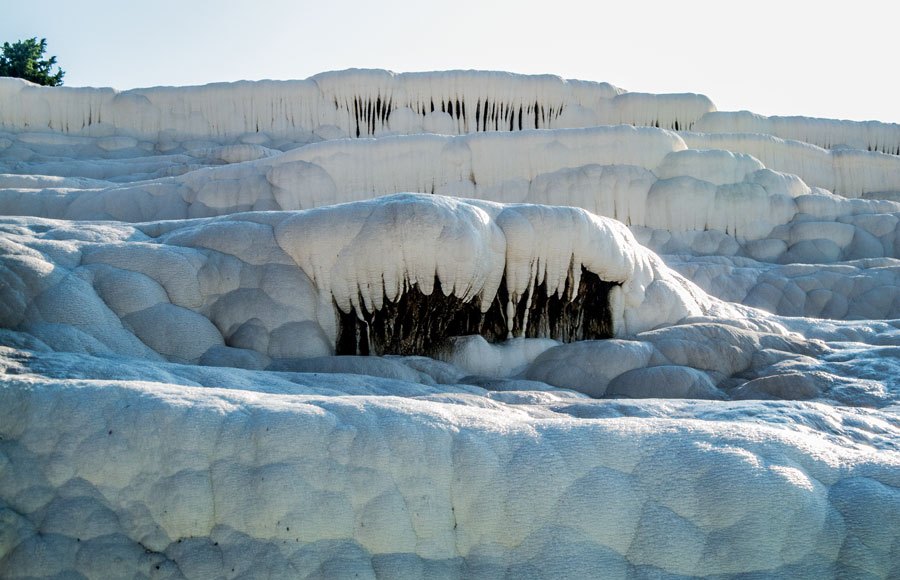
From below, each pool looks roughly like this:
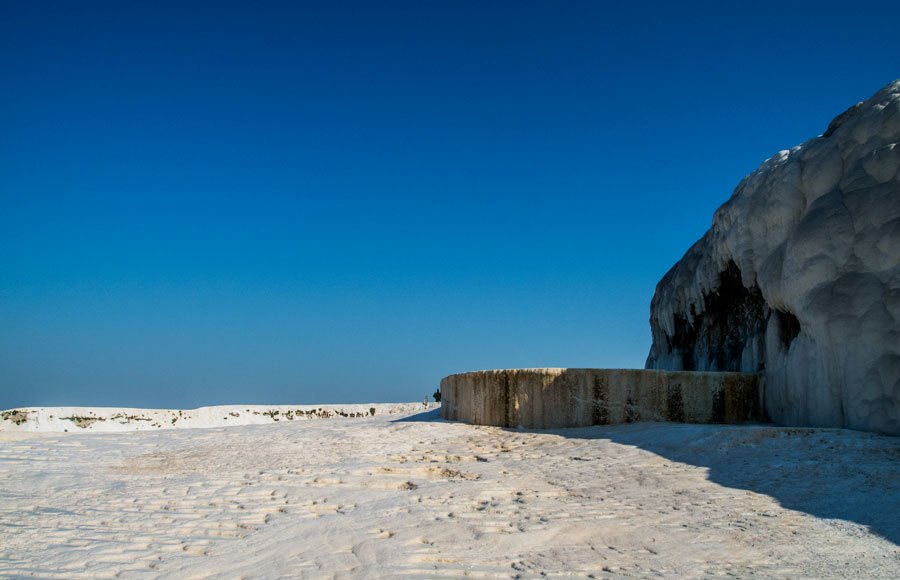
And from above, like this — a whole staircase of pools:
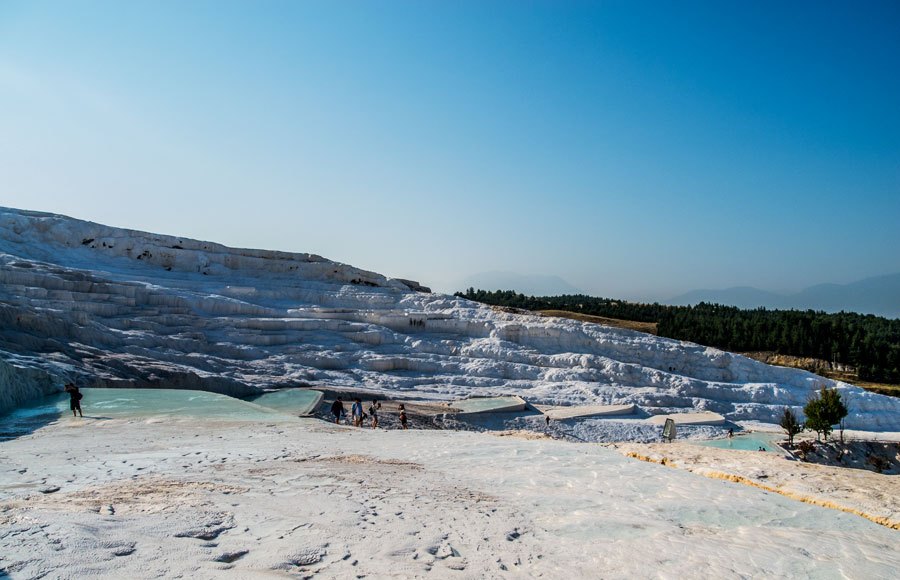
And I would love to believe that these are genuine natural pools — but let me reveal a terrible secret! All the “travertine” pools on this side are man-made! They were made specially for tourists, which is why they look so neat and tidy. First, concrete pool bowls were built on this side, and then the flow of the springs was adjusted so that they ran this way and covered the artificial pools with real calcium deposits. So the water here, at least, is genuine — and healing:
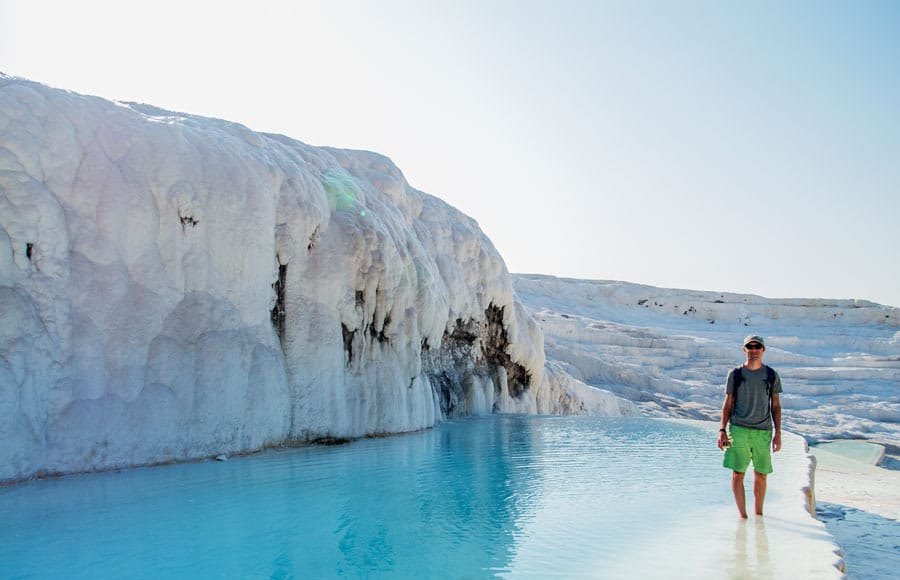
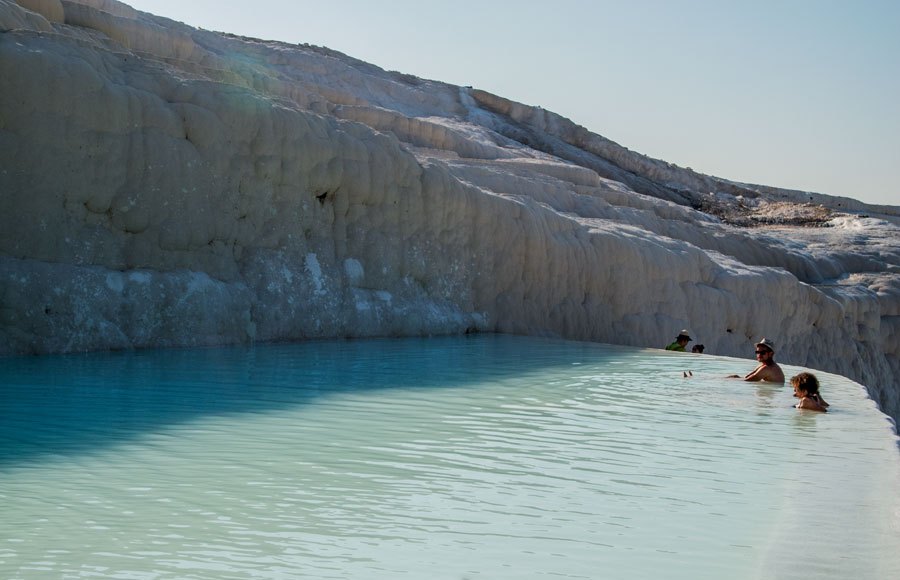
Some tourists bathe right in the travertine terraces, so if you want to warm up in the hot water, you can head up the mountain in your swimwear straight away:
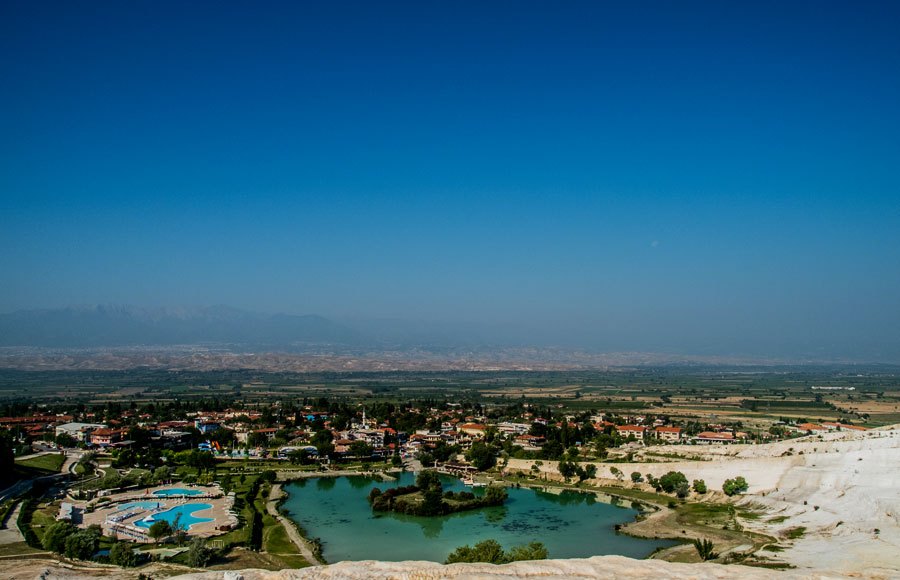
From the mountain there is an excellent view of Pamukkale village and the park at the foot of the mountain:
You can sit and admire the views:
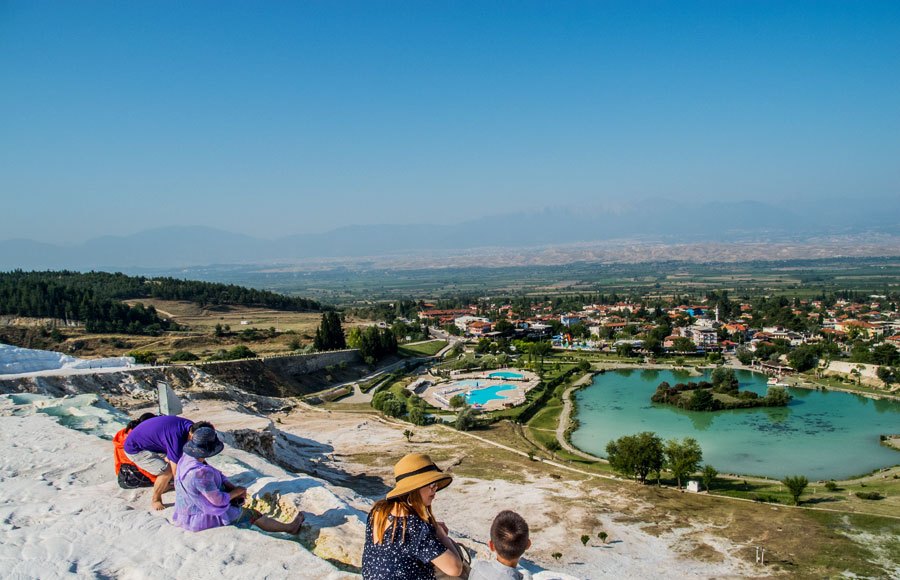
By the way, you get sunburnt very quickly in Pamukkale — despite using sunscreen, we got quite badly burnt, so do not forget to bring both cream and long clothing. And on the left, in the distance, the ruins of Hierapolis are already visible:
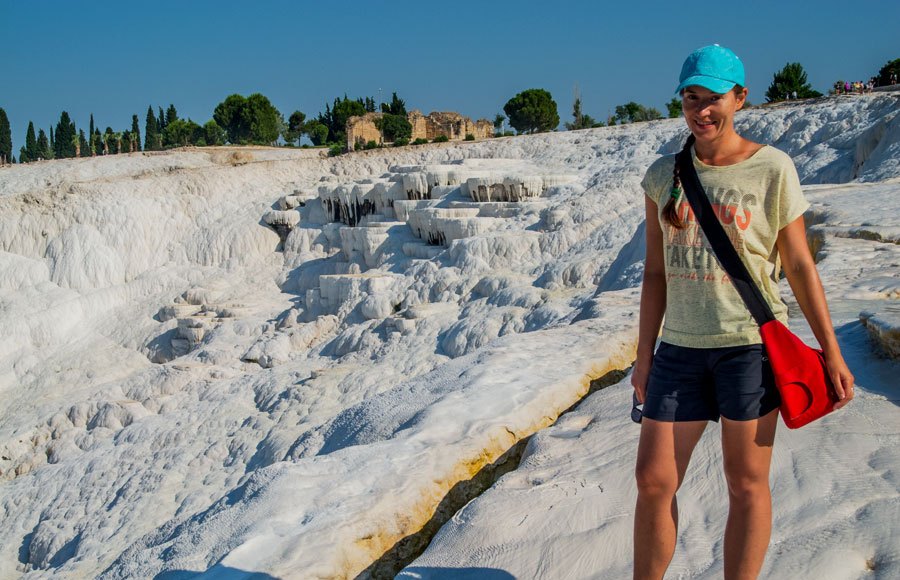
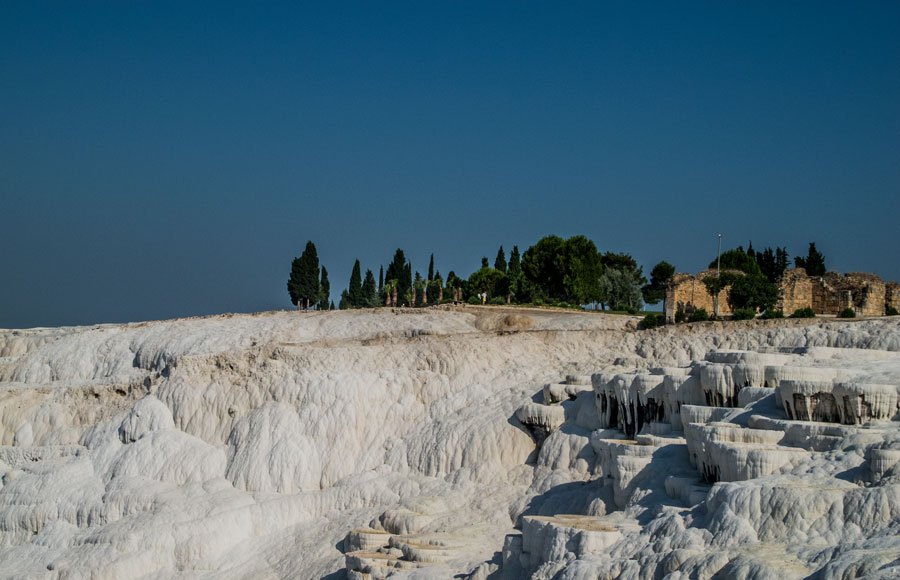
Travertine terraces without water no longer look quite so stunning:
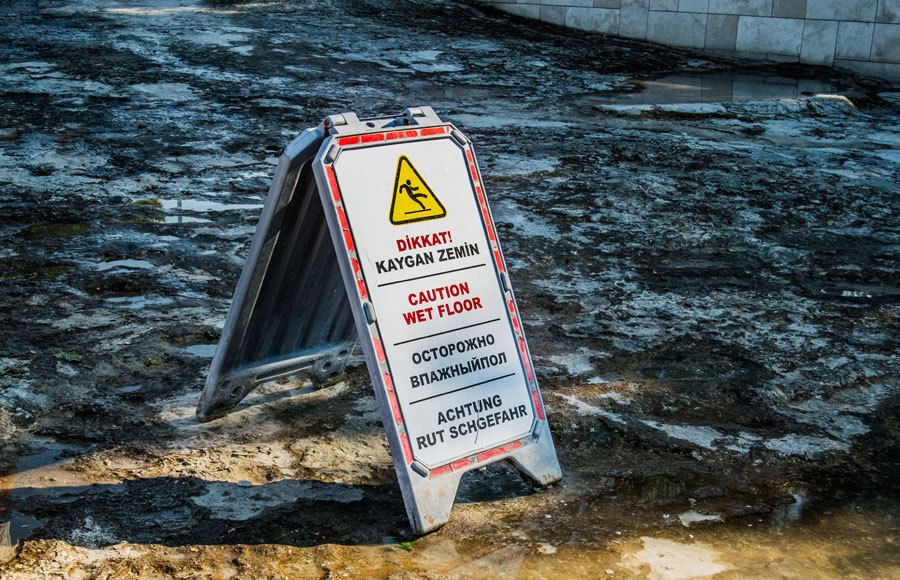
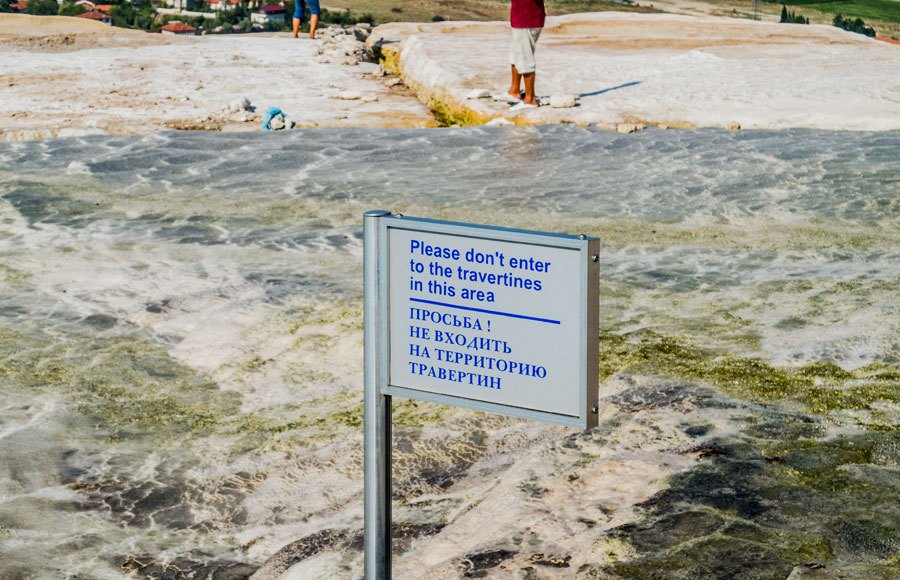
A warning in Turkish, English, Russian and German — you can see straight away where most of the tourists come from:
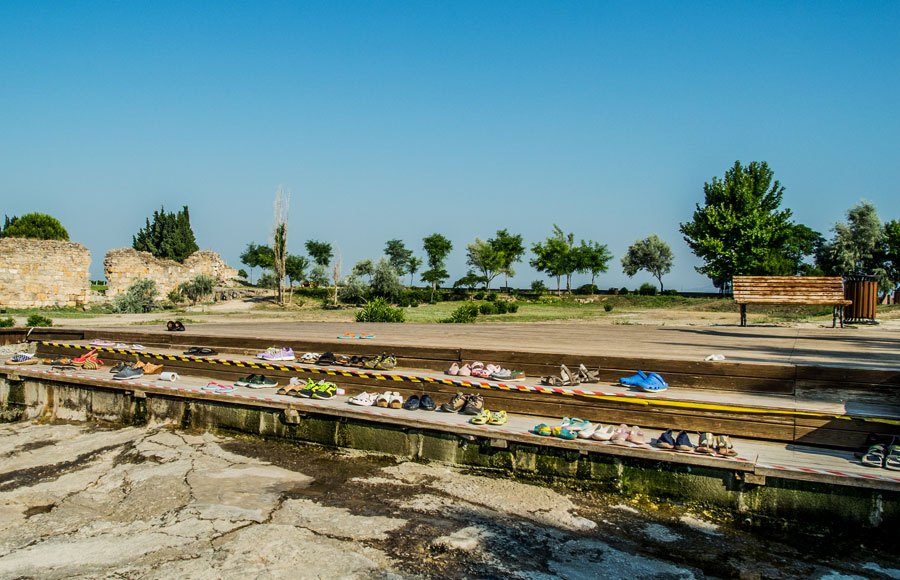
At last we reached the top of the mountain! Here you can put your shoes back on and walk on. Many people, by the way, leave their shoes right here (tourists who arrive at the other entrance to Pamukkale park):
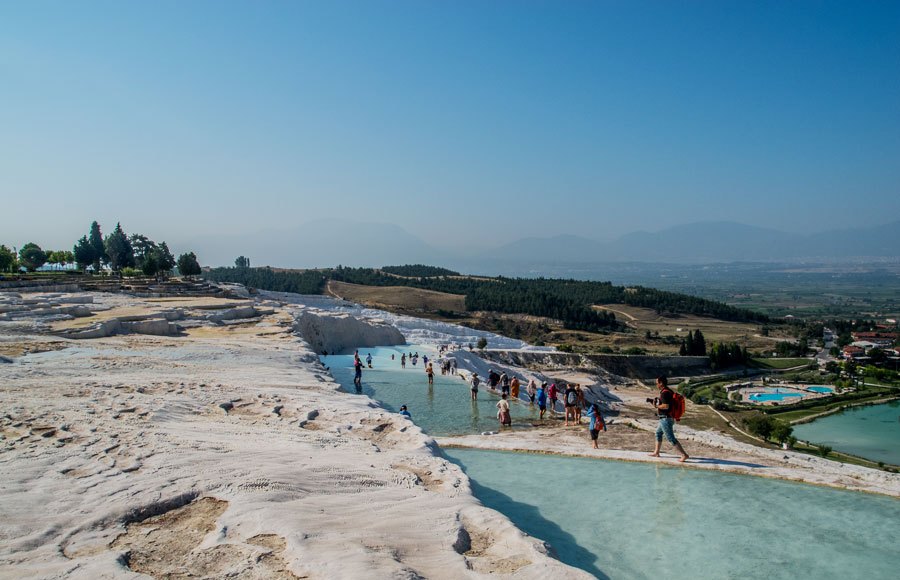
For comparison, I took photos of Pamukkale at different times of day. We climbed the mountain at around 9:00–10:00 in the morning; there were relatively few tourists, and almost all of them had arrived independently:
And now the same place after 15:00, when the tour buses with tourists have arrived:
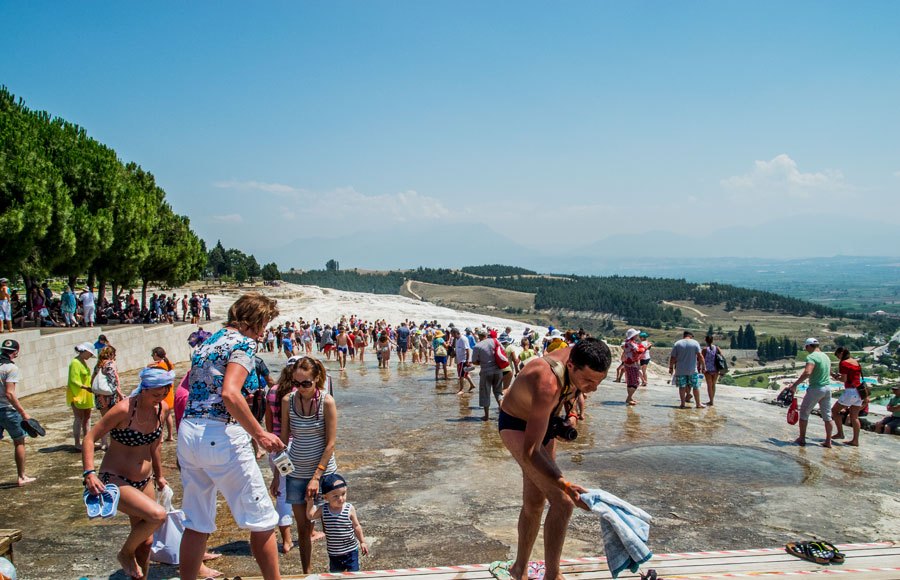
Can you feel the difference? Do you still want to travel with tour groups and guides?
In a crowd like this it is quite difficult not only to take a decent shot, but even simply to walk:
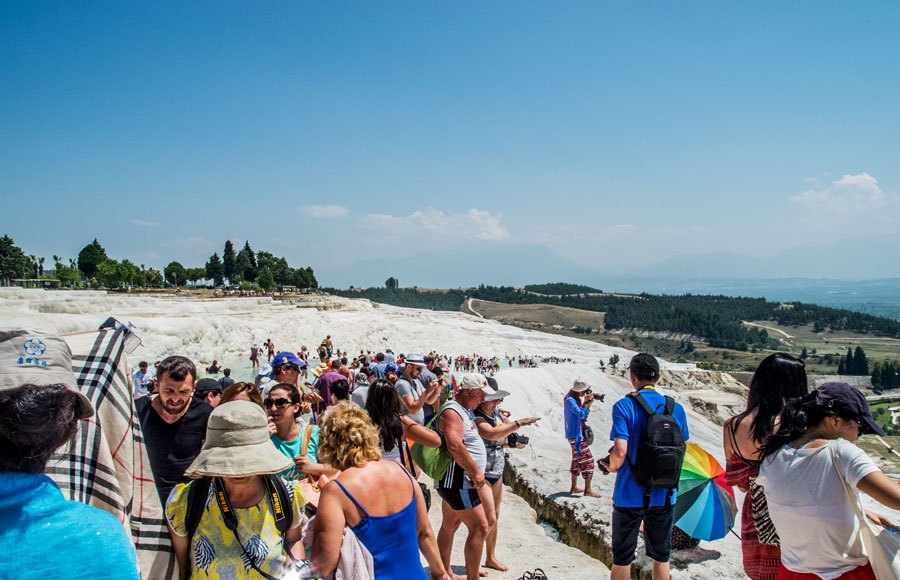
But let us leave all these tourists behind and go in search of the real travertine terraces! Straight after climbing the mountain, you can head directly towards Hierapolis, or you can wander around the surroundings a little to see the other side of the mountain. As we had plenty of time (we were leaving Pamukkale only the next day), we decided to go for a walk first.
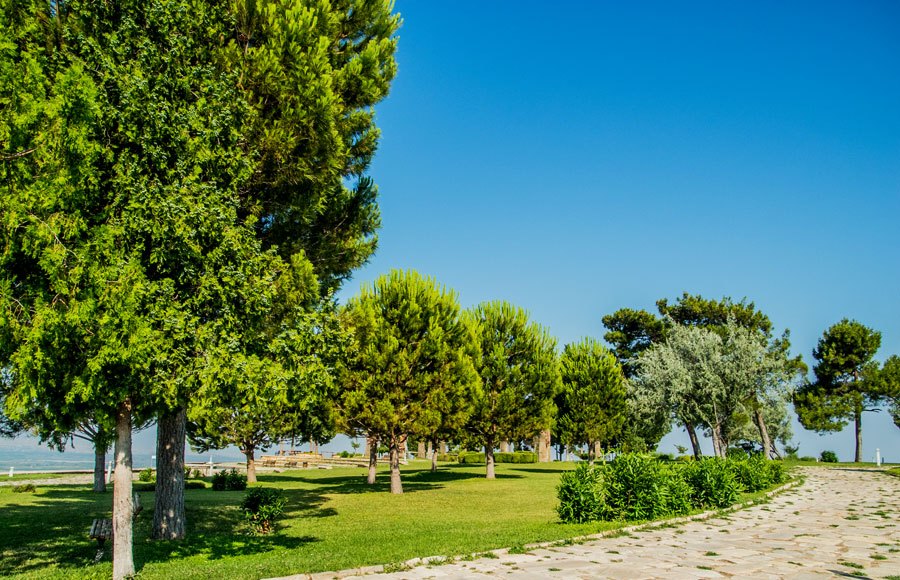
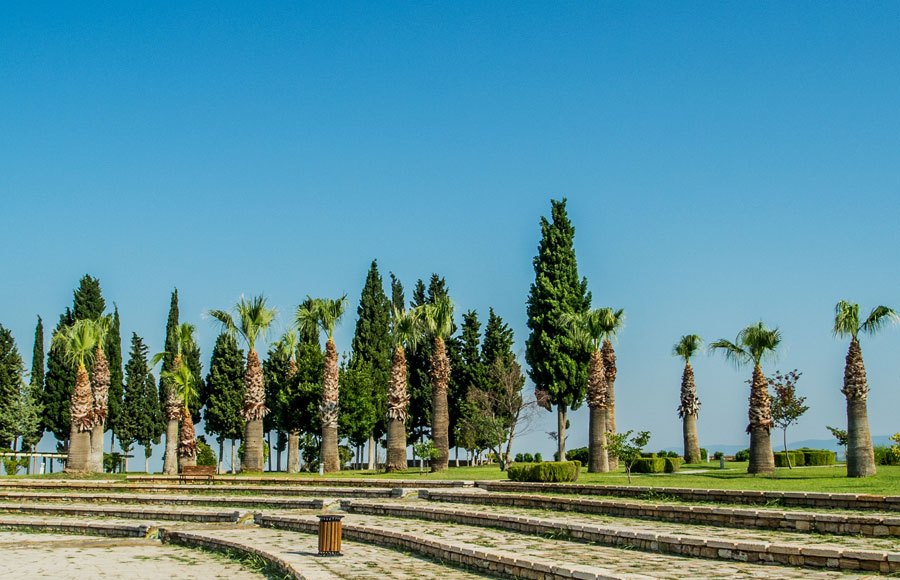
At the top of the mountain there is a beautifully landscaped green park:
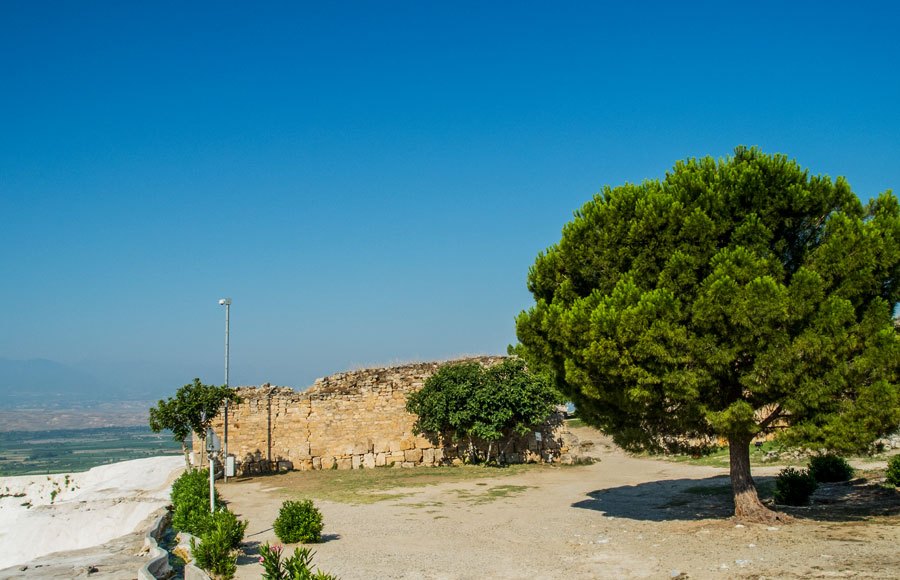
Convenient paths and pleasant lawns for picnics:
Some terraces have now dried up because the water has been redirected elsewhere. In old photos you could see this very stepped terrace with turquoise water, but now it is deserted here:
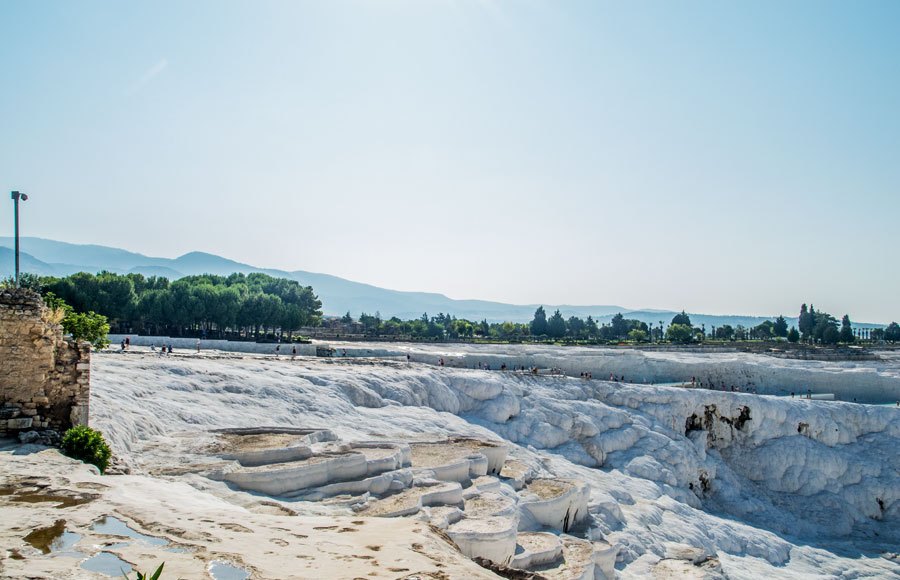
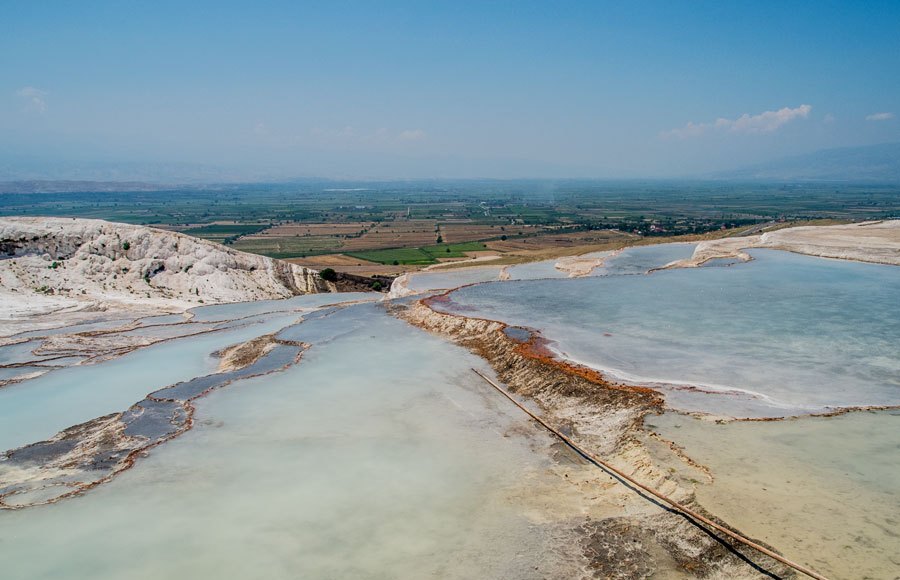
And here are the real travertine terraces — they look nothing like the artificial pools. They are lower, and there are far more pools:
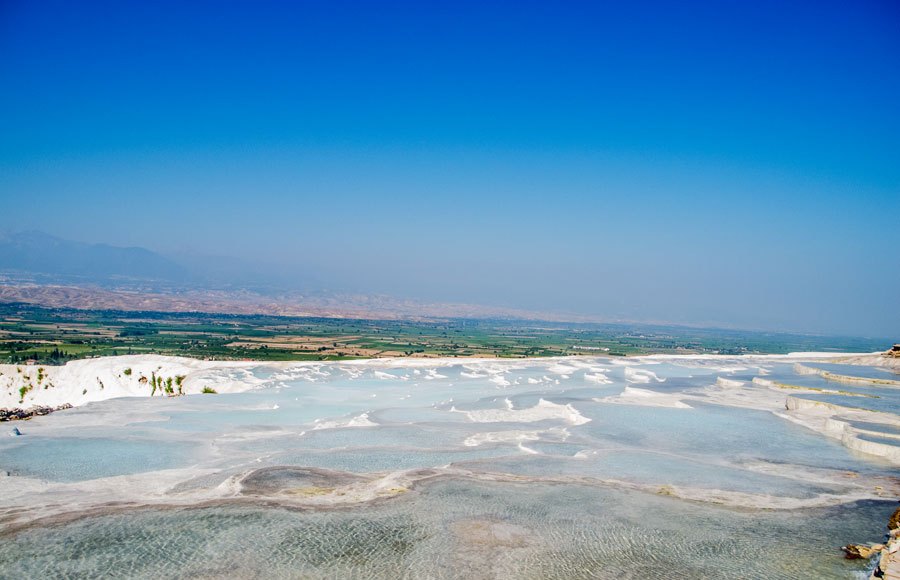
Along this path you can walk around the mountain and look at the real travertines:
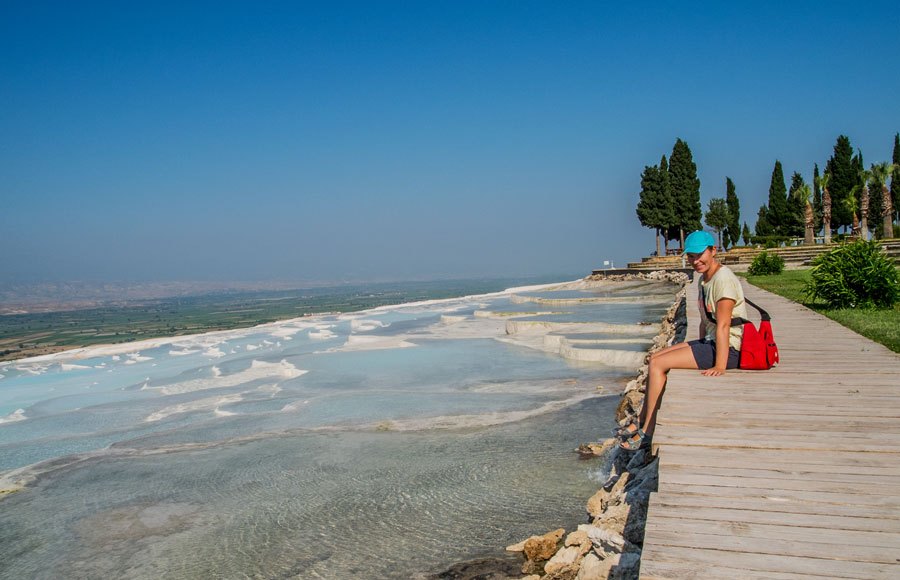
The park is gorgeous — why do package tourists never come here, when it is so beautiful too?
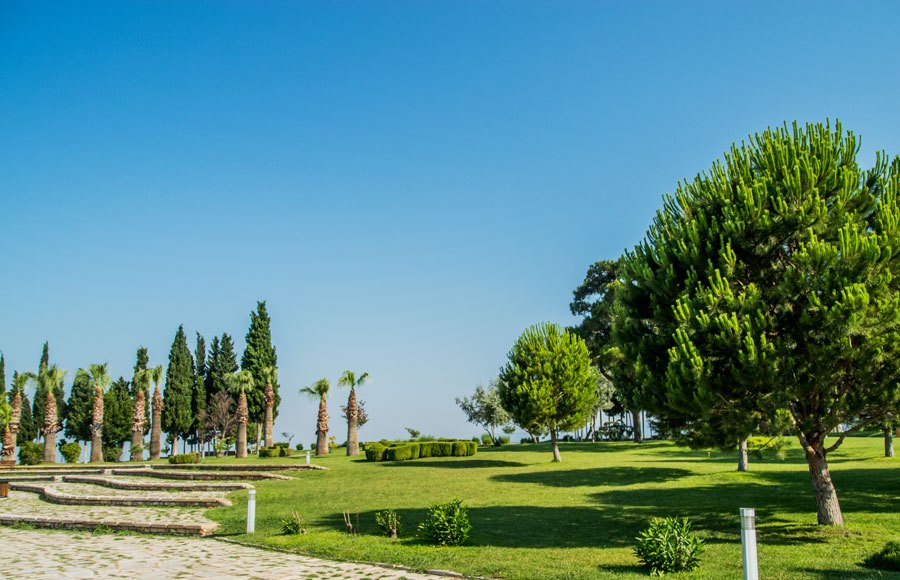
The steps have been made to look like the travertines themselves, also in a cascade:
Real travertine is quite fragile, so it is easily damaged. Tourists are not allowed to walk here — only park workers, who at the moment this photo was taken were adjusting the flow of water from the spring, building small dams in the channel:
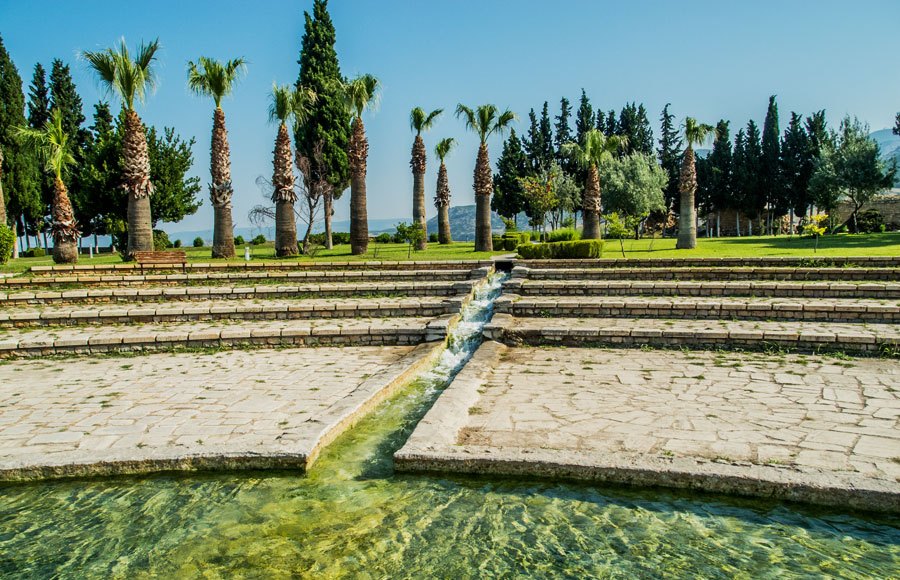
Water from the hot springs flows through the whole park, and the springs themselves are higher up, at Cleopatra’s Pool:
Completely dry travertines:
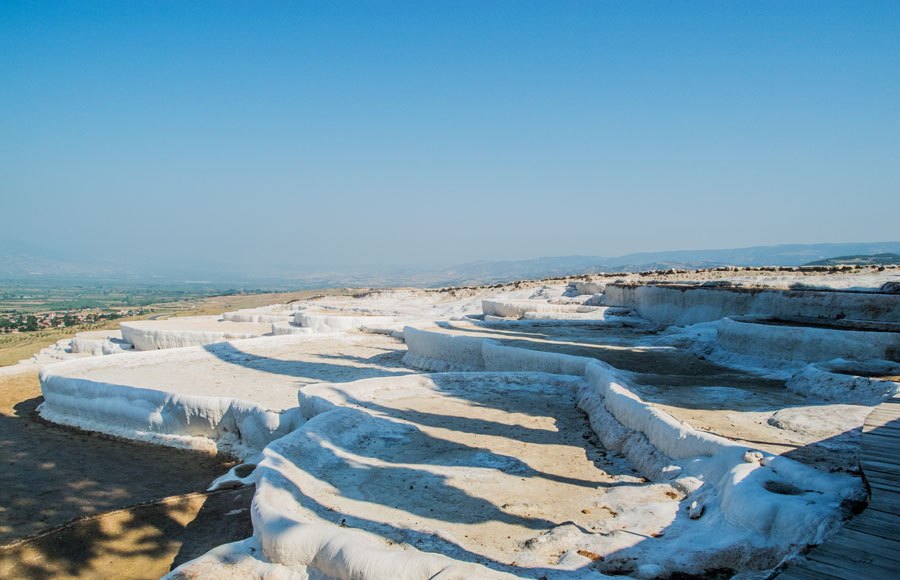
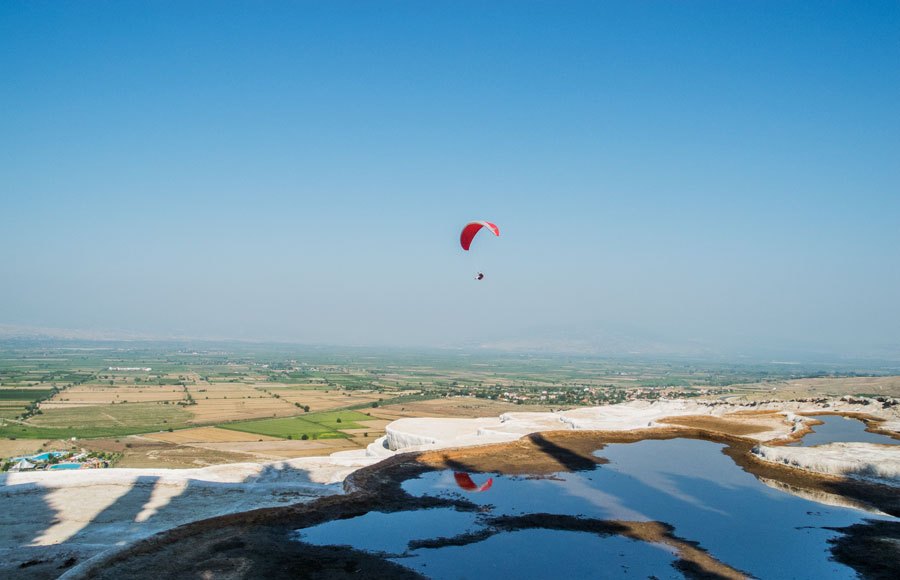
By the way, paragliding is popular in Pamukkale — you can admire Pamukkale and Hierapolis from a bird’s-eye view:
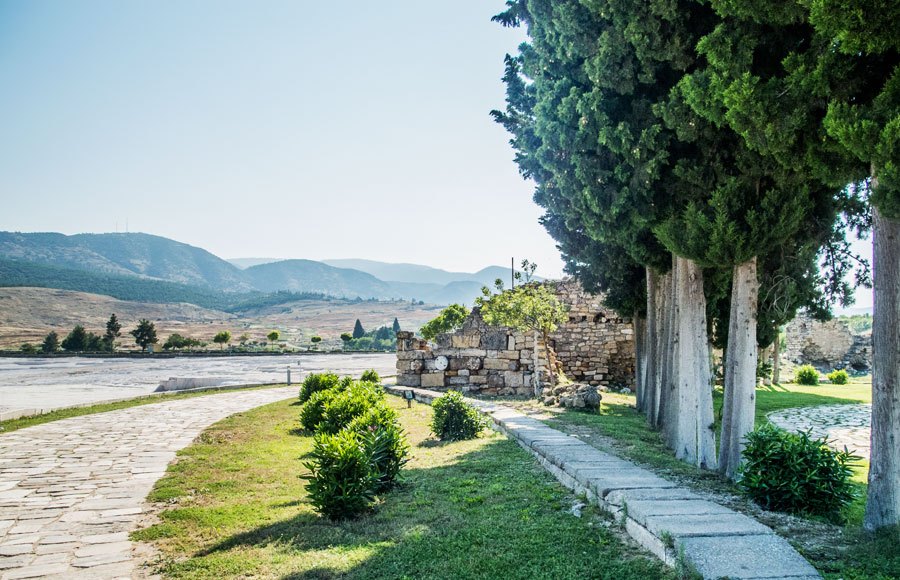
The path goes around the park, and beyond it are the ruins of Hierapolis:
The real Pamukkale travertines, which tourists are not allowed to enter:
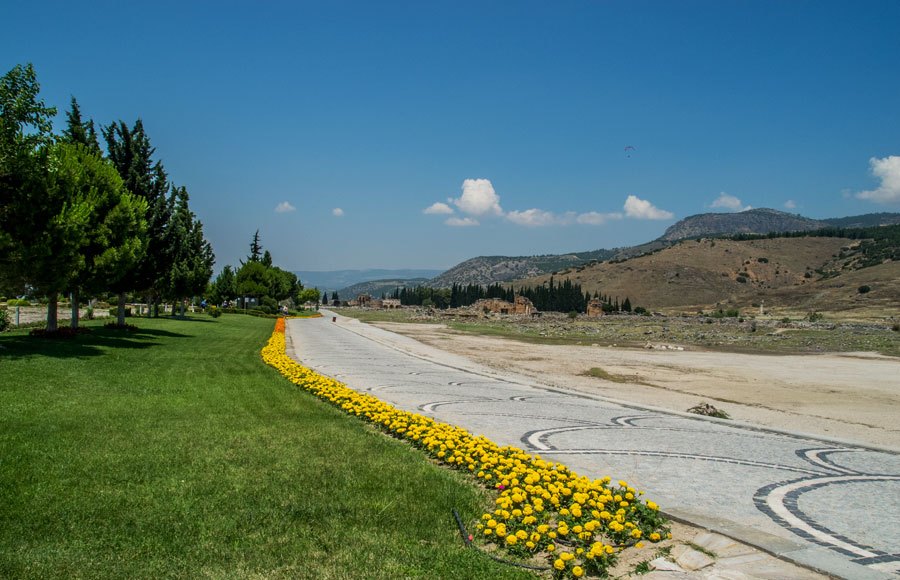
This flower-lined path leads to the gates of the ancient city of Hierapolis.
Look who we found right in the flowers! Such a cutie! Apparently hiding from the sun:

4. Conclusions
The Pamukkale travertines are simply a stunning wonder of the world! You absolutely have to come here at least once in your life — it makes a colossal impression! The landscapes are simply otherworldly! After our many journeys, few things make a strong impression, but unusual natural sites like this really stay with you. The place is, of course, very touristy and much hyped, so it is almost always very crowded. But you can come early in the morning and enjoy the beauty of Pamukkale in peace and quiet.
If you have enough time, it is of course better to go to Pamukkale independently: arrive in the evening and check into a hotel, then set off for the “cotton” mountain first thing the next morning. We wandered around Pamukkale and Hierapolis for a full 8 hours! And we still did not manage to see everything, so I cannot even imagine how anything can be done in the 4 hours that a standard excursion lasts — especially as tourists try to devote most of that time to bathing in the healing waters. Here is a secret for you: at the foot of the mountain, in Pamukkale park, the very same healing water flows, and at the time of our visit entry there was free.
Be sure to take with you hats, long clothing (to avoid getting burnt), sunscreen, water and some kind of snack. In principle, you can eat at Cleopatra’s Pool, but the prices there are steep. Inside the pool complex there are toilets, shower cubicles and lockers.
Tell us in the comments: have you bathed in the hot springs of Pamukkale? How much time did you spend on the trip? Did you get there independently or through a tour company? What impressions did you take away?