Public transport in Prague serves an exceptionally important function: it connects the districts of a huge city. As you would expect, there are several types of transport, each with its own features and timetable. In this article you will learn which types of transport Prague has, which tickets are the best value, and a few other useful things.
Paying for travel in brief (prices checked in September 2026). A single ticket is valid on all city transport: the metro, trams, buses, trolleybuses and ferries. A 30-minute ticket costs 39 CZK, a 90-minute ticket 50 CZK, a 24-hour ticket 150 CZK and a 72-hour ticket 350 CZK; in the PID Lítačka app each of them is cheaper: 36, 46, 140 and 340 CZK. You can buy a ticket in the app, from a machine at a stop or in a metro vestibule, or at a tobacconist’s or newsstand; on a tram, city bus or trolleybus you can pay by bank card at the terminal in the middle of the car or by the second doors (contactless only — 30-minute, 90-minute and 24-hour tickets are sold this way). A paper ticket must be validated before the journey, and travelling without a ticket carries a fine of 2,000 CZK. Each method is described in detail in section 3.
1. The different types of transport
Prague’s municipal transport comprises trams, buses, trolleybuses, the metro and a funicular, plus ferries. I will go through each type in more detail below. Trolleybuses have returned to the city: as of September 2026, lines 58, 59 (from the airport to Nádraží Veleslavín metro station) and 52 run in regular service, and two more — 51 and 53 — operate on a trial basis. The tickets are the same as on all other city transport.
You can also hire a car through one of the car-sharing services or through an online booking service. You need to carry an International Driving Permit and to have held a licence for at least 3 years (some companies require this, or charge a high price if your experience is shorter). You then leave a deposit, sign the paperwork and collect the car. Important: the car is handed over with a full tank and must be returned the same way.
The cost of car hire in Prague depends on the season and the class of car, and the easiest way to check current prices for your dates is to compare them online — the cheapest options are usually economy-class cars such as the Skoda Fabia.
Prague also has taxis, of course. They all carry a special roof light with the appropriate wording. Inside there must be a clear price list, and the company’s name and licence number must appear on the doors. At the end of the ride the driver must give you a receipt from the taximeter showing the price of the journey. Since 1 August 2026 the city has set maximum, all-inclusive prices for taxis with a taximeter.
They consist of three components:
- the pick-up charge (no more than 70 CZK);
- the waiting charge (no more than 7 CZK/minute);
- the journey charge (no more than 42 CZK/km).
It is better to book a car in advance, so that you know the fare straight away. The phone number of one taxi company (Modrý anděl): +420 737 222 333.
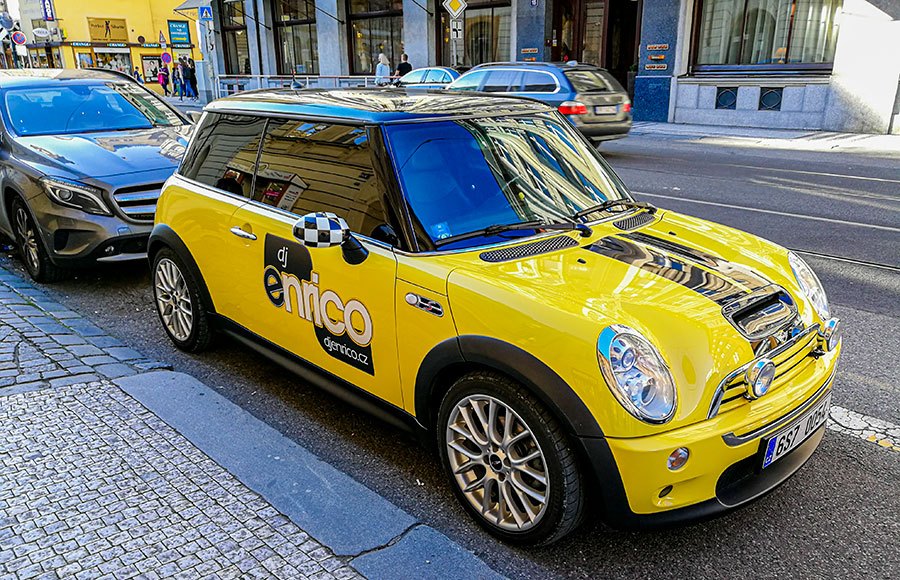
This car may be yellow with chequered mirrors, but it is not a taxi!
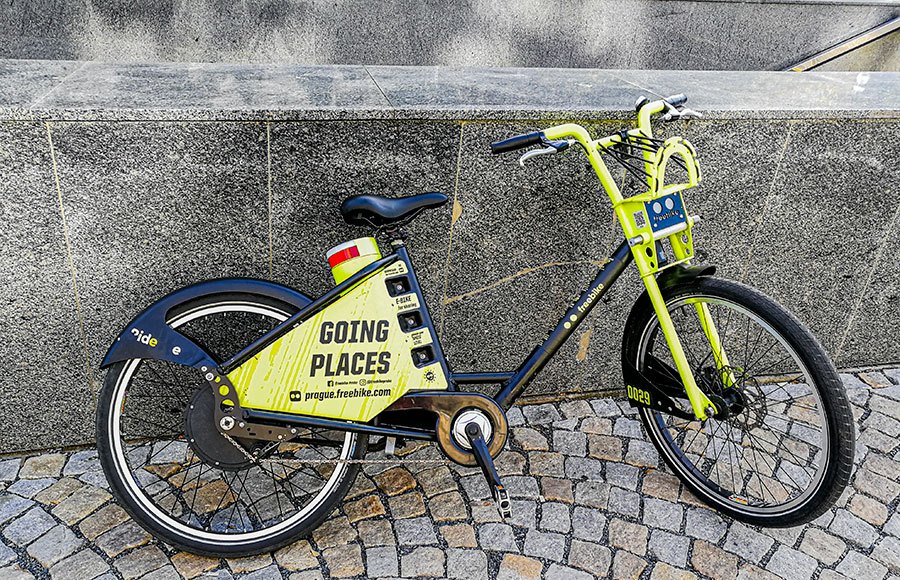
Prague also offers bicycle and e-scooter hire.
Tip: the bike-share schemes linked to city transport are Rekola and Nextbike: you get 15 minutes free twice a day, but only if you hold a long-term PID pass — tourists with a 24- or 72-hour ticket are not entitled to this benefit.
To use one, download the rental app (the list of schemes linked to city transport is on the official PID website), scan the QR code on the bicycle or scooter in the app, and off you go.
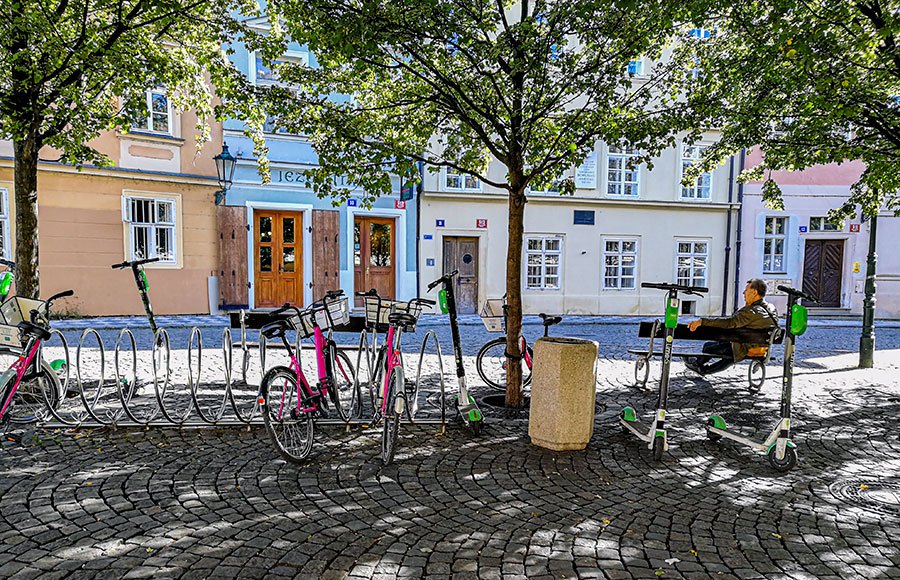
This kind of transport is popular with visitors and locals alike:
Parking for bicycles and scooters:
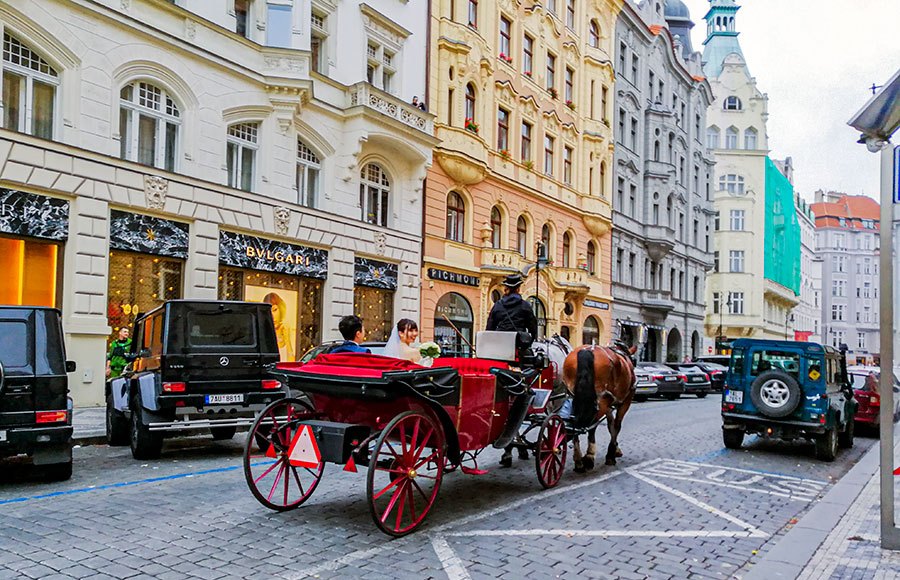
You can also ride around Prague in a carriage like this one, though that is more entertainment than transport:
2. Routes, timetables and prices
If your trip falls over Christmas or New Year: on 24 December transport runs to a Saturday timetable, but daytime services finish as early as about 18:00; on 25 December it follows a Sunday timetable, with daytime trams and buses only entering service at around 7:00; 26 December is also a Sunday timetable; 28–30 December follows a holiday timetable; on 31 December daytime services wind down at around 22:00; and on 1 January it is a Sunday timetable again, with daytime trams and buses from about 7:00. This is the planned calendar of ROPID, the city transport coordinator (pid.cz); it is approximate and may differ for individual types of transport, so check the exact holiday timetable a week before your trip on the website of the carrier DPP. Bear in mind, too, that by law large shops are closed on 25–26 December and 1 January, and on 24 December they only open until noon.
2.1. Metro
The metro runs all year round from about 5:00 to midnight. You rarely have to wait long at a station: at peak times trains come every 2–4 minutes, and every 5–10 minutes at other times. There are no ticket gates in the metro, but do validate your paper ticket on the way in — fare-dodgers are caught here quite often. You cannot buy a ticket on the metro train itself, only in advance, from a machine or in the app. Prague’s metro has 3 lines in total:
- A (Depo Hostivař – Nemocnice Motol);
- B (Zličín – Černý Most);
- C (Letňany – Háje).
A more detailed metro timetable can be found here. You can recognise a metro entrance by the distinctive sign with an arrow pointing downwards.
2.2. Trams
Prague has more than 20 tram lines, divided into daytime and night-time routes. Here is how late each type runs:
- daytime trams run roughly from 5:00 to 24:00;
- night trams run from midnight to 5:00, every 30 minutes; they all pass through the Lazarská stop, which is convenient for changing.
Detailed line-by-line tram timetables can be seen here. Night trams are numbered 90 to 99.
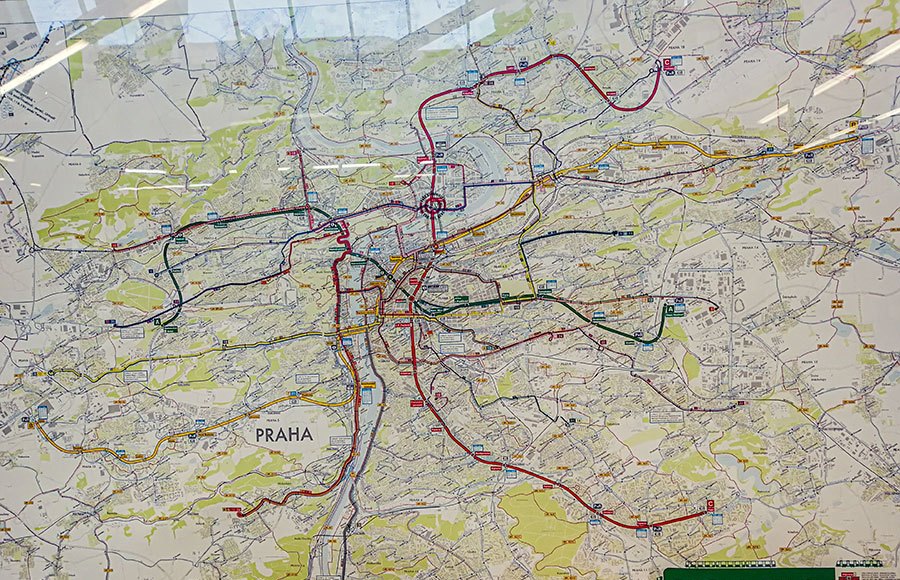
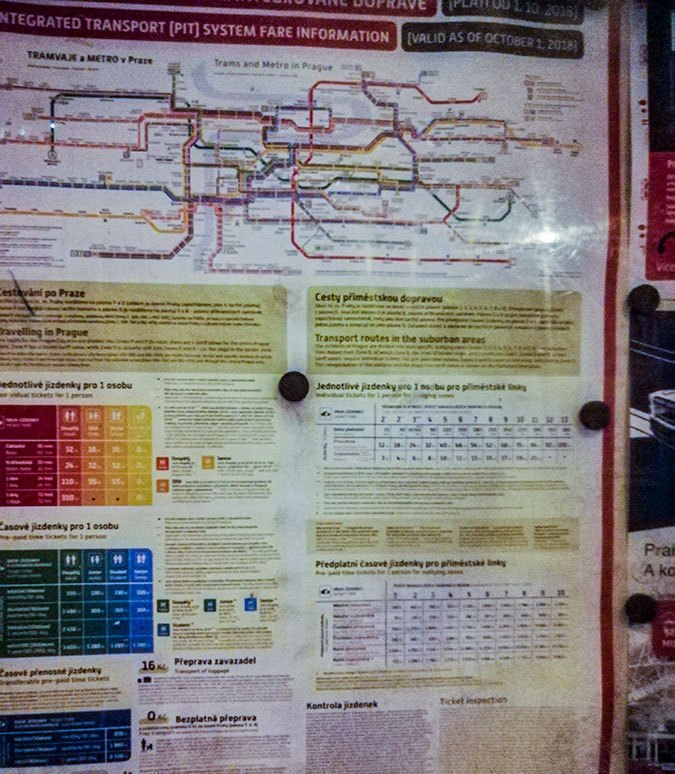
Every tram stop has a timetable and a map of the city’s transport (a map like this saved me when I got lost in Prague at night and my phone wasn’t working):
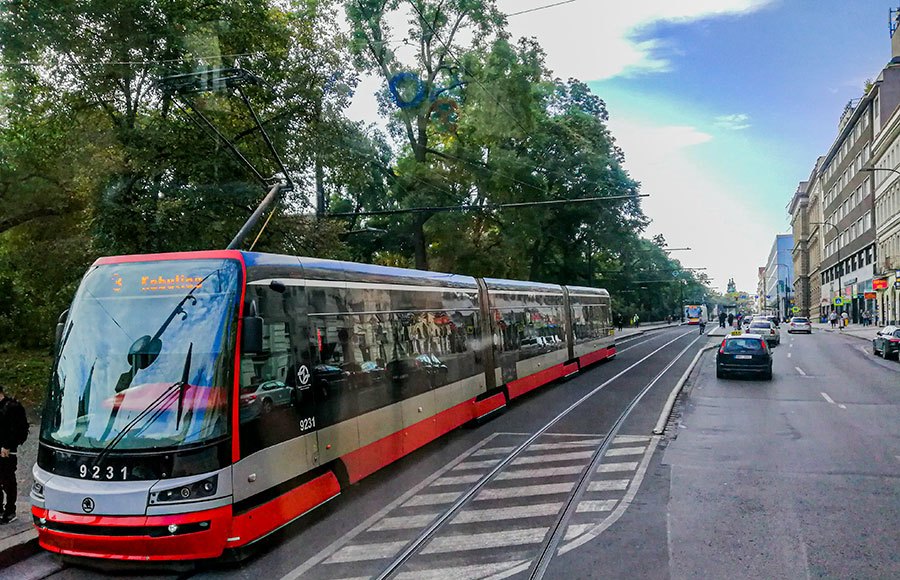
The cars are brand new and very smart-looking:
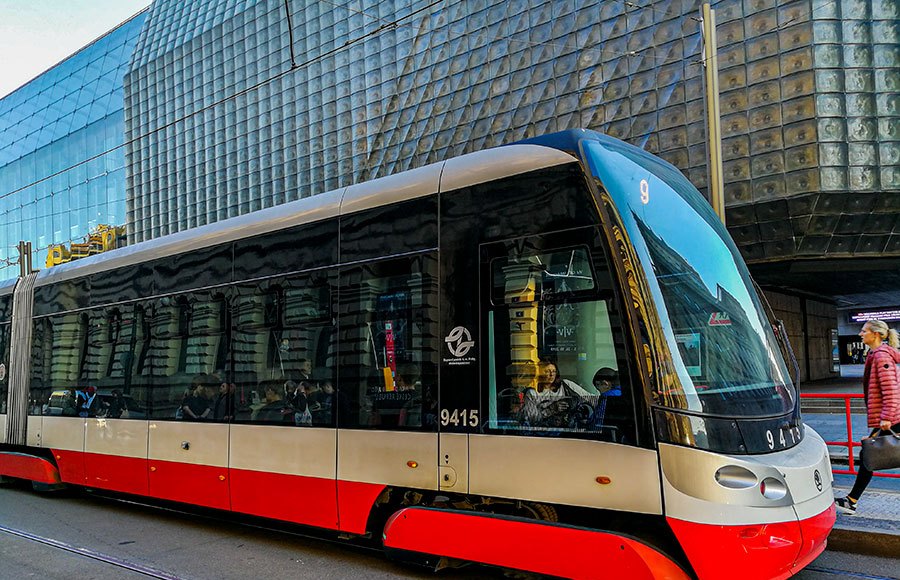
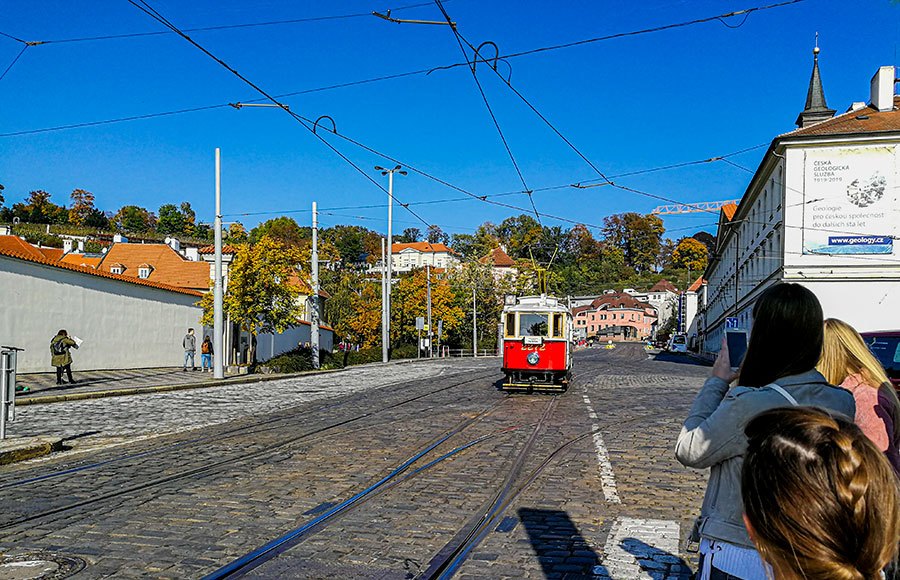
That said, you will also come across older ones, and they are in good condition too; this tram will take you to Prague Castle:
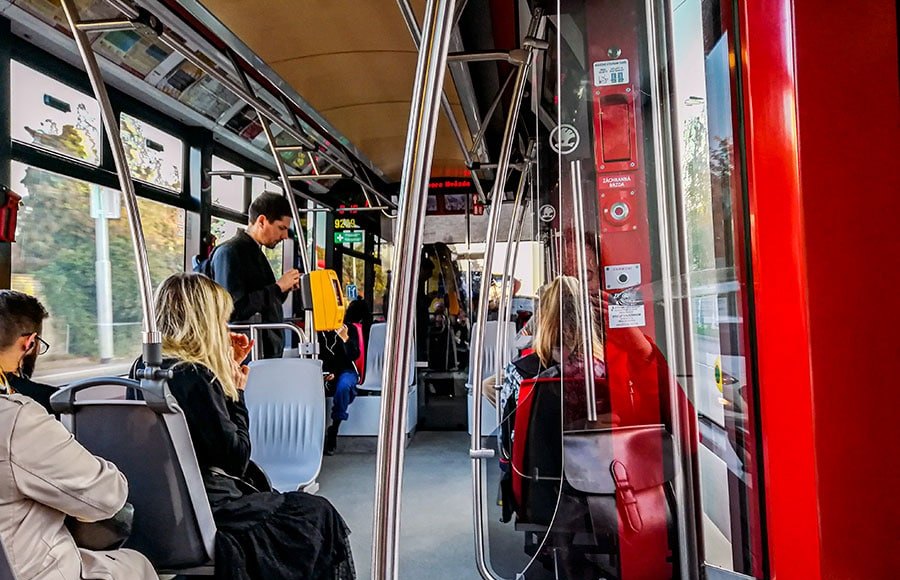
This yellow thing is the validator:
Inside the cars you can also look at route maps:
Trams come in different colours — there is no monotony here:
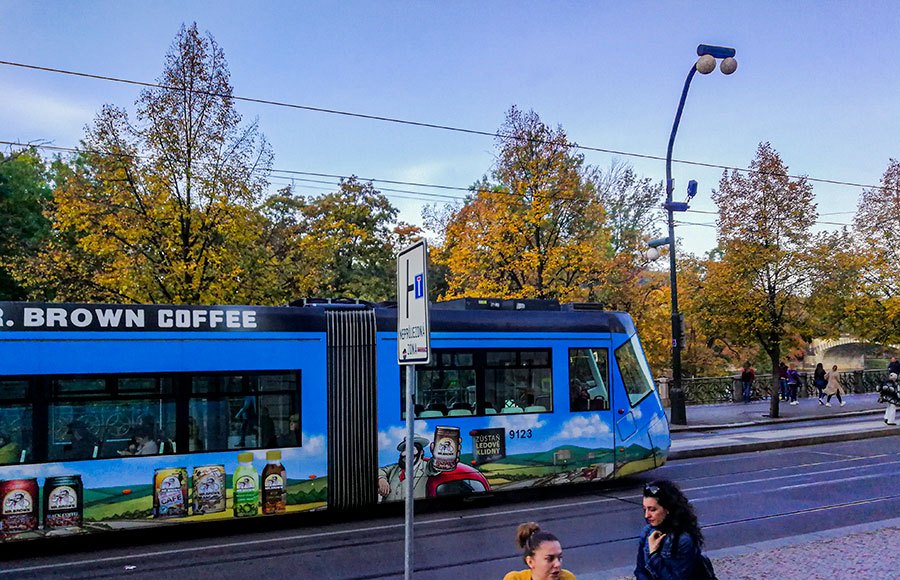
A tram ride can also double as a decent tour of the city (especially if you buy a travel pass and don’t have to worry about tickets):
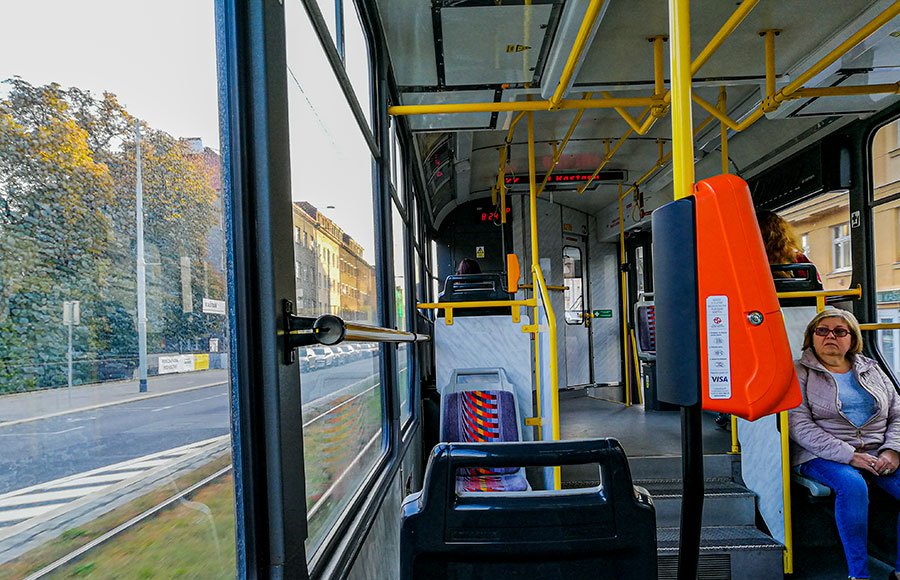
Paying your fare is possible right on the tram: the terminal in the middle of the car sells 30-minute, 90-minute and 24-hour tickets, with the money charged to your bank card (contactless only — the terminal does not accept cash):
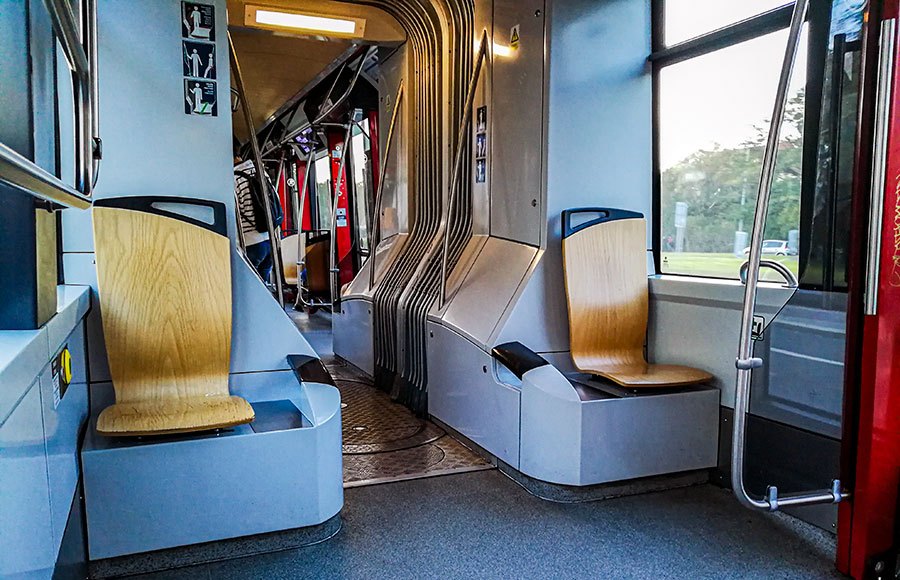
And these are the seats fitted in the newer cars:
2.3. Ferries
As of September 2026, Prague has 5 municipal ferry routes:
- P1 (Sedlec – Zámky), all year round;
- P2 (V Podbabě – Podhoří), all year round;
- P4 (Dostihová – Belárie), from spring to the end of October;
- P5 (Císařská louka – Výtoň), from spring to the end of October;
- P6 (Lahovičky – Nádraží Modřany), from spring to the end of October.
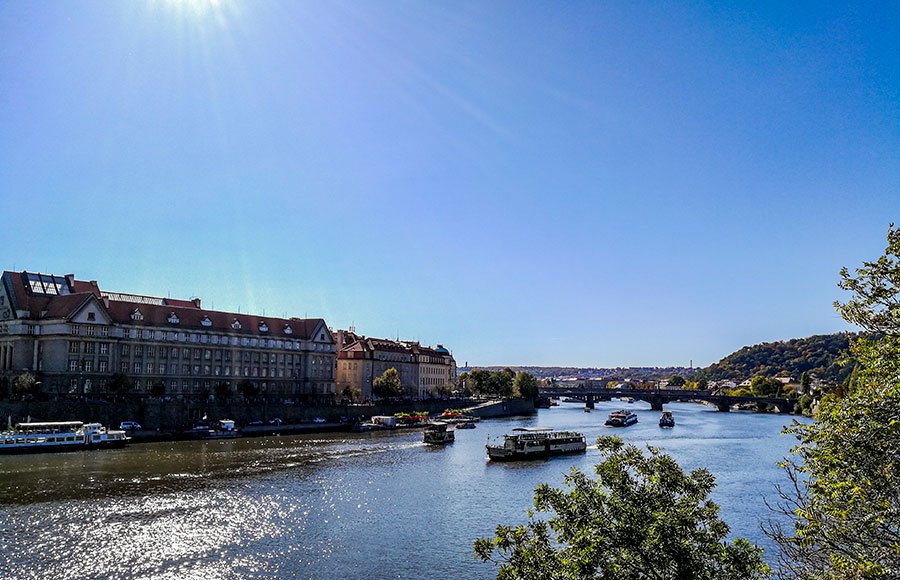
The detailed timetable can be found on the city website.
The year-round P1 and P2 start at 5:25 and run until 20:00 and 22:00 respectively, while the seasonal P4, P5 and P6 run from 7:00–8:00 until 19:00–21:00, depending on daylight; the ferries do not run at high water. Their main job is to carry people from one bank of the city’s river, the Vltava, to the other. All the usual tickets are valid, and bicycles are carried free of charge.
2.4. Buses
Prague has more than 150 city bus routes, and they too are divided into daytime and night-time services. Night buses are easy to tell apart by their numbers:
- city night buses — Nos 901 to 918, running from midnight to 4:30 every 30–60 minutes;
- daytime city buses run roughly from 5:00 to 24:00.
Bus timetables for the various routes can be found here. In terms of hours, night and day buses work much like the trams. You board city buses through any door, and a ticket can be bought by card at the terminal by the second doors. An interesting detail, by the way: when trams break down, their routes are replaced by buses, and these routes get the number X**, where ** is the number of the tram route being replaced.
2.5. Types of tourist buses
Prague has several kinds of buses that take tourists around the city.
- Hop-On/Hop-Off buses
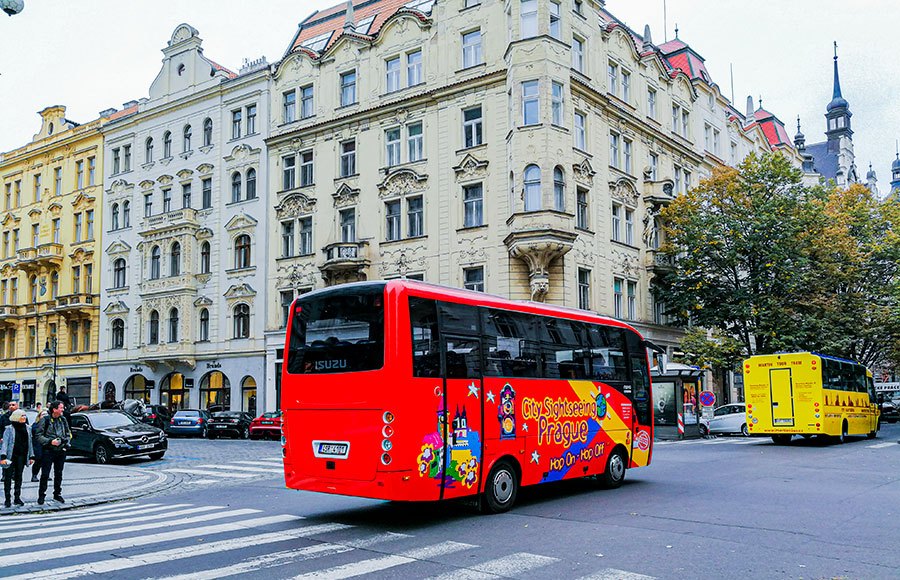
In this case the bus follows a set route with several stops. You can get on and off at any of these stops, and each passenger can use an audio guide along the way.
What is convenient here is that you can see the city’s best-known sights in considerable comfort. Tickets can be bought at kiosks around the city and online.
These are the signs you will see at ticket outlets for these buses:
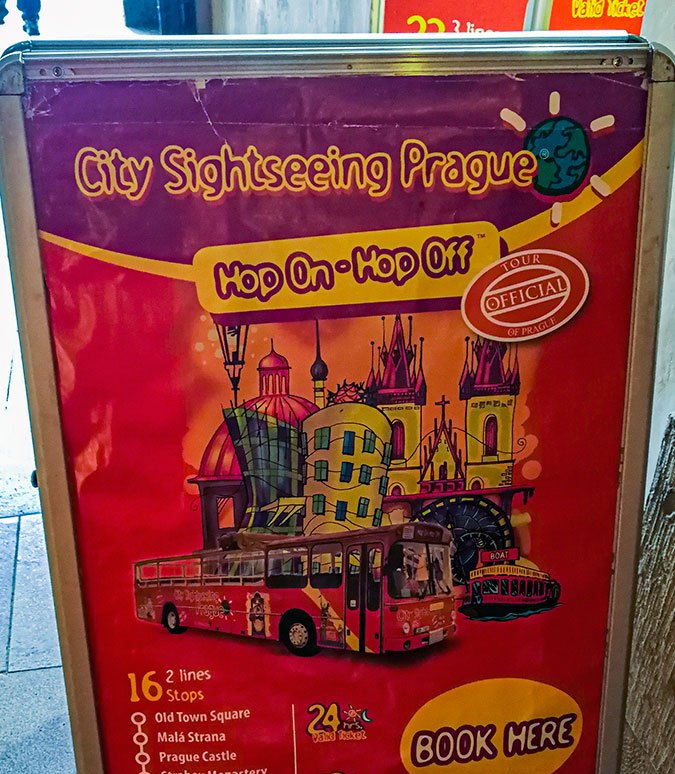
There are several route options, so there is plenty to choose from:
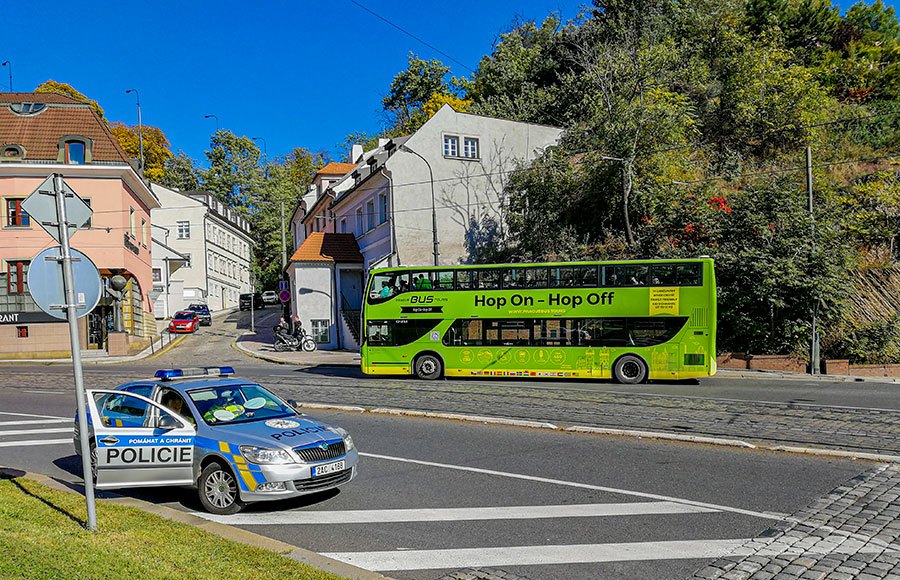
- Standard sightseeing buses
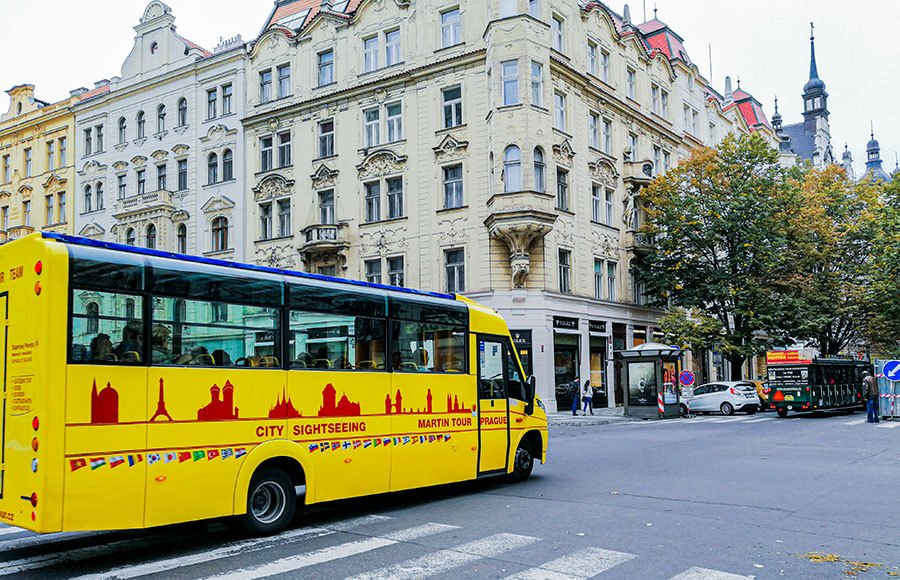
The length of the tour can vary, but it is usually one hour. You can use an audio guide on the way. A good option for those who have little time but want to get to know the city.
This is a standard sightseeing tour:
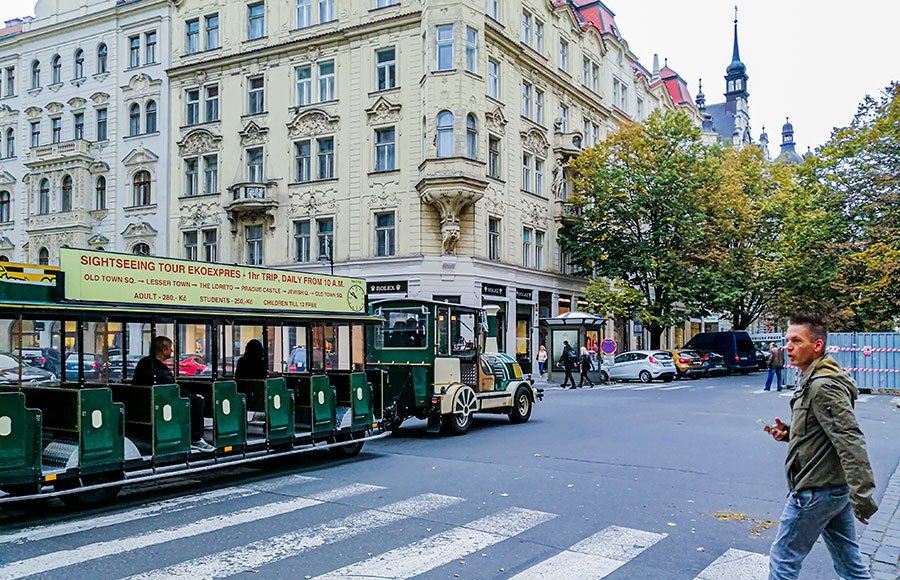
And here a carriage of tourists is pulled by an electric vehicle styled as a steam locomotive:
- Beer buses
This one, of course, is only for lovers of the foamy drink. On these trips you can drink beer in unlimited quantities, snack on peanuts and use the Wi-Fi. A “beer bus” usually means a transfer from the airport to your hotel, taking about 45 minutes. The pleasure is not cheap, so it suits a group of friends best. Tickets and details are available online.
2.6. Funicular
Prague has a funicular and a small cable car at the zoo.
- The first takes you up Petřín Hill. The ascent starts on Újezd street. After a two-year reconstruction the funicular reopened on 22 September 2026: it runs all year round, daily from 7:00 to 22:15, with cars every 10 minutes. Important: 30- and 90-minute tickets are not valid here — you need a separate single-ride ticket costing 100 CZK (90 CZK in the PID Lítačka app). You can ride at no extra cost with a 24- or 72-hour ticket or a Prague Visitor Pass.
- The second is the chairlift at Prague Zoo. It is also operated by the city transport company, but it is not part of the PID system, so city tickets are not valid. A ride up or down costs 40 CZK for everyone over 6; children under 6 ride free on an adult’s lap (prices as of October 2026). The 2026 season runs from 20 March 2026 to 3 January 2027. Until 1 November inclusive the cable car operates daily: until 24 October from 9:30 to 17:00, and from 25 October from 9:30 to 16:00; in November and the first half of December it runs on selected days, and from 22 December to 3 January almost every day from 9:30 to 16:00, except 28 December; on 24 and 31 December the working day is shorter, until 14:00. Check the exact calendar for your dates on the DPP website, and note that services may be suspended in bad weather.
3. Rules for using public transport
3.1. How to pay your fare
You can pay in cash or by card; the payment methods are covered below. Let me say straight away that I do not recommend travelling without a ticket — the fine is 2,000 CZK (1,200 CZK if you pay the inspector on the spot, and 1,500 CZK within 15 days), and checks are quite frequent. There are several types of ticket for public transport (prices as of September 2026; the first figure is for a paper ticket, the one in brackets is for the PID Lítačka app):
- 30 minutes — 39 CZK (36);
- 90 minutes — 50 CZK (46);
- 24-hour pass — 150 CZK (140);
- 72-hour pass — 350 CZK (340).
Children under 15 and pensioners aged 65 and over travel free in Prague, though from the age of 6 proof of age is required. A paper ticket from a kiosk or machine must be validated in the special validator when you board or enter the metro (tickets from the app, from the on-board terminal and from Czech Railways ticket offices do not need validating). You can then change lines within the ticket’s period of validity without validating it again.
3.2. Where and how to buy tickets
- Tickets can be bought from self-service terminals, which you will find at transport stops, railway stations and metro stations. Be careful: button-operated machines accept only coins, while touchscreen ones take bank cards, so carry some small change just in case.
- Tickets are also sold at tobacconists’ kiosks and at newsstands. The sellers are well used to dealing with tourists, so feel free to go and ask.
- You can also use the PID Lítačka app — tickets in it are cheaper than paper ones. It is very simple: choose the type of ticket you need, then the card to pay with, and pay. Tickets then have to be activated in the app itself (when we used the app, activation took about 2 minutes). You will then see your ticket with a QR code for inspection. So you need not worry about how to buy tickets: with this method you do not even need a Czech SIM card — your own SIM working in roaming is enough.
- You can also pay inside trams, city buses and trolleybuses: they have terminals that accept only contactless card payments. This way you can buy a 30-minute, 90-minute or 24-hour ticket, and it is valid immediately, with no need to validate it. This is not possible on the metro.
- There is one more exotic option if you have a Czech SIM card with enough credit. Send a text message to 902 06 with the text DPT42 (30-minute ticket, 42 CZK), DPT55 (90 minutes, 55 CZK), DPT150 (24 hours) or DPT350 (72 hours); for the 24-hour and 72-hour tickets you also need to confirm the purchase by replying “Ano”. The ticket arrives after about 2 minutes, and you may only enter the metro once it has arrived.
3.3. How to save money on fares
A city transport ticket is valid on buses, trams, trolleybuses, ferries and the metro. On the Petřín funicular only 24- and 72-hour tickets are accepted — 30- and 90-minute tickets will not get you in.
That is why I advise buying a 72-hour ticket straight away: as of September 2026 it costs 350 CZK, or 340 in the app. Of course, this only makes sense for those planning to spend several days in Prague. If you are in the Czech capital for just one day and will make a couple of journeys, 90-minute tickets at 50 CZK (46 in the app) will be enough, and for three journeys or more the 24-hour pass at 150 CZK is better value.
It used to be convenient to buy a Prague Card, which included free travel on public transport. Since the beginning of 2019, however, the municipality has removed that benefit, so the card now only covers free entry to a number of museums and sights. The city does, however, have its own tourist card, the Prague Visitor Pass for 48, 72 or 120 hours: it includes unlimited travel on the metro, trams, city buses, trolleybuses and ferries, including the journey to the airport and back.
For those staying in Prague for a long time there are long-term passes: as of October 2026 a monthly pass costs 550 CZK, a quarterly one 1,480 CZK and an annual one 3,650 CZK. The easiest option is to arrange an electronic pass in the same PID Lítačka app, while paper passes are issued at DPP ticket offices — you will need your passport and a photograph.
4. How to find the right route
To work out which transport to take, you can use Google Maps. It is available on any smartphone; here is how to use it:
- turn on geolocation;
- open the app and tap the route-building button;
- set your current location as the starting point and choose your destination;
- from the suggested travel options, choose public transport, marked with a bus-shaped icon;
- you will now see instructions telling you at which stop to board which service. Pick a suitable option and off you go!
You can find your way in much the same way with the PID Lítačka app. A handy touch here is that the app itself offers to sell you the ticket that best suits the journey (tickets, as a reminder, differ in their period of validity).
Tip: the only caveat is that the app needs an internet connection, otherwise it cannot build routes. As a backup, always carry a paper map (any guidebook has one) and download offline maps to your phone.
5. Final thoughts
The fastest type of transport, reaching most parts of the city, is of course the metro. I would put the tram in second place. There are tram stops near all the sights, and trams run frequently, so it is the most convenient transport.
The bus predictably takes third place. I never ended up using the buses, as I got everywhere by tram.
In my view, if you are in the city for several days, it is best to buy a pass straight away. On my first day I bought single 30- and 90-minute tickets through the app, and then arranged a 3-day pass in the same app — as of September 2026 the 72-hour ticket costs 340 CZK in the app. It is very convenient, with all city transport included.
When paying I had to enter my card details (it asks for a confirmation code, so the SIM card to which the card is registered must be able to receive it). Learn from my mistake: do not bother with short-term tickets if you are in the city for a few days — a pass lets you change lines as often as you like and saves a fair amount of money.
Which kinds of Prague transport have you used? Tell us about your experience: what downsides would you note, and what would be worth borrowing for your own city’s transport system? Let’s chat in the comments!