After Koh Chang I was ready to move on. I had seen in the New Year in Thailand, and it was time to head to Cambodia — and renew my visa, or rather my Thai entry stamp, while I was at it. So come with me on a journey from Thailand to Cambodia!
In short: how to get from Thailand to Cambodia now
The essentials first, because everything has changed since my trip. You cannot cross the land border between Thailand and Cambodia at the moment. After fighting on the border in summer 2025 and a renewed flare-up in December, the land checkpoints are closed — and as of September 2026 they remain closed. The UK Foreign Office’s Thailand advice (page updated 11 September 2026) puts it plainly: “Land borders and crossings between Thailand and Cambodia continue to be suspended.” The Canadian government’s Cambodia advice (updated 9 September 2026) says the same: “Land border crossings between Cambodia and Thailand are currently closed.” Both departments also advise against going within 20–50 kilometres of the border.
That means the route I describe below — the ferry from Koh Chang, the bus to Poipet, crossing on foot — does not work today. What remains is flying: there are direct flights from Bangkok to Siem Reap, and instead of thirteen hours on the road you get about an hour and a half in the air. Flights now land not at the old airport but at the new Siem Reap Angkor International (SAI), which stands noticeably further from town, so plan the transfer to your hotel separately. You can check current flights and prices online.
Visa arrangements have changed too. The visa-exemption list on the official portal covers only Cambodia’s ASEAN neighbours, so travellers from other countries need a visa. The simplest option is to arrange it online in advance on the official portal evisa.gov.kh: the tourist “T” visa costs US$30, takes three working days, is valid for three months from the date of issue and gives 30 days in the country, which can later be extended by a further 30 days while in Cambodia. You need a passport with more than six months’ validity, a digital photo and a Visa or Mastercard. You can also get a visa on arrival at the airport — there you pay in US dollars in cash and are asked for a photograph.
And one more thing that did not exist at all in my day: since 1 September 2024 every arriving traveller completes an electronic arrival card, Cambodia e-Arrival, on the portal arrival.gov.kh — no earlier than 7 days before arrival. It is free: the Cambodian immigration service’s site says exactly that — “Submission is Free”. If someone offers to complete this card for money, that is not the government.
What follows is my account of how this journey looked in winter 2014, when the border was open. Read it as a story, not as instructions: prices, timings and procedures have long since changed.
1. How to get from Koh Chang to Cambodia
When the border was open, there were two ways from Koh Chang to Cambodia — and both run into crossings that are now closed:
- you could go to Siem Reap (via the town of Aranyaprathet)
- or head to Sihanoukville (via Koh Kong).
Either way, you first had to get to the pier, then take the ferry to the mainland, and from there ride a bus to the Cambodian border. What happened next depended on whether you travelled through a local agency or bought all the tickets separately on your own.
- Through an agency or online. You buy a single ticket, ride to the border, cross it yourself, and on the other side the right bus to Siem Reap or Sihanoukville is already waiting. It worked exactly the same when bought online. Today such a through ticket cannot be bought: the land crossings are closed. The only viable route from Thailand to Siem Reap now is by air from Bangkok.
- On your own. Each time you buy a ticket for just one leg of the journey — you make your own way from your hotel on Koh Chang to the pier, buy a ferry ticket, ride to the town of Trat, buy a ticket to the border, cross the border, and on the Cambodian side buy a ticket to the town you need.
All in all, buying a single ticket was much simpler, and you didn’t have to worry about being late for anything: they always waited for you.
And there is something I must warn you about separately. Aggregator sites still show overland connections from Koh Chang to Siem Reap — with ferry, bus and a change, for US$34–39. I saw this myself in September 2026. But the official sources of two governments were saying in those same days that the crossings are closed, which means there is simply nowhere to use such a ticket. Do not buy an overland through ticket on trust: there will be no one to refund your money.
2. Applying for a Cambodian visa
I had read all sorts of horror stories about the Cambodian border — that everyone is out to cheat you, to squeeze as much money out of you as possible, that they don’t put you on the right bus so you end up having to take a taxi, and so on. I was, admittedly, a little nervous about going, but fears are there to be fought, and I had wanted to visit Cambodia for a very long time, so I decided to try it all first-hand.
The first unpleasant point that practically every independent traveller from Thailand to Cambodia writes about: at the border, instead of the official US$20 for the Cambodian visa, some dodgy office first demands US$40 (the bus takes you there on purpose, on the pretext that this is the only place you can get a visa), and then — if you weren’t taken in and walked straight to the border — the border guards demand extra money from you anyway (usually 100 baht on top). All this information put me on edge, so to reduce the risk of any conflicts at the border to a minimum, I arranged a Cambodian e-Visa in advance.
Back then I applied on the foreign ministry’s website. That address no longer exists — the domain simply does not open. The only official e-Visa portal today is evisa.gov.kh, and the Cambodian embassy warns outright that there are plenty of lookalike sites: they charge two or three times as much for the same visa. Check the address: it ends in .gov.kh.
In 2014 the visa cost US$25 plus US$3 for applying online — or for paying by card, I no longer remember; the paperwork was done back in Moscow, so that I could take a printout with me. The portal’s official tariff is different now: US$30 for the tourist “T” visa, and the portal shows the final amount before payment. Incidentally, there is a quirk in Southeast Asian countries: often, when you pay for something online with a foreign bank’s Visa/Mastercard, a commission is charged. When I bought tickets on airasia.com, for example, I was charged an extra fee.
In the end the visa cost more than the then “standard” price of US$20 plus 100 baht (the hundred baht being that very surcharge for nothing), but I had peace of mind and saved my nerves — and as a bonus I saved space in my passport, since an e-Visa is not stuck in, whereas a regular visa takes up a whole page 🙂
An important feature of the e-Visa: it is not accepted at all Cambodian checkpoints, and the list changes. In my day, two of the Thai crossings were valid — Cham Yeam (Koh Kong) and Poi Pet (Poipet). Right now, neither works. On the e-Visa portal’s official page both crossings are marked “Temporarily closed for e-Visa entry until further notice”, and the whole “entry” column opposite the Thai crossings says “No”. You can enter on an e-Visa today via:
- Phnom Penh airport — Techo International Airport (KTI);
- Siem Reap airport — Siem Reap Angkor International Airport (SAI);
- Sihanoukville airport;
- the Bavet land crossing on the border with Vietnam;
- the Tropaeng Kreal land crossing on the border with Laos.
The portal’s official FAQ on this is extremely brief: not all crossings support e-Visa, check before you apply, and where they don’t, get a visa on arrival. So for someone flying into Siem Reap the e-Visa works perfectly — SAI airport is on the list.
So there wasn’t much choice, and I went via Poipet. The plan was to go to Siem Reap first, see Angkor Wat, then on to Sihanoukville for the sea, and from there back to Bangkok.
3. Where to buy a ticket to Cambodia on Koh Chang
While the border was open, the convenient thing was that on Koh Chang you bought a single ticket to Siem Reap covering everything: the ride across the island to the ferry, the ferry itself, the road to the border, a change of bus and then the journey on to Siem Reap on another bus. You could, of course, make your own way on connecting services, buying tickets at local bus stations, but to my mind it isn’t worth it — and it works out, strangely enough, more expensive. So the simplest thing is to buy the full ticket.
The island is full of tourist agencies; I picked at random the one that was on my way to the beach. Interestingly, the girl at this agency turned out to have a review book with entries in Russian 🙂 For the ticket I paid 300 baht — at the time a very good price for such a distance. For comparison: in September 2026 aggregators were asking US$34–39 for a comparable overland connection, roughly four times as much — except that there is simply no one left to sell it. I bought the ticket about three days before the trip; the day before, you must without fail go and confirm that you are definitely travelling.
Back then such a ticket could also be bought online, without going into any agency. Now what people buy online for this route is the flight from Bangkok.
Departure was promised at 07:00, with arrival in Siem Reap at 19:00 — which I didn’t really believe, since reviews on the internet told a very different story.
4. The journey to the Thailand–Cambodia border
On the appointed day I checked out of the hotel and at 06:55 spotted a small minibus not far from the hotel, and went over to ask whether it had come for me. There were several minibuses; I simply went up to the drivers, showed my ticket and asked whether this was my bus. After a while the right one turned up, I climbed in, and at 07:05 we set off. Also in the minibus were a family of foreigners of uncertain nationality (Swedes, perhaps?) and a German. We drove around other hotels collecting more passengers, then headed for the pier.
At 08:00 we arrived at the pier. The minibus stayed on the first deck; all the passengers rode on the second, where you could also buy some food (various snacks, instant noodles and so on). I had no appetite at all — it seems I had picked up food poisoning the day before, I don’t know.
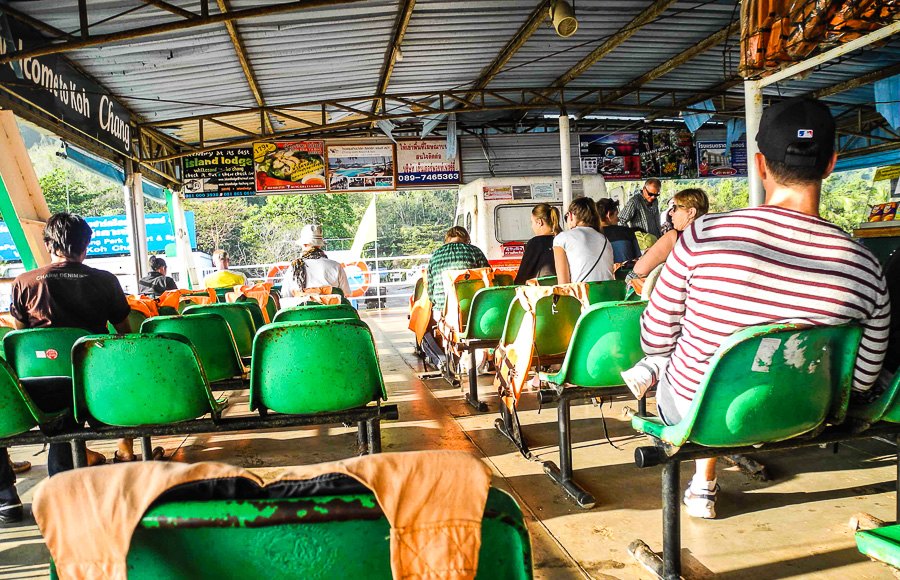 On the ferry from Koh Chang
At 09:20 we reached the mainland on the ferry, loaded back into the minibus and drove on. Interestingly, we stopped at the very station where I had already been when I bought my ticket to Koh Chang, and picked up a few passengers there.
At 10:10, a stop in Chanthaburi for a snack and the toilet. It felt like déjà vu 🙂 Probably the last time I was there, someone was also travelling on to Cambodia…
At 10:30 we drove on; there were no more food stops, and we went straight to the border. First, though, they stopped us at a café where everyone was handed forms to fill in for the visa application. But I said I already had a visa, so I was given an immigration card, a sticker was stuck on me in place of a ticket, and I was put into a songthaew.
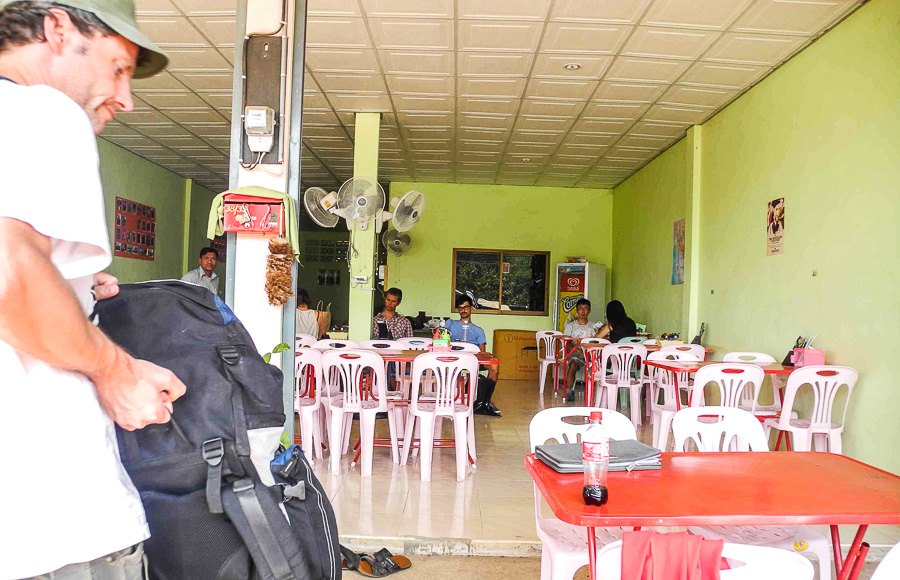 Stop in Aranyaprathet to fill in the visa paperwork
5. Crossing the Thai–Cambodian border
At about 13:30 we stopped in front of the border on the Thai side. Everything is intuitive — where to go, signs and notices everywhere — so it’s hard to get lost. The only thing that kept bothering me was not knowing how to travel on, since all the passengers I had been riding with had stayed somewhere back there at the café… But amazingly, each time I arrived at the right place and was shown where to go and which bus to get on to reach Siem Reap.
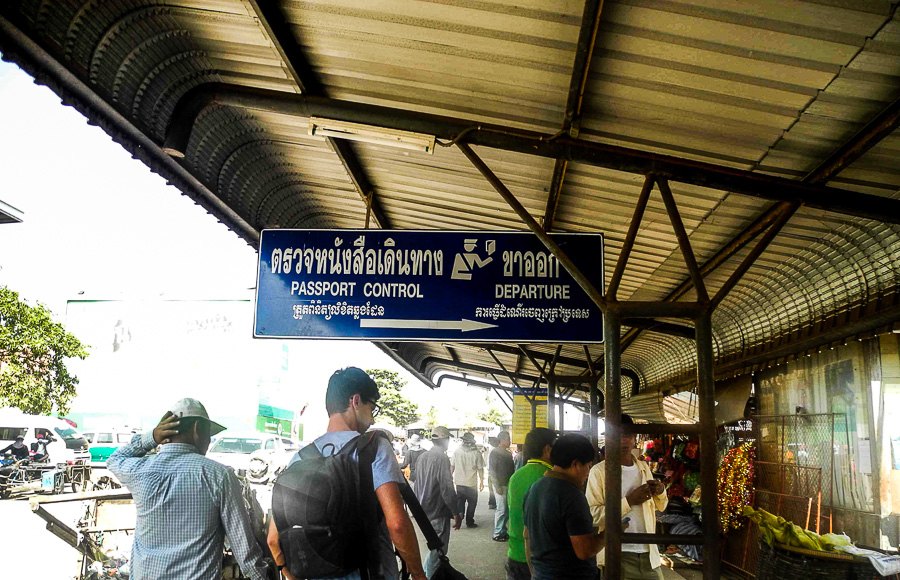
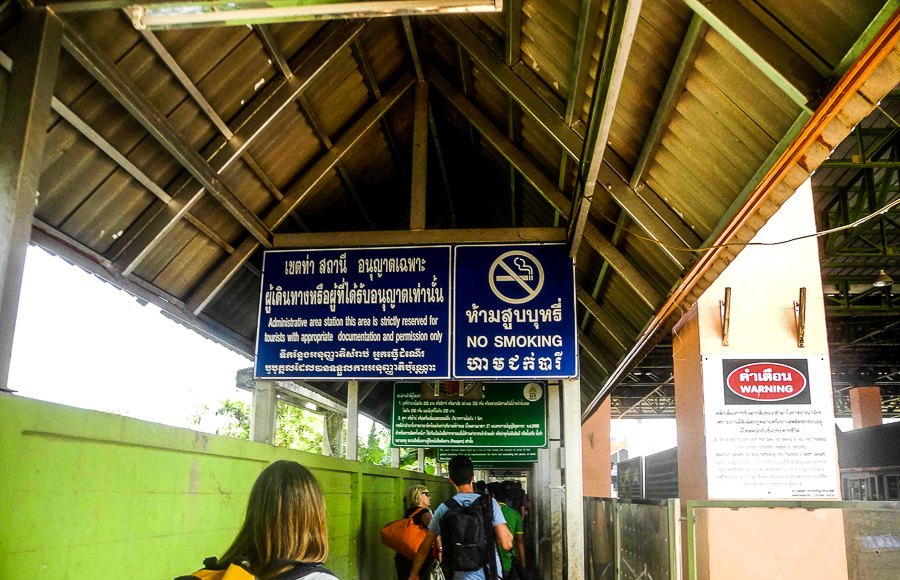
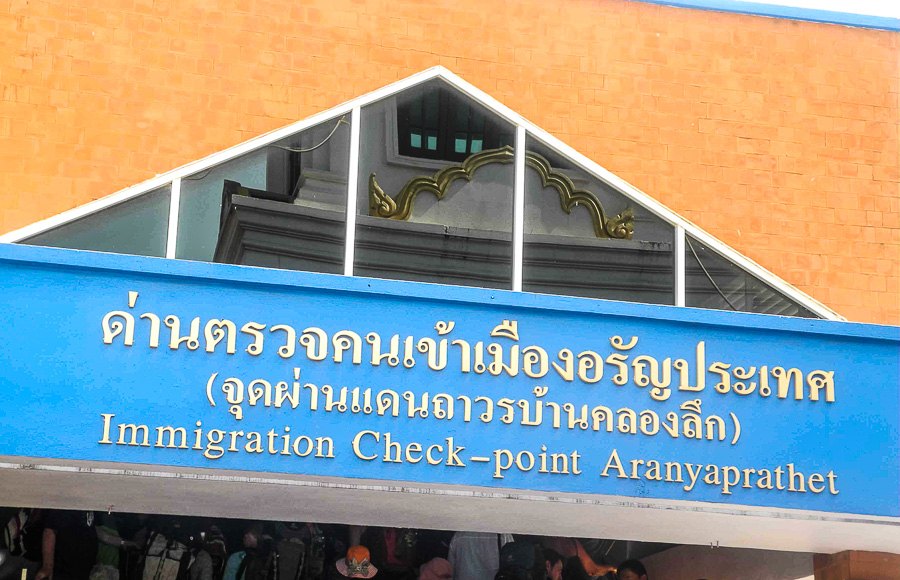 The checkpoint on the Thai side of the border
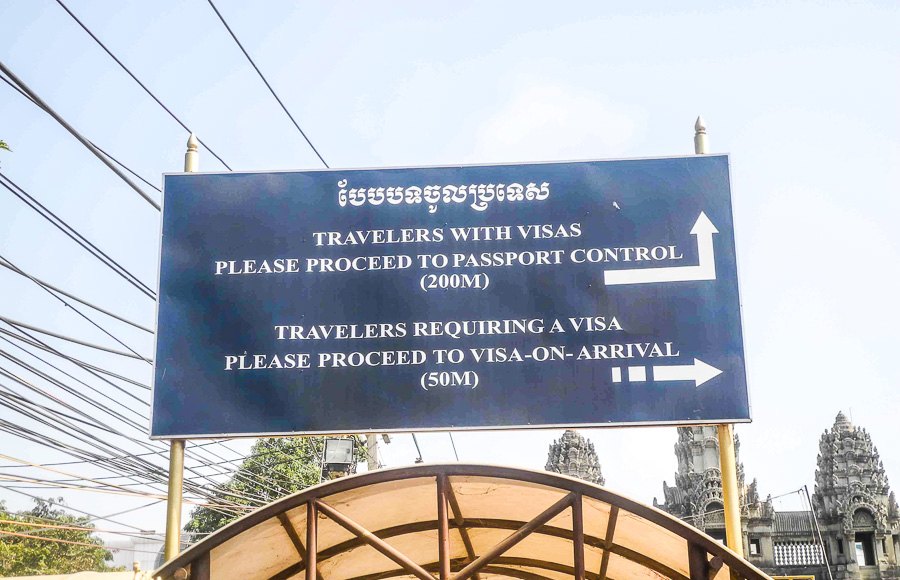
14:05 on the clock. In half an hour I had crossed the Thai border: the immigration card was pulled out of my passport, a stamp was put in, and I walked out into the town. Again, everything is clear: to the right, a sign and the official visa issuance point (for those who don’t have one yet); straight ahead, the road to the border.
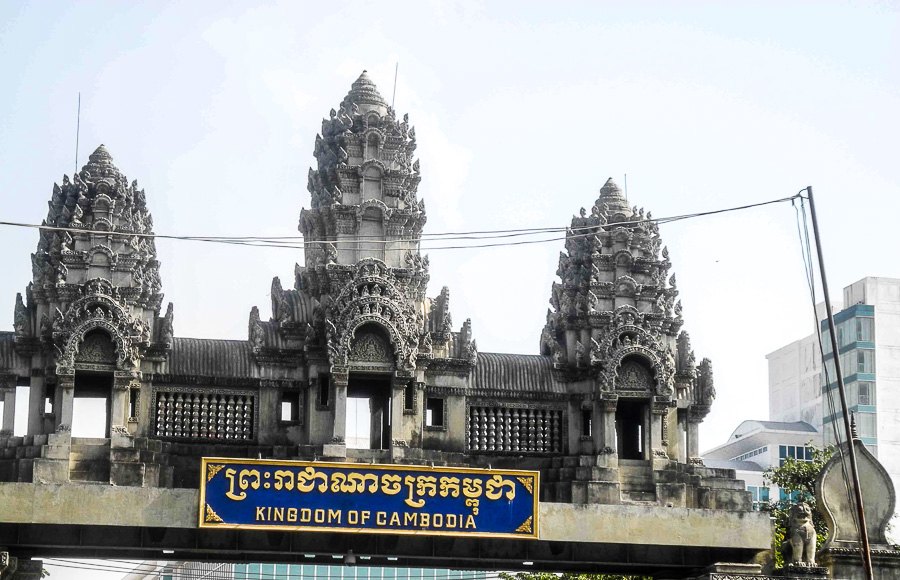
Beyond this arch begins the territory between the two states — this is still not Cambodia, because the Cambodian border has yet to be crossed:
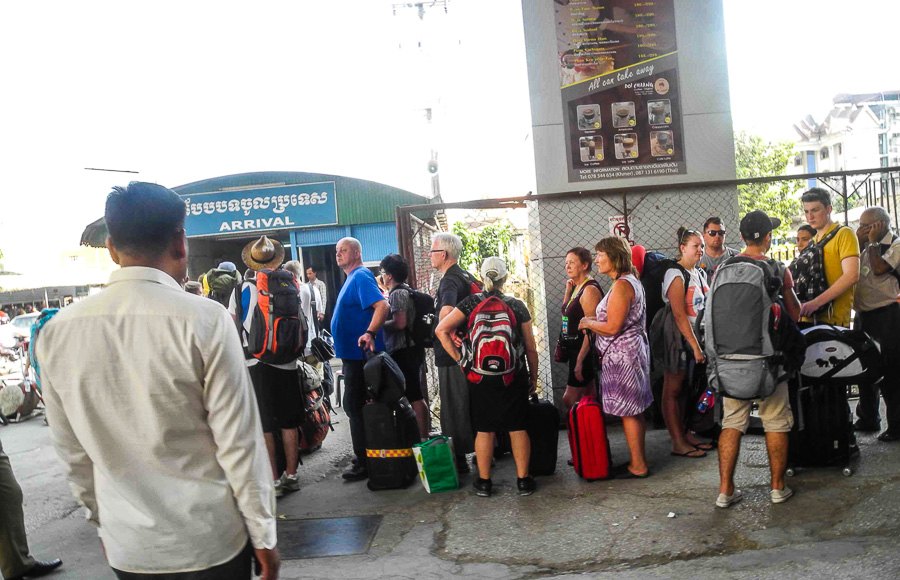
At 14:16 I joined the queue at the border; there were quite a lot of people.
 The Cambodian border
The surroundings changed at once: far fewer motorbikes now, but plenty of carts that Cambodians were hauling along by hand.
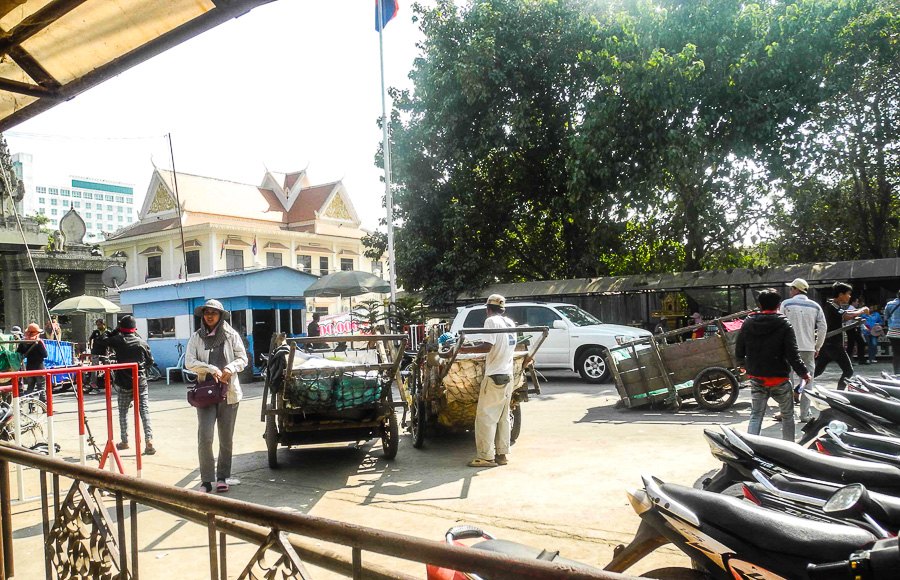
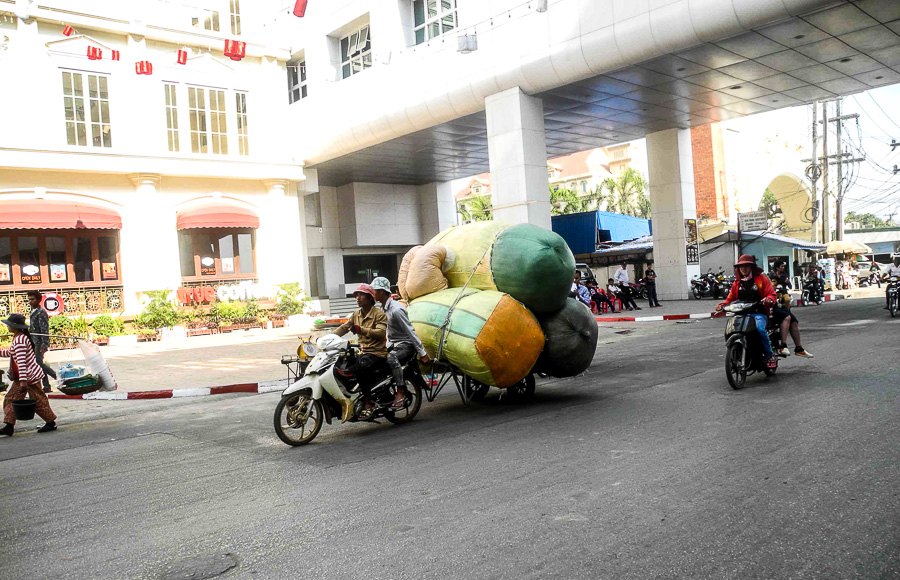 That’s some load!
No one begged money from me, though I saw a woman with a child latch onto some foreigner. He simply walked past; no one chased after him or demanded anything 🙂
At 15:16 I finally cleared the Cambodian border and walked to the stop, where there were many people with backpacks. Again I asked which way I should go for Siem Reap, and was told to wait. All along the way you meet people who are clearly in the business of shepherding tourists across the border. And there is always someone who identifies your sticker and tells you to follow them 🙂 So there’s nothing scary — you can relax, you won’t get lost; the main thing is to ask and stay visible.
6. From the Thai border to Siem Reap
At 15:36 we were all gathered onto a bus that took us to the stop. There we boarded the bus to Siem Reap and at 16:06 set off.
This was now a perfectly ordinary bus — not a minibus but a big coach, with air conditioning and a television (films in English were shown the whole way).
Unlike the reports I had read before the trip, I never had to wait long anywhere (some people wrote that they waited an hour and a half for a bus, that they were told there would be no more buses, and so on). Maybe I was lucky, I don’t know, but everything went fairly smoothly. Nowhere did I have to pay anything extra. Though before boarding the last bus, the lad who had gathered everyone onto it asked for 100 baht; I asked what for, and he asked for nothing more 🙂 Presumably just in case someone would pay 🙂
At 17:53 we arrived at a restaurant; the menu looked like this:
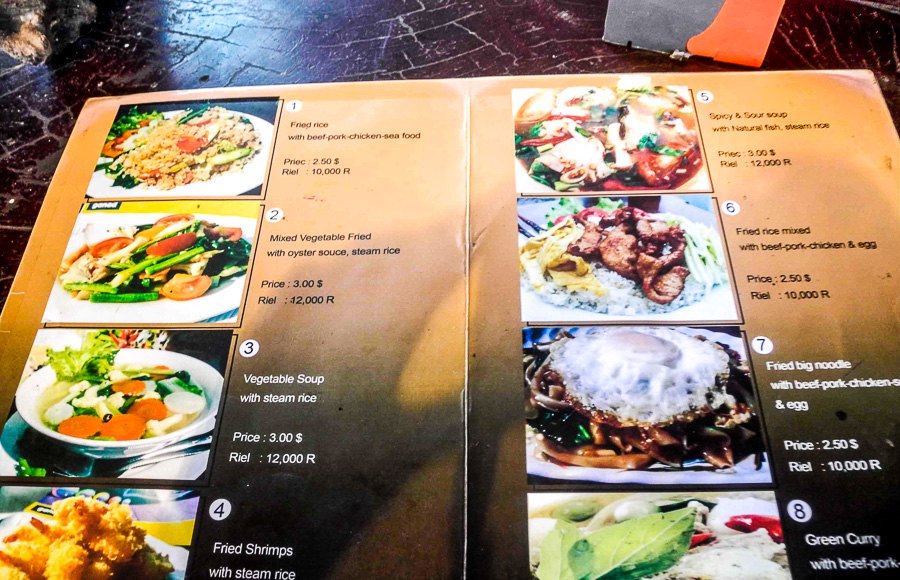 The menu at the restaurant on the way to Siem Reap
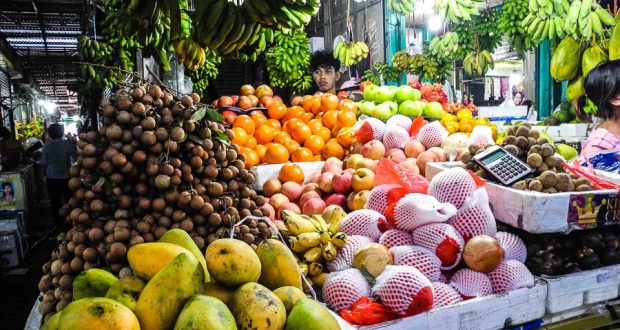
I still didn’t feel like eating, and I had food with me (bananas, crispbread, juice) which I never did eat. The stop lasted a little under an hour; it had already got dark.
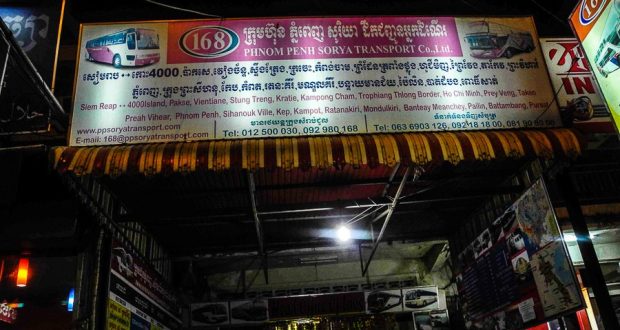
At 18:40 we drove on, and around 20:20 arrived in some back corner of Siem Reap where a crowd of tuk-tuk drivers was waiting for passengers.
I had read that a tuk-tuk driver should take you from the station to your hotel for US$1, and that for the same sum he can drive you around several hotels if you haven’t booked anything in advance. But as it happened I was almost the last off the bus, and most of the tuk-tuk drivers had already been taken. One refused to take me (I don’t know why), while another went on at length about how terribly far away my hotel was and that he would only take me for US$3. I haggled him down to US$2, on condition that he would later drive me around Angkor. The next day I simply wanted to rest rather than get up at 05:00, so we agreed on the day after that — and we weren’t talking about any specific route, just a full day around Angkor. Reports said that US$15 was a fair price for a tuk-tuk driver taking you all day to whichever temples you liked. So, without thinking twice, I agreed.
In the end it turned out the hotel was not horribly far away at all — just 5 minutes — but that didn’t ring any alarm bells (though it should have). Riding a tuk-tuk around Siem Reap is something else! I wasn’t prepared for it: I was shaken as if I were galloping on a horse, and constantly had the feeling the tuk-tuk was about to fall apart.
By 20:30 I was already at the hotel.
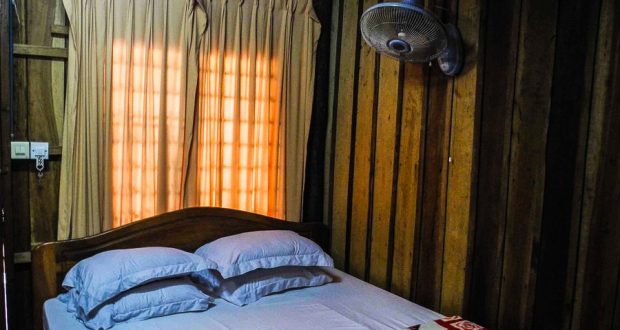
A perfectly decent hotel: good Wi-Fi, hot water. And, conveniently, sockets next to the bed. The room even has a table and chair (a real rarity) and a wardrobe. But there’s no drying rack of any kind — I should carry a rope or something for such cases.
FAQ: travelling from Thailand to Cambodia
How do I get from Thailand to Cambodia now?
As of September 2026 the land crossings between Thailand and Cambodia are closed, so the way to get from one country to the other is by plane. There are direct flights from Bangkok to Siem Reap; the flight takes about an hour and a half. Planes arrive at the new Siem Reap Angkor International (SAI) airport, which is noticeably further from town, so the transfer to your hotel needs to be planned separately.
Can you still travel overland from Koh Chang to Siem Reap?
No. The old route — the ferry from Koh Chang, the bus to Poipet and crossing on foot — does not work now: the land checkpoints are closed. The story in this article is about a trip in winter 2014, when the border was still open. Aggregator sites still show overland connections from Koh Chang to Siem Reap, but you shouldn’t buy such a through ticket: there is nowhere to use it, and there will be no one to refund the money.
Do I need a visa for Cambodia?
The official portal’s visa-exemption list covers only Cambodia’s ASEAN neighbours; other travellers need a visa. The tourist e-Visa “T” can be arranged in advance: it gives 30 days in the country and can then be extended by a further 30 days while in Cambodia. The other option is to get a visa on arrival at the airport.
Can I fly into Siem Reap on an e-Visa?
Yes, Siem Reap Angkor International (SAI) airport accepts the e-Visa. You currently cannot enter on an e-Visa through the Thai land crossings: in the official portal’s list they are closed to this kind of entry.
Leave a comment, share your impressions and don’t forget to subscribe to site updates so you don’t miss the most interesting posts!