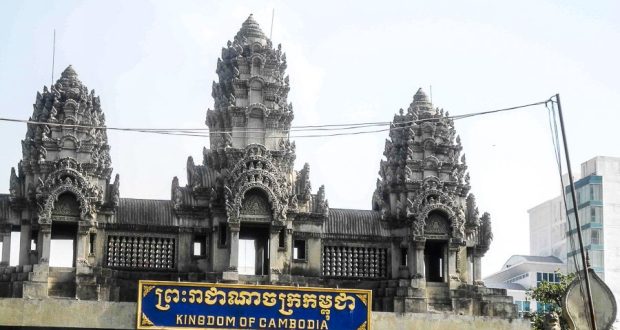
After the stuffy cultural-and-entertainment whirl of Siem Reap I wanted the sea, at least for a couple of days before Bangkok. So, of course, I set off from Siem Reap to Sihanoukville. I had never fancied Phnom Penh in the first place, and limiting a trip to Cambodia to a single town seemed rather dull. That was why I decided to find out what this resort called Sihanoukville actually was. I travelled in January 2014, and everything you will read below about the bus, the agency and the $15 ticket is the story of that trip. The timetables, prices and carriers, and what Sihanoukville itself has turned into over the years since, have been compiled afresh as of September 2026 and are given separately further on, so that the old is not passed off as the present. In short: today the easiest way to get from Siem Reap to Sihanoukville is the night sleeper bus (9.5–13 hours on the road; in September 2026 a ticket cost roughly $12–28) or a direct flight of just over an hour — timetables, boarding addresses and prices are gathered in section 4 at the end of the article.
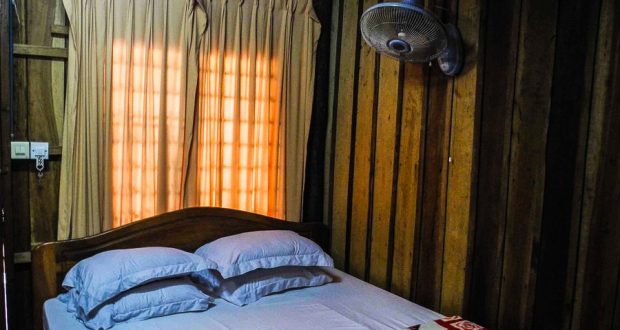
I decided not to book a hotel in advance; nothing on Agoda appealed to me at the time, so I simply saved a few options from various trip reports and planned to play it by ear once there (in the end I stayed at the G.B.T. guesthouse — but that is a 2014 story, not advice for today: we were unable to confirm that this guesthouse currently takes guests; an Agoda listing with an address on Street 14 Mithona is still up, but there is no recent availability and no clear recent reviews). And turning up with nothing booked, as I did, is riskier today. Over the intervening years Sihanoukville has been rebuilt around Chinese investment, casinos and high-rise construction; after the ban on online gambling from 1 January 2020 and the pandemic, the city was left with many frozen building sites, and from 2024 these began to be revived — according to the World Bank, development permits worth $875.5 million were issued in Sihanoukville in the first eight months of 2024, 132.4% more than the year before. The resort I found and the city you will see are two different places, so accommodation is now better booked in advance and on the strength of fresh reviews. Back then, in 2014, people advised against going to Sihanoukville at weekends because the locals snapped up the rooms. These days it is only the aggregator that reminds you about weekends and holidays — and simply advises booking earlier. That time, I set off on a Sunday evening.
You can get there by bus, by plane or by taxi (there is no train on this route: 12Go sells no through rail ticket from Siem Reap to Sihanoukville). Having read a heap of horror stories, I went by bus all the same — I wanted to check for myself whether this transport really was so bad, especially as my journey to Siem Reap had been perfectly decent.
1. Choosing a bus company: Siem Reap – Sihanoukville
It remained to choose a departure time and a bus company and to buy a ticket. Both daytime and overnight buses run to Sihanoukville — the so-called sleeper buses. From the reports I found online at the time, I concluded it was best to take the 20:00 night bus: in 2014 it was the only service without a change onto another bus in Phnom Penh. That no longer holds — there are plenty of overnight options now. As of September 2026, tickets were on sale for Virak Buntham departures at 19:30, 20:00 and 20:30, Larryta at 21:00, Torch at 21:30, while Giant Ibis’s official timetable lists a night departure at 22:00. And something else matters even more: the “direct” label by itself does not guarantee you will not change vehicle. SIMA, for example, openly sells a “Sleeping Bus + VIP Van” combination. So before paying, look at the transfer field in the details of the specific fare and, if in doubt, ask the carrier directly whether the same bus continues after Phnom Penh.
There are several bus companies running to Sihanoukville. In 2014 I read other people’s reviews about Virak — that the buses break down, that they make you pay for other transport, that they don’t pick you up from your hotel — and simply crossed the company off my list. I wouldn’t do that today: a label from old reviews doesn’t actually check anything. Virak Buntham still sells several overnight services on this route and publishes its terms of carriage. It is fairer to choose a carrier by what can be checked before paying: departure time, direct or with a change, the length of the sleeping berth, where exactly boarding takes place and how much luggage is included in the ticket.
Siem Reap is generally full of agencies (literally at every step); you need to read the signs carefully — the timetable itself usually says at the top which company a given agency represents.
These days the simplest way to buy a bus ticket is online in advance — on 12Go, for example: you choose your berth before the trip rather than in a queue at a counter. As of September 2026, Siem Reap – Sihanoukville buses there cost roughly $12–28. To be perfectly honest: the service itself writes “from $18” in its header while the table shows offers from $12, so go by the row for your own date, not the advertised “from”. Back in 2014, though, you had to find an agency yourself.
A positive experience with a company called Gold Vip had been described online, and in 2014 its office stood directly opposite the Terrace de elephant restaurant-hotel (on Sivatha Road, if you walk from the temple complex towards Tonle Sap lake, past Pub Street). I would not advise heading there today on the strength of my description: no current Gold Vip timetable and no confirmation that the office is still in place could be found, and this carrier does not appear in the checked listings for the route. That does not mean the company has closed — only that my decade-old address is not an address for today. I decided to call in, but for some reason they had no buses that ran without a change in Phnom Penh. Very strange: they assured me that all buses went via Phnom Penh and that a change onto another bus there was unavoidable.
Why is that change so bad?
Firstly, in the middle of the night you have no desire at all to gather your things and clamber onto another vehicle; you want to fall asleep (if you manage to) and not crawl out anywhere until morning.
Secondly, you don’t know what the second bus will be like or what seat you will get. It might be a seated coach, there might suddenly be no seats left, or the seat itself might be desperately uncomfortable.
So, without much hesitation, I went off to look for another agency. My main criterion was that it should not be Virak 🙂 I walked a little further along Sivatha Road, and there was a Sorya office. One caveat straight away: no through Sorya service from Siem Reap to Sihanoukville appears in the checked listings for September 2026, so my route cannot be repeated exactly as it was. I would not go so far as to claim the company no longer exists, though — those are two different things.
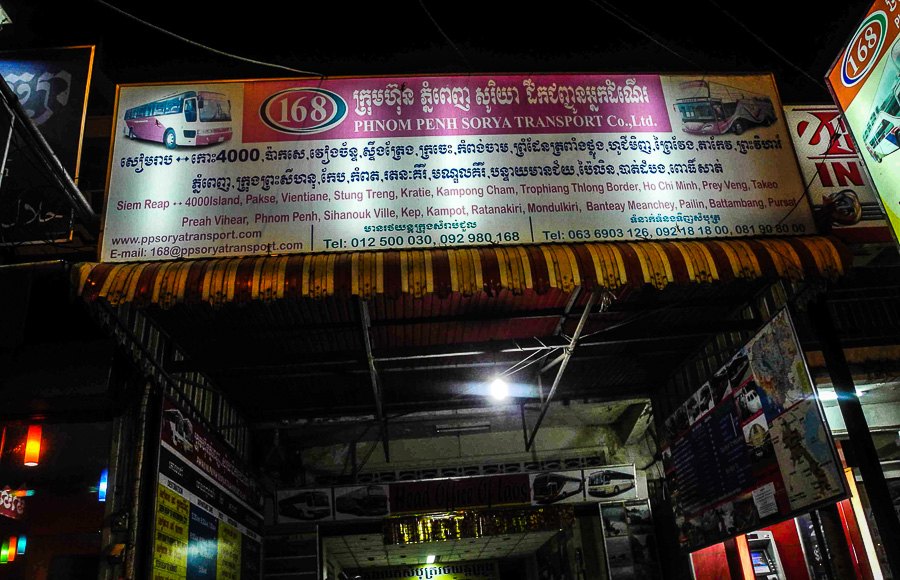 The Sorya company sign
Reviews of it were decent enough. They had a direct night bus with no changes at all, and I bought a ticket for the 20:00 — a reminder that this was January 2014. You could choose your berth; I booked three days ahead and almost everything was taken, but there was an upper berth by the window, just as I wanted, one away from the driver. Arrival time in Sihanoukville was 07:30. I wasn’t really counting on that, though — I expected to arrive around 10:00.
The Sorya office stood here — the map survives from that trip, and I can’t vouch for its accuracy now:
The ticket cost $15 back then. Today’s benchmark is different: as of September 2026, buses on this route cost roughly $12–28, and you need to check the fare for your own date.
As my hotel was nearby, it was agreed that I would simply turn up at this office at 19:30. The Sorya ticket back then did include a pick-up from the hotel to the bus station. That cannot be taken as the rule: Giant Ibis, for example, currently includes no free transfer with its night service — passengers make their own way to the departure point. Check this with the specific carrier rather than relying on someone else’s trip report.
2. The night bus journey: schedule, stops and impressions
On the appointed day at 19:30 I arrived at the office; there were no other passengers yet. About ten minutes before departure a tuk-tuk turned up, checked my ticket and drove me to the bus station. The ride took about five minutes. And that was where the crowd of people longing to get away somewhere was (not everyone goes to Sihanoukville, after all).
Our bus soon pulled in and I tried to climb aboard as quickly as possible, having read that two tickets are sometimes sold for the same berth, which would have been thoroughly miserable. At the door of that bus we were handed plastic bags to put our shoes in, and from then on you walked barefoot (so it is worth having socks with you — they will also save you from the cold in an air-conditioned bus); whether this is still the rule with today’s carriers I don’t know — there is no first-hand source for it. I quickly found my berth, which came with a blanket, but there was no pillow, let alone bedding, on that bus. Fittings vary between companies and change over time: Giant Ibis, for instance, currently promises both a pillow and a blanket. The seat-beds are very short — fine for the average Thai or Cambodian. At my height of 164 cm I only just fitted, though I did manage to stretch my legs out; not very comfortable, but basically all right. There is no provision for hand luggage at all and no overhead shelves, so my rucksack had to be squeezed onto my berth somehow.
But the real shock — the unpleasant moment, so to speak — came when I saw my neighbour 🙂 A French Gandalf 🙂 A tall, grey-haired man with long hair, a long beard and glasses. You should have seen him trying to squeeze into that miniature seat; I kept bursting into laughter at the sheer comedy and absurdity of the whole situation. Bear in mind, too, that there is no partition at all between the seats, not even an armrest, so you really did have to sleep shoulder to shoulder — now that is the truly hardcore part! Moving, let alone turning over, was extremely problematic.
So, the conclusion: if you are a typical non-Asian man, you definitely won’t fit; you’ll have to sleep with your knees pulled right up, and I say nothing of the very tall, heavy or muscular — large people in general should definitely take a taxi or fly. Or travel as a couple, where you can at least drape your legs over each other 🙂 The problem has not gone away, but at least it can now be measured in advance: Giant Ibis states the berth length outright — 1.8 m; berths come as singles and doubles, and a reading lamp is available only on the upper one. If your height is close to that figure, confirm the size with the carrier before buying, and a couple should check whether a whole double berth is sold or a space for two.
Judging by the nervous giggling while everyone was settling in, those who didn’t fit were in the majority.
Quite apart from the berths, there was a second problem — the omnipresent air conditioning. As my berth was by the window, the air vent was directly above me and blew into my ear with enviable consistency. It could of course be turned off, but that didn’t help much: for some reason the air kept coming even with the knob turned fully off, and by morning the walls were even covered in frost…
I simply wrapped my head in my hoodie, otherwise I would certainly have caught a cold.
In the end, what with everyone gathering and settling down, we only pulled out at 20:30.
At 22:30 came the first stop; there was a toilet and a small shop. I had brought bananas and biscuits just in case, not really counting on food en route. I wanted sleep more than food anyway, so I didn’t get out once during the whole journey.
At 01:30 came the second stop.
And by 03:30 we had already reached Phnom Penh. Some people got off, others got on in their place; the stop lasted about 30 minutes.
After that, with no more stops (or perhaps I was simply fast asleep?), we reached Sihanoukville at 07:20, which I hadn’t even expected. Only, the second half of that journey still followed the old National Road 4. In 2022 Cambodia’s first expressway opened between Phnom Penh and Sihanoukville: 187 kilometres, with trial traffic from 1 October and the official opening on 9 November 2022. The Ministry of Public Works and Transport estimated the run along that stretch at about two hours instead of the previous four to five. No miracle should be expected, though: the long leg from Siem Reap to Phnom Penh remains, and the whole journey still takes a night — in the timetables on sale for September 2026 that is 9.5–13 hours, while Giant Ibis quotes 11 on its own website.
Our bus:
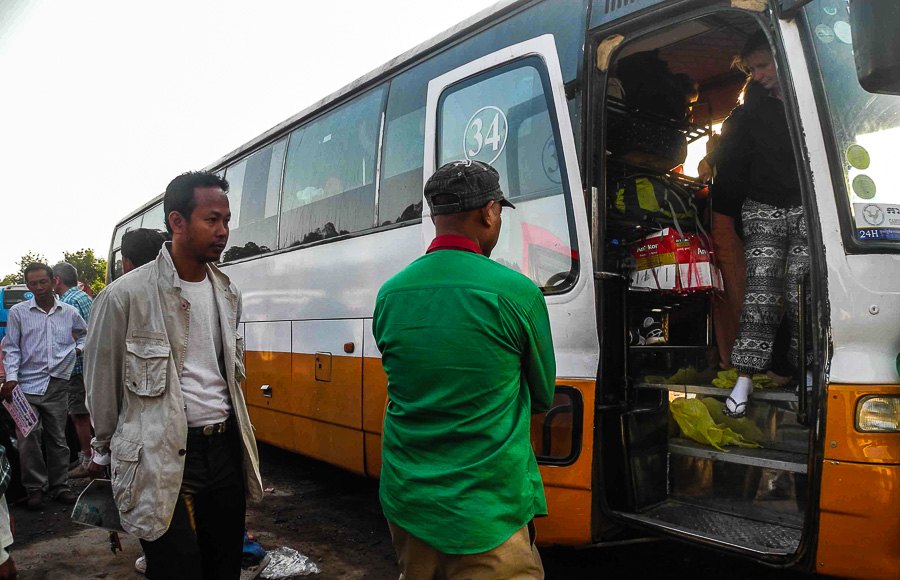 The bus arrived in Sihanoukville
3. Summing up the journey
On the whole it was tolerable enough, especially if it hadn’t been for the man beside me and the freezing cold. More comfortable than seated seats; my legs went numb, but not badly. People write that lots of locals pile in along the way, so many that they even sleep in the aisles. Nothing of the sort happened with us. Locals did get on now and then, but they took free seats; nobody slept in the aisle. Perhaps we were lucky that the bus didn’t break down and that was why we arrived on time, but in the end they delivered us exactly as promised. The journey was a mixed bag, but in any case I was now in Sihanoukville — which meant it was time to enjoy the sun, the sea, the sand and fresh fruit!
4. What this route looks like now — September 2026
Timetable and prices. In the listings for the nearest dates in September 2026, the Siem Reap – Sihanoukville route had both daytime minivans and night sleepers: Chan Moly Roth 18:30–04:30 for $12, Sarah Transport 19:00–06:00 for $12.60, Olongpich 17:30–06:00 for $14.45, Mevis 18:00–04:00 for $15.20, Virak Buntham at 19:30, 20:00 and 20:30 for $15.91–16.77, Torch 21:30–07:30 for $20.67, Larryta 21:00–06:30 for $21, Giant Ibis 22:00–08:00 for $28 and SIMA minivans late at night for $26.86. This is a snapshot of sales for a single date, not a permanent timetable: neither the aggregator nor Giant Ibis publishes days of the week, so no one has promised you daily, year-round operation — check your own date. And a word about the calendar: December–February are the dry months on the coast, and for holiday dates — Cambodia’s Independence Day on 9 November and the three-day Water Festival (in 2026 it falls on 23–25 November), international New Year and Chinese New Year (in 2027 it falls on 6 February) — the night bus and accommodation by the sea are better booked in advance.
Where to board and where you get off. The words “bus station” without an address are useless. With Giant Ibis, for example, the Siem Reap departure is from the terminal behind the old stadium on Khmer Pub Street, and arrival in Sihanoukville is at the office on Phe Street, Sangkat 3, near the port. The carrier asks you to be there 35 minutes beforehand and honestly warns that arrival time depends on the road and that it is not responsible for arriving early or late. So don’t schedule either a ferry to the islands or a flight tight against the stated arrival time.
Luggage and children. Giant Ibis’s carriage terms allow one piece of hand luggage and up to two checked bags with a total weight of no more than 25 kg (though the promotional block for the route on the same site says 20 kg — if you have a lot of luggage, confirm the allowance when buying); Virak Buntham also allows up to 25 kg plus hand luggage, with a possible surcharge for excess weight. Neither carrier publishes rules for carrying bicycles or oversized items — that has to be asked about before paying. Child terms differ: with Giant Ibis on domestic routes an infant can travel on your lap, from the age of three a ticket is needed, and a separate seat must be bought for a car seat; with Virak Buntham in a sleeper everyone needs their own berth and a full ticket, including infants. There is no single “child discount on the route”.
How to pay. Giant Ibis’s site shows acceptance of Visa, Mastercard, UnionPay, JCB, Alipay, WeChat, ABA and KHQR, while 12Go takes cards and PayPal and shows the payment-gateway fee before payment. This does not carry over to street agencies, ticket counters and minivans: we have not checked how money is taken there.
Flying instead of a night on the bus. There are direct flights: on the Sihanoukville airport board for 17–19 October 2026, an Air Cambodia K6 131 flight from Siem Reap is listed every day, taking just over an hour (in September the same board also showed Cambodia Airways KR 803, so check the make-up of flights for your own dates). Only, you have to count it together with the ground leg at both ends. Siem Reap’s new airport is outside the city; the official bus to it leaves from the station on 7 Makara Road by the ACE school, and a hotel transfer is not included in the ticket; from 1 August 2026, domestic-flight passengers get a 50% discount on this bus and $10 towards a taxi on showing their ticket or boarding pass. Sihanoukville airport is about 20 km south-east of the centre; a taxi from there starts at $15 and takes about twenty minutes to town. I am deliberately not naming the fare: it dances around depending on the date, so check the search results for your own dates and compare the full cost — the ticket plus two transfers.
A taxi for the whole way, the distance and the border. A private transfer on the route is offered, but there is no clear fixed price: the reference figures on different pages of one and the same service differ from each other several-fold, so request a price for your own dates and your own pick-up address. The road distance is roughly 500–525 km in total: about 314 km from Siem Reap to Phnom Penh and 187 km of expressway beyond that. And one more thing: you cross no border anywhere — the route is entirely domestic, so the visa hassles from my account of entering from Thailand do not apply here.
Would you take a bus like this? Have you had similar adventures on the road? How did you travel from Siem Reap to Sihanoukville? Share in the comments!