We love visiting markets in different countries — that is usually where real life happens; the Grand Bazaar in Istanbul and the colourful Phsar Leu market in Sihanoukville were cases in point! Markets are where you find the most unusual local produce and the freshest fruit and vegetables, and prices are lower than in the shops. Does that hold true for the food markets of Belgrade? Let’s find out.
Markets. The city’s food markets — Zeleni Venac, Skadarlija (also called Bajloni’s market), Kalenić, Zvezdara and about two dozen more across the districts — are almost all open every day from 6:00 to 19:00, but come before midday for the best produce. Getting to any of them costs nothing: Belgrade’s public transport has been free since 1 January 2025.
Food shops. The main chains are Maxi, Lidl, Idea and Roda (which share a single price list), Univerexport, Aman and DIS. They are currently cheaper than the market: according to the chains’ mandatory price lists for 8–9 October 2026, loose potatoes cost 70–80 dinars per kilo and onions 40–50, against city market averages of 138 and 140. Shops trade on Sundays too: of Belgrade’s 66 Idea stores, only one closes on Sunday and 14 stay open until 14:00–16:00.
So is the market cheaper? The honest answer, as of October 2026: not any more. We compared the official price barometer of Belgrade’s markets for 8 October with the mandatory price lists of Maxi, Lidl and Univerexport for 8–9 October — and of thirteen comparable items, the market was not cheaper than the shops on a single one. It was dearer on eleven of them — by a factor of 1.2 to 2.2, and three and a half times for onions. And it is not the market that has gone up: market prices have barely moved for two years. It is the shops that became cheaper, after Serbia capped retail mark-ups in autumn 2025. The cap itself ended on 1 March 2026, but even in October the chains remain cheaper than the market.
Does that mean you should skip the market? No. Only the reason for going has changed: you now go to the market for quality, variety and farm produce, and to Lidl or Idea for the savings. Read everything below with that in mind; the freshest market-versus-shop price comparison is in the third section.
Local people also prefer market goods to shop-bought ones. What can you buy here? Vegetables, fruit, meat and dairy produce are best sought out precisely at the city markets. The fruit and berry season begins as early as late spring, so you can safely book your tickets!
1. Food markets in Belgrade
In Belgrade a trip to the market is a must: the meat, fruit and vegetables are of very high quality. Prices, however, are no longer the main argument: compared with the chain stores the market is now dearer — but the produce is different too. The city company Beogradske pijace runs 29 markets, and they are found in most districts of the city, so locating the nearest one is easy. And do make time for Kalenić — the best-known market in Belgrade!
1.1 Seasonal fruit and vegetables
Grapes appear on the stalls earliest of all — as early as late winter, though they are still very expensive then. Their real season comes closer to autumn. While we were there in early September they cost 150 dinars per kilo, which really was pennies. That is no longer the case: according to the market barometer for 8 October 2026, the median price of grapes is 312 dinars per kilo (ranging from 150 to 700 across the city). In Lidl and Maxi they cost 150–180 — that is, half the market price.
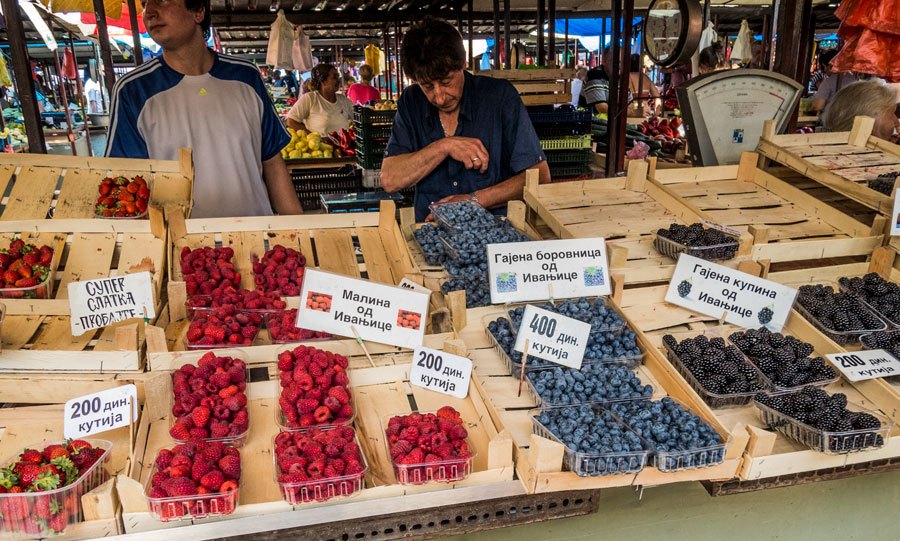
Belgrade’s markets are full of farm and homemade produce, with an especially wide choice of berries of every kind:
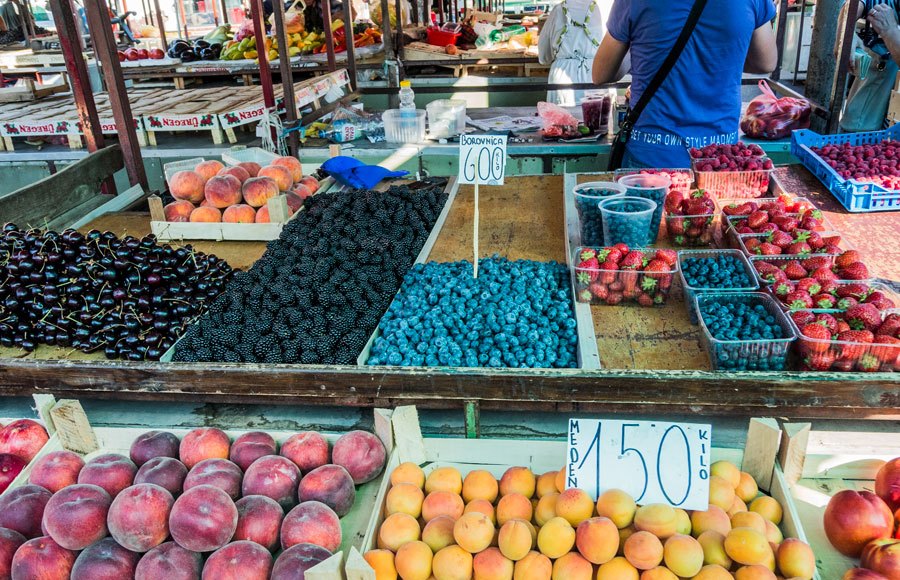
The berry season starts early, at the beginning of summer. Fruit and vegetables are most often brought in from neighbouring sunny countries, so they appear early. You can safely buy watermelons as early as July, and melons appear even earlier.
Fresh fruit and vegetables almost all year round:
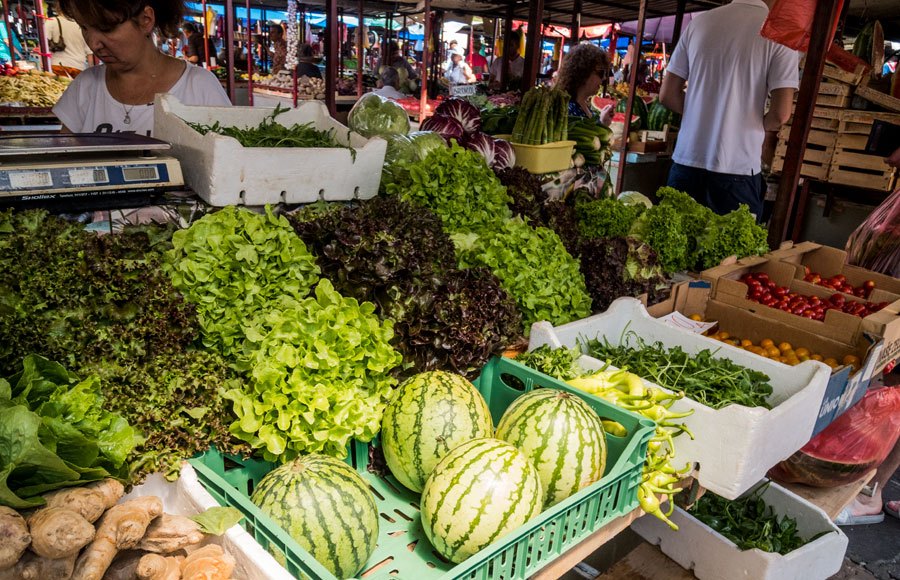
Home-grown strawberries reach the stalls at the start of summer, followed by the sour-cherry and sweet-cherry season. At the time of our visit, a kilo of sweet cherries at the market in season cost just 200 dinars — excellent, large and very sweet.
We strongly recommend trying the Macedonian tomatoes — large and very aromatic. Slightly dearer than the local ones, but well worth it! They appear in June–July.
The best seasoning is fresh herbs:
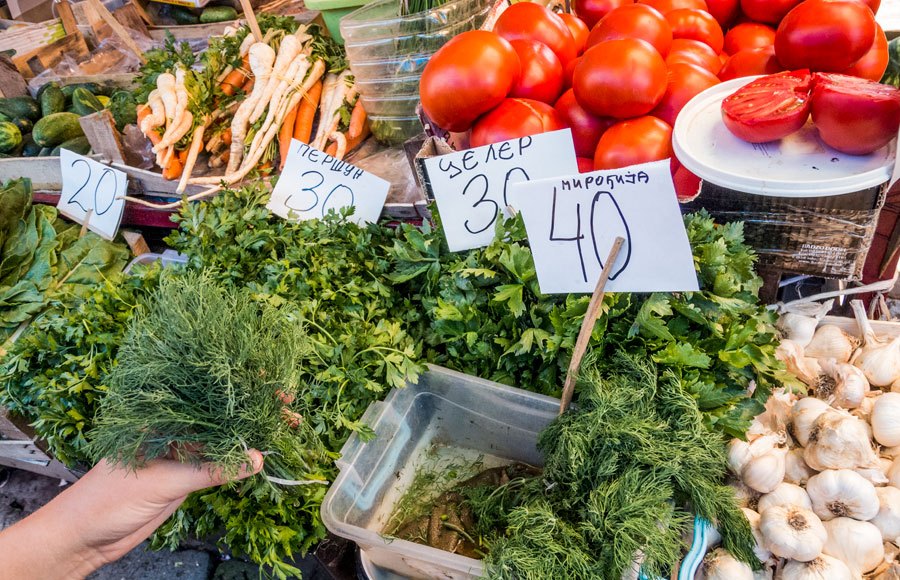
In autumn, figs and good apples appear. And peppers — a great many of them! Sweet and hot, they are sold by the kilo or by the crate. Ajvar — preserved sweet pepper — is hugely popular in Serbia. And roasted peppers, of course. According to the market barometer for 8 October 2026, apples average 175 dinars per kilo, pears 225 and peppers about 200. October is the season of ajvar and homemade preserves: at weekends the city markets host the “Karavan zimnice” fair, where farmers sell ajvar, pickles, compotes, jams, honey, wine and rakija. The fair’s twelfth season opened on 3–4 October 2026 at Zeleni Venac (from 8:00 to 16:00), after which it moves from market to market — last season it ran until December inclusive. Which market it will visit on the coming weekend is announced by the city company in the news section of the markets’ website.
2. Where they are and how to get there
Which days are best for shopping? There is almost no difference. Unlike Turkish bazaars, Belgrade’s markets are open every day.
It gets crowded at weekends and quieter on weekdays. On the other hand, the choice at weekends is much richer.
They open early, at 6:00, and trade until 19:00, seven days a week — this is the official schedule of the city company Beogradske pijace (we checked on 9 October 2026; it has no separate winter timetable, the one exception being the Palilula market, from 7:00 to 21:00). The catch is that by 12:00 all the freshest and best produce has been sold — especially at weekends — so we advise coming early. This applies to berries, fruit and meat.
It is worth getting up early for this:
Now for the best markets and where to find them.
2.1. Skadarlija
Set in the old town, next to the bohemian quarter of Skadarlija, which is famous for its restaurants and bars.
Address: Đorđa Vašingtona 1B. You can get there:
- on trams 5, 10 and 2;
- on bus 79.
A wide choice of farm produce. Belgraders still call this Bajloni’s market — after the brewer Bajloni, whose brewery stood nearby. In the city company’s assessment, it is the largest market in the centre: around 100,000 people shop here.
2.2. Zeleni Venac — the market in the centre
Address: Zeleni venac 2.
Transport:
- buses 15, 16, 27E, 35, 43, 52, 53, 56, 56L, 65, 67, 68, 71, 72, 75, 77, 84, 95, 704, 706, 707.
Very conveniently located.
2.3. Kalenić — the city’s best-known market
It stands right next to the Church of Saint Sava, in Vračar. The city company calls Kalenić the biggest and best-known market in Belgrade: the stalls here are rented by genuine farmers and the spot is handed down from generation to generation, and the market is renowned for its fruit, vegetables and dairy produce. Our impression at the time was that prices here were slightly higher, but the barometer for 8 October 2026 simply shows the widest spread at Kalenić: potatoes from 70 to 200 dinars per kilo, peppers from 50 to 250, eggs from 10 to 35 dinars apiece — you can either save money or overpay at the neighbouring stall. During our stay we also found fish, pickles and horse-meat delicacies here; meanwhile the city company calls fresh river fish from the catch of Danube fishermen the signature of the Zemun market. A reconstruction of Kalenić has been promised since 2019, but the tender for it was cancelled in July 2026, and the market is trading as normal.
Address: Maksima Gorkog 2B (on the corner with Njegoševa).
The easiest way there is on buses 25 and 26 — they run straight to the market.
You can find the addresses and opening hours of all the city’s markets on the city company’s website, bgpijace.rs. It also hosts something almost nobody knows about: the price barometer — an official table of prices across fourteen of the city’s markets (the latest snapshots are 10 September and 8 October 2026). If you want to know what a kilo of tomatoes costs at a particular market today, this is the most honest source.
2.4. Zvezdara
This market stands almost at the very end of King Alexander Boulevard. Belgraders call it Cvetko’s market — after the old “Cvetko’s mehana” (tavern), next to which the market stood at the beginning of the 20th century.
The entrance to the market:
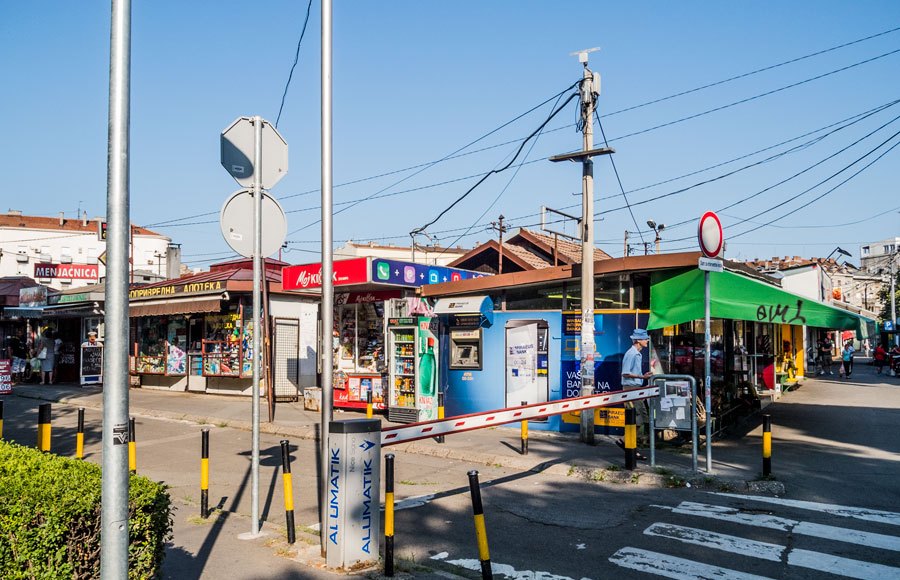
Address: Bulevar kralja Aleksandra 293.
Transport:
- buses 46, 55, 79, 309;
- trams 5, 6, 7, 9, 14.
This is the very market we used to go to, as we were renting a flat on Toplička Street, very close by.
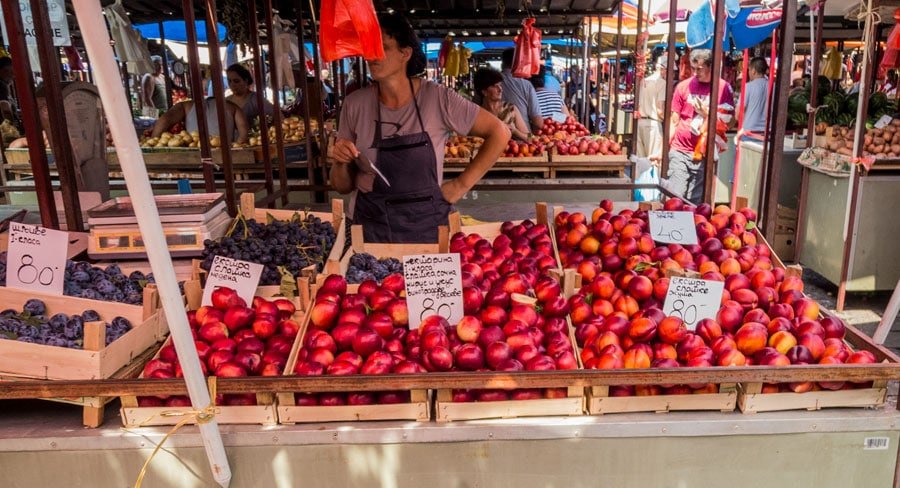
These are the peaches we bought in summer:
3. Prices at Belgrade’s markets
First the fresh snapshot, then our older observations. Here is how the market compares with the supermarket on 8–9 October 2026, in dinars per kilo (the median across the city’s markets versus the loose price in Lidl and Maxi):
- onions: market 140, shops 40 loose — and 26 per kilo for a bag at Lidl: a three-and-a-half to fivefold difference;
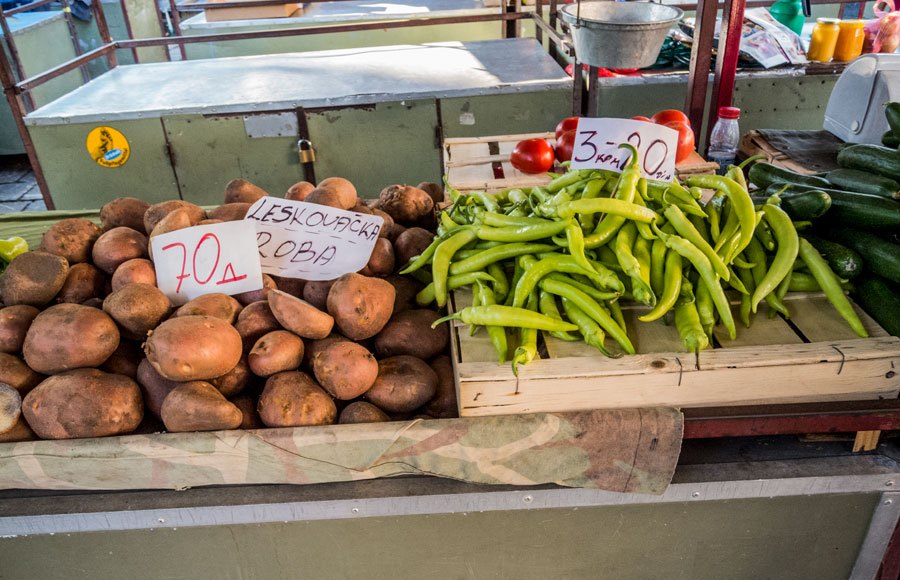
- potatoes: market 138, shops 70 — twice as expensive;
- carrots: market 175, shops 80;
- cabbage: market 105, shops 70;
- cauliflower: market 275, shops 200;
- cucumbers: market 175, shops 130;
- tomatoes: market 262, shops 200;
- apples: market 175, shops 120;
- pears: market 225, shops 130;
- grapes: market 312, shops 150;
- eggs: an average of 23 dinars apiece at the market, 16–19 at Lidl.
Only two items came out comparable — the “babura” pepper (about 200 at the market and 190–200 in the shops) and plums (125 versus 120). An honest caveat: the figures compare kilograms, not varieties. A 70-dinar supermarket potato is the standard graded kind, while the 138-dinar market potato is usually farm produce from a specific smallholding. Taste is something we cannot measure, and we will not argue with it.
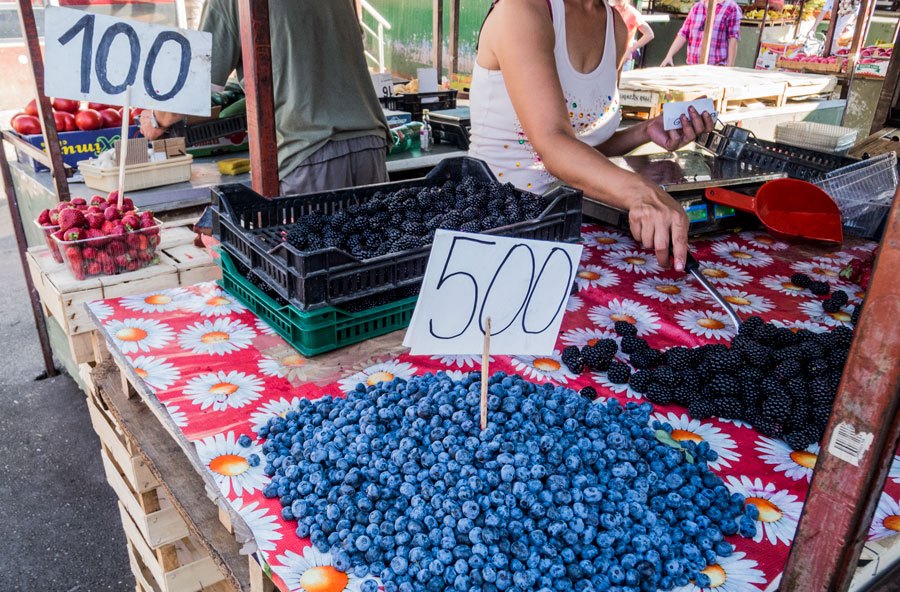
At the time of our visit, 350 dinars in season bought a kilo of choice raspberries. Did you know that Serbia is the world’s largest exporter of frozen raspberries by export value? And for 600 dinars you could take a kilo of blueberries or blackberries. At the height of the season prices fall, and a kilo costs almost half as much!
Fruit in all its variety:
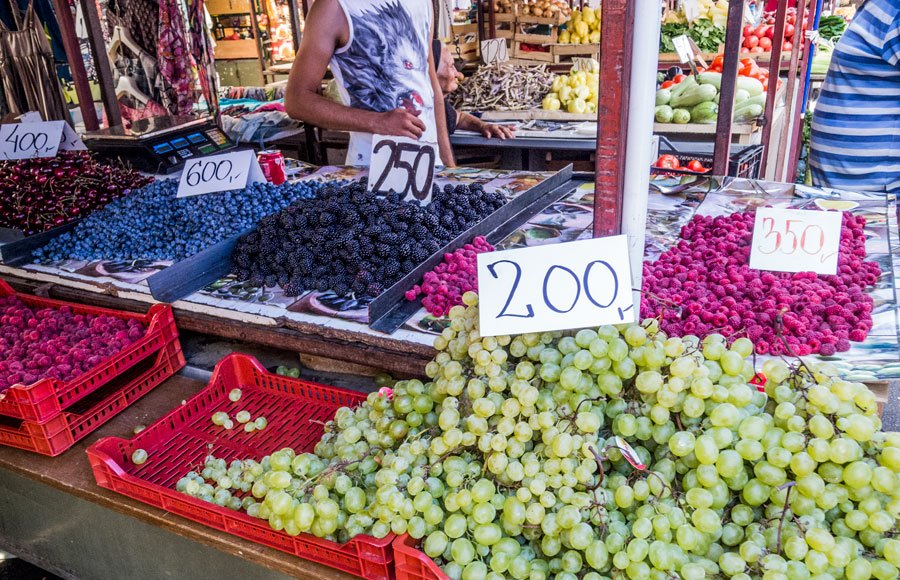
The height of the raspberry, blueberry and blackberry season is mid-summer, and we happened to catch it during our trip that August:
Fresh meat in those days cost from 500 to 1,100 dinars per kilo, with beef fillet at 850. Everything is noticeably dearer now: at Maxi on 9 October 2026 pork loin is about 700 dinars per kilo, beef is 1,100–1,750 and a whole chicken about 400. Fillet has raced far ahead: beef steak is 4,300 dinars per kilo.
We were surprised to find no lamb. You would think the Balkans would be full of delicious lamb dishes, but we could not find it at the markets — only ribs with almost no meat on them. You will not have to give up on a lamb pilaf, though: lamb does exist in Belgrade, you just have to look for it not at the farmer’s stall but in the supermarket — Maxi sells both whole lamb and lamb ćevapi with sausages. The only question is the price: about 1,300 dinars per kilo (Maxi, 9 October 2026).
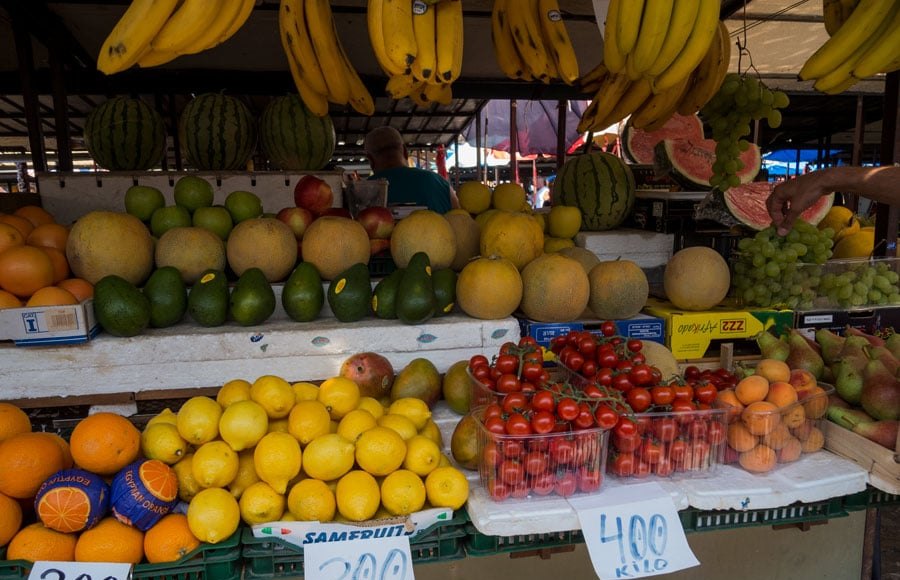
There are even tropical fruits:
Lots of homemade products — white (young) and yellow homemade cheese, kajmak. At the time of our visit a portion for three cost 250–300 dinars. For reference: at Maxi on 9 October 2026, 250 grams of kajmak costs 463 dinars. Do try the local delicacy — peppers marinated in sour cream.
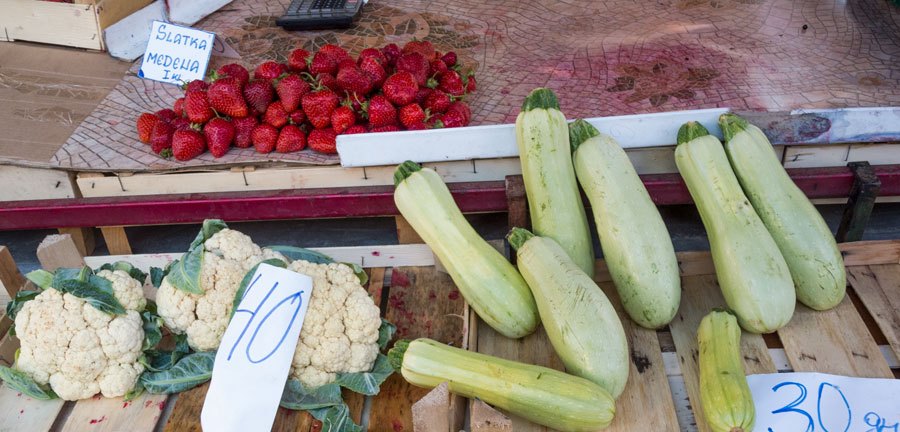
The vegetables in this photo were very cheap at the time. That is no longer true: prices have risen, and — more importantly — the same vegetables in the chain stores now cost one and a half to two times less than at the market.
Don’t pass by the pickle stalls! Serbia makes excellent marinated delicacies, and the prices are quite low. At the time of our visit, excellent salted or pickled gherkins at the market cost about 300–450 dinars per kilo. You can also try marinated carrots, cauliflower and green tomatoes.
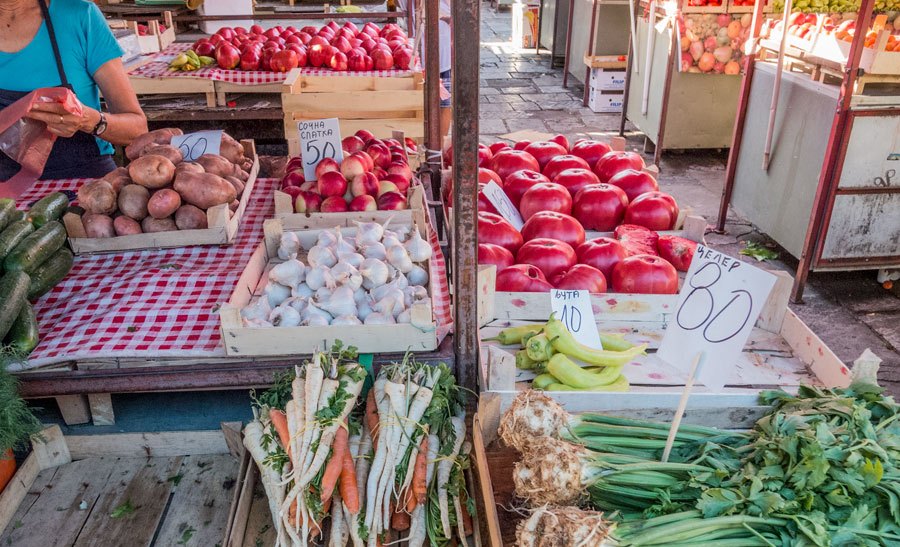
Big Macedonian tomatoes on the right; in the foreground, bunches of carrots with celeriac root (sold together, as they are often used together in the same dish):
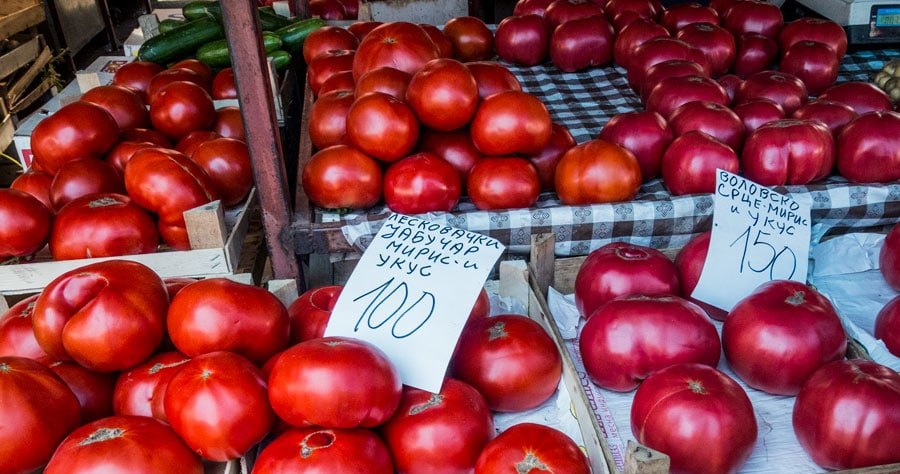
And here are Serbian home-grown tomatoes:
Lots of greens, including fresh spinach. At the time of our visit it was very inexpensive — 300 dinars per kilo. Excellent for salads, by the way!
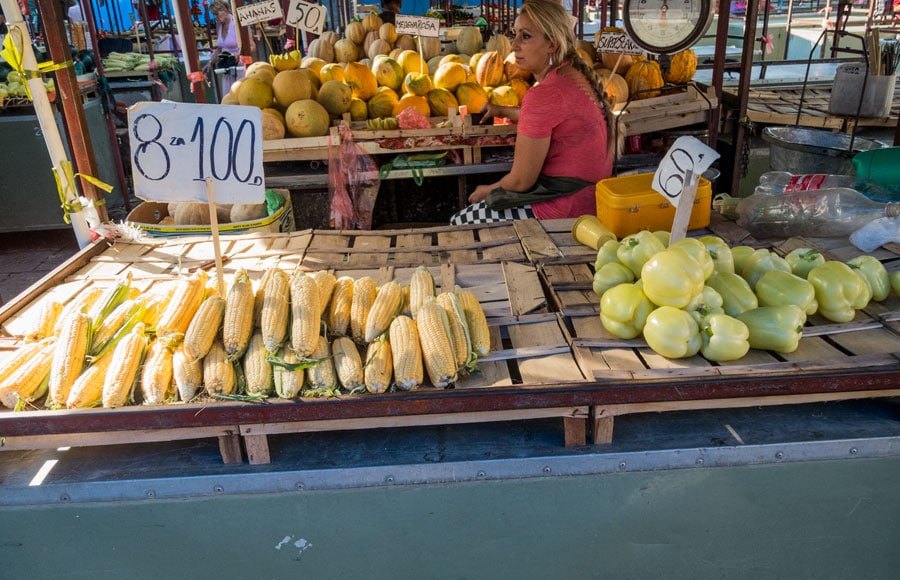
Eight cobs of sweetcorn for 100 dinars:
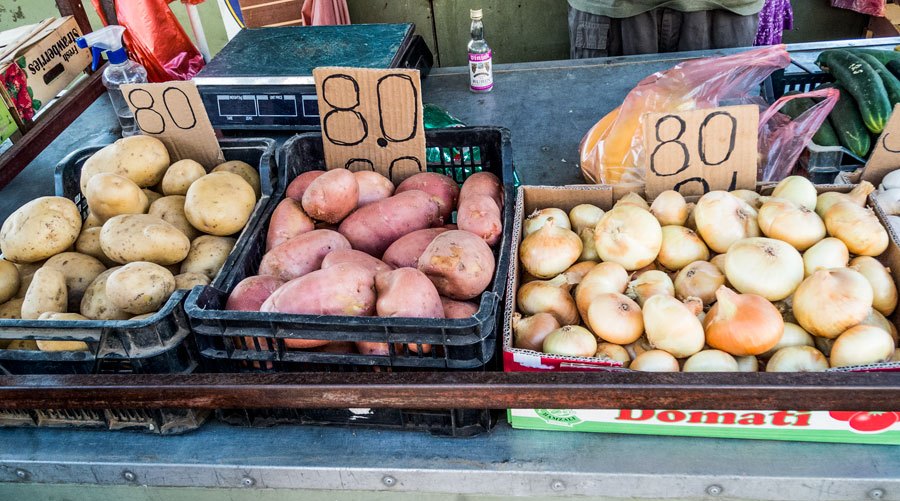
Farm potatoes. The white ones are for boiling, the pink ones fry better:
We recommend buying all the seasonal fruit and vegetables! While living in Belgrade, we went to the market every day.
Two practical points. First: since 1 January 2025 Belgrade’s public transport has been free — you can get to any market without thinking about a ticket (the city decision is still in force in October 2026). The only services that remain paid are the E express minibuses and the A1 airport shuttle, and you do not need those for the markets.
Second — about taking food home, if you want to carry kajmak or cheese back (rules as of September 2026). You cannot take any Serbian dairy produce into the European Union at all — none, in any quantity, no kajmak, no cheese, not even for personal use. Honey is allowed up to 2 kilograms, rakija up to one litre.
Belgrade’s markets have everything:
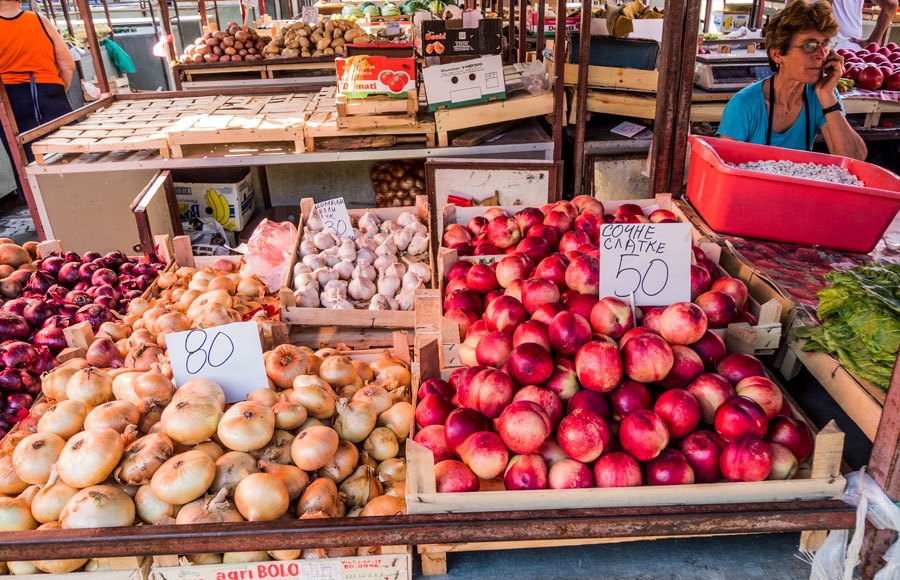
We rarely saw anyone haggling. More often the sellers themselves offer a discount or gift you some of their produce. Some grandmother vendors, smiling, add another couple of apples to your bag after weighing. You can haggle, but within 10–30 dinars; nobody will give you a big discount.
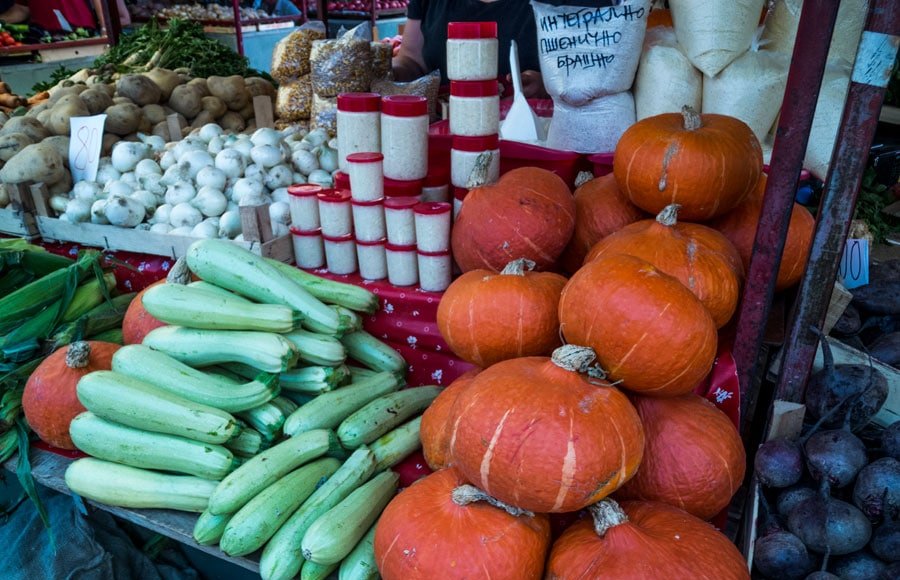
The little jars hold homemade horseradish:
4. Conclusions
Quality and taste are the reasons to come here; for low prices, head to the chain stores. The produce quite literally tastes different — you start to look at a simple vegetable salad in a new way.
Have you ever seen round courgettes?
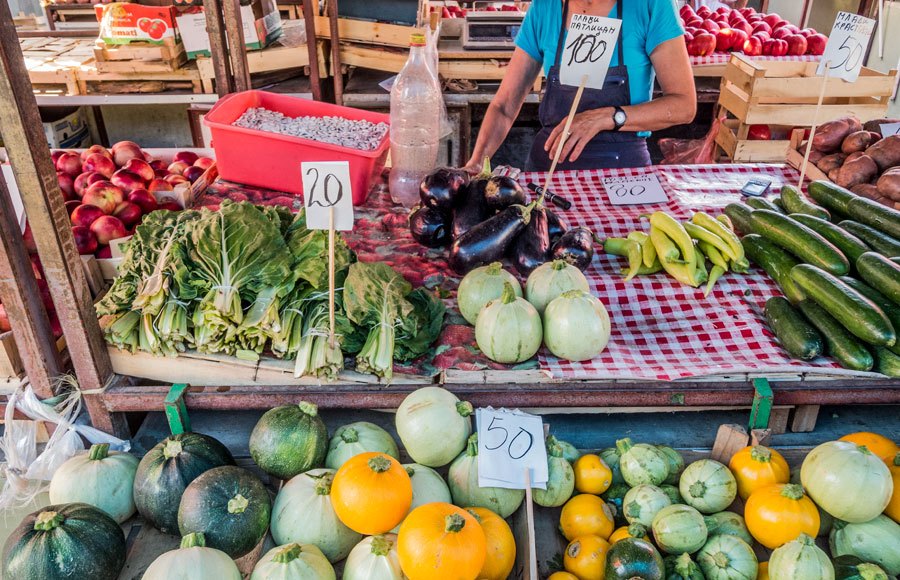
It really is better to buy these things at the markets, as the choice in the shops is not as wide. The difference is plain to see. This applies especially to meat and vegetables — supermarket tomatoes, for example, do not bear comparison with market ones. There are plenty of markets on the city map: in the central districts, wherever you stay, a market will almost always be within 10–15 minutes.
It is also worth noting how fresh the produce at the markets is — it is guaranteed to sell. In our impression, most of the sellers grow their own goods.
Fresh button mushrooms and chanterelles:
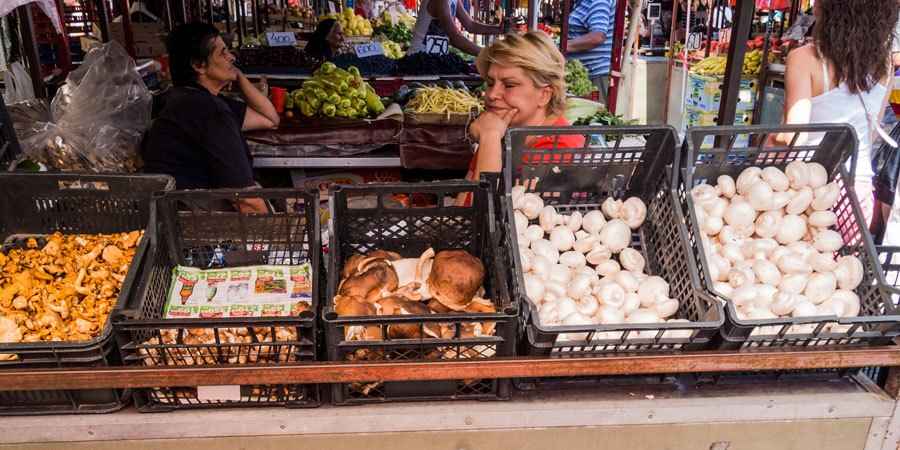
Both the prices and the attitude to customers were a pleasure. Nobody tried to cheat us, and everyone let us taste and choose.
A wide choice of produce:
We recommend popping into the city markets even just out of curiosity — this is the real life of the city. You will also find traditional Serbian products and snacks. It is wonderful that there are so many markets in the centre, even in the old town.